ZB 47 · Volume 2
The Guns: ZB 46, ZB 47 and the Paratrooper Version, the Cylindrical Cartridge, How Many Were Made, and Where They Are
Telling the three forms apart, every published dimension with its source, the experimental straight-walled 9 mm round, the 7.62 mm trial guns, the production figures that do not agree, the surviving examples, and why no American can own one
2.1 What this volume rests on
Three groups of sources. The first is the Military History Institute in Prague (VHU): its exhibit pages on the ZB 46 and on ZB 47 serial 1032, Jan Skramoušský’s 2018 article on the ZB 47, and the photographs on all three.123 The second is the Zbrojovka Brno user’s manual, Samopal ZB 47 (1947). VHU has photographed pages of an original copy, and the complete 1997 reprint is online as a scan. It was read in full for this dive.34 The third is the 1946–1947 patent filings, of which only abstracts could be read.5
Volume 1 tells the history of the competition. This volume describes the guns.
2.2 Three forms of one gun
The ZB 47 is one design that took three forms:
- ZB 46 (ZB vzor 46). The first form, demonstrated to the army on 27 March 1946. It had a 64-round magazine. Four were made.1
- ZB 47, infantry version (pěchotní provedení). It has a fixed wooden butt behind a steel stock pressing that houses the 72-round magazine. This was the version ordered for the troop trials.3
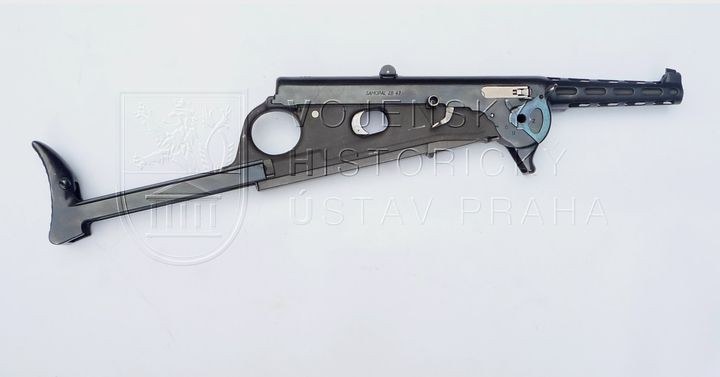
- ZB 47, paratrooper version (výsadkářská verze). It was built “on the basis of the military administration’s requirements”, with “a sliding shoulder rest”. It could use “both 72-round magazines and short 30-round magazines”.2
Two further sub-forms existed on paper or in small numbers. Guns marked for the experimental cylindrical cartridge, and guns converted to 7.62 mm Tokarev, are described below. No photograph that can be identified as either was found.
2.3 Telling them apart
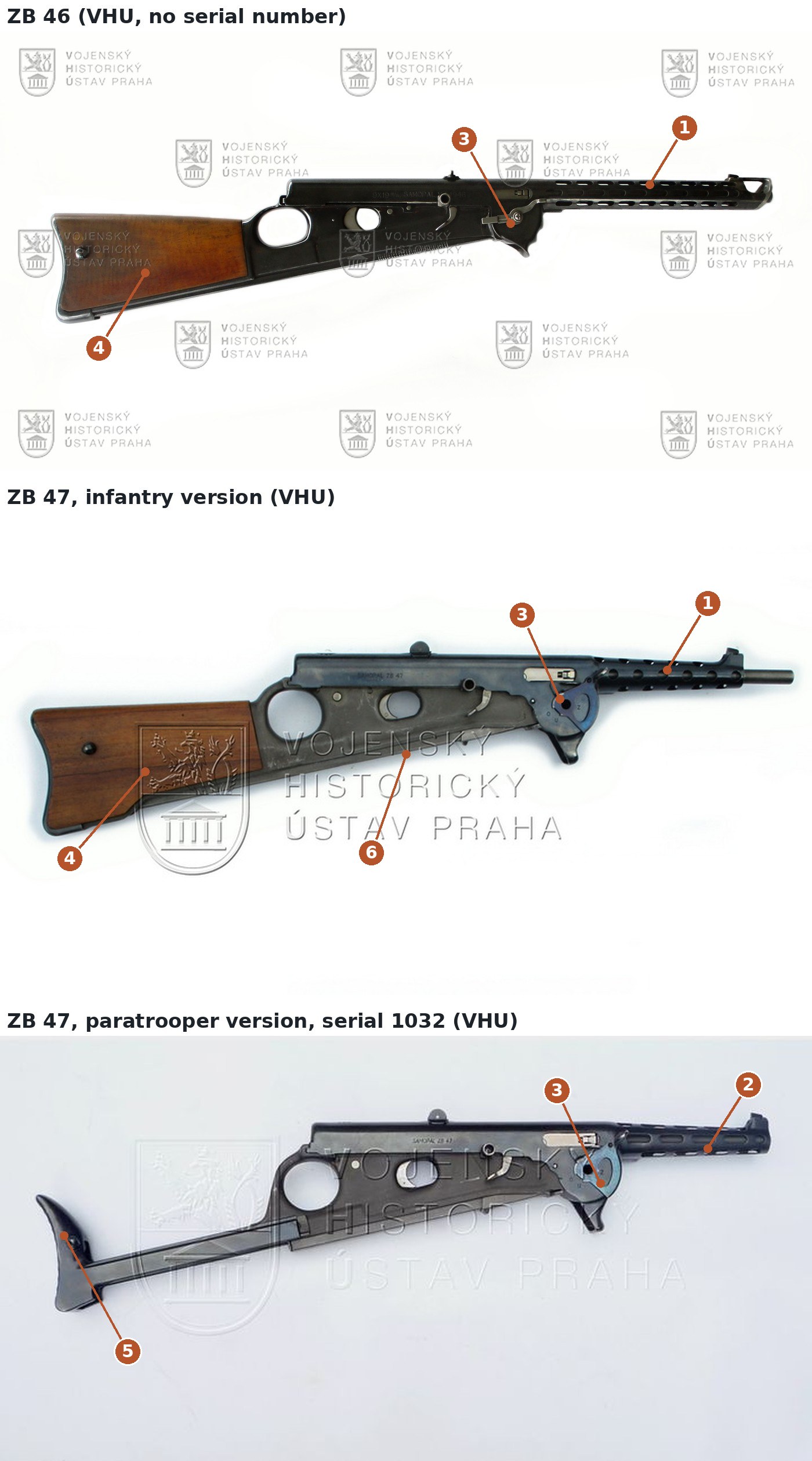
Table 1 — Telling them apart
| Feature | ZB 46 | ZB 47 infantry | ZB 47 paratrooper | Where to look |
|---|---|---|---|---|
| Model marking | ”…SAMOPAL VZ. 1946" | "SAMOPAL ZB 47" | "SAMOPAL ZB 47” | Right side of the receiver, above the trigger |
| Maker marking | ”ČESKOSLOVENSKÁ ZBROJOVKA BRNO" | "ZBROJOVKA BRNO" | "ZBROJOVKA BRNO” | Left side of the receiver |
| Barrel jacket | Long, cylindrical, rows of small holes | Shorter, round holes | Slotted (elongated openings) | Ahead of the receiver |
| Butt | Wooden butt behind the pressing | Wooden butt behind the pressing | One-piece sliding metal rest with a curved shoulder piece | Rear |
| Magazine | 64 rounds, two-column | 72 rounds | 72 rounds, or a short magazine (30, 32 or “half length”, see below) | Along the underside of the stock |
| Overall length (VHU) | 813 mm | 750 mm | not published | — |
| Takedown lever | Two-armed on the oldest survivor, one-armed on the others | One-armed (manual drawings) | One-armed (photograph) | Right side, at the front of the receiver |
Sources: VHU photographs and exhibit texts; the manual’s drawings.1326
The identification rule used for every photograph in this dive is in photo_credits.txt. Side was determined from VHU’s statement that the takedown lever is on the right. Photographs with the muzzle to the right show that lever, so they show the right side.
2.4 The ZB 46
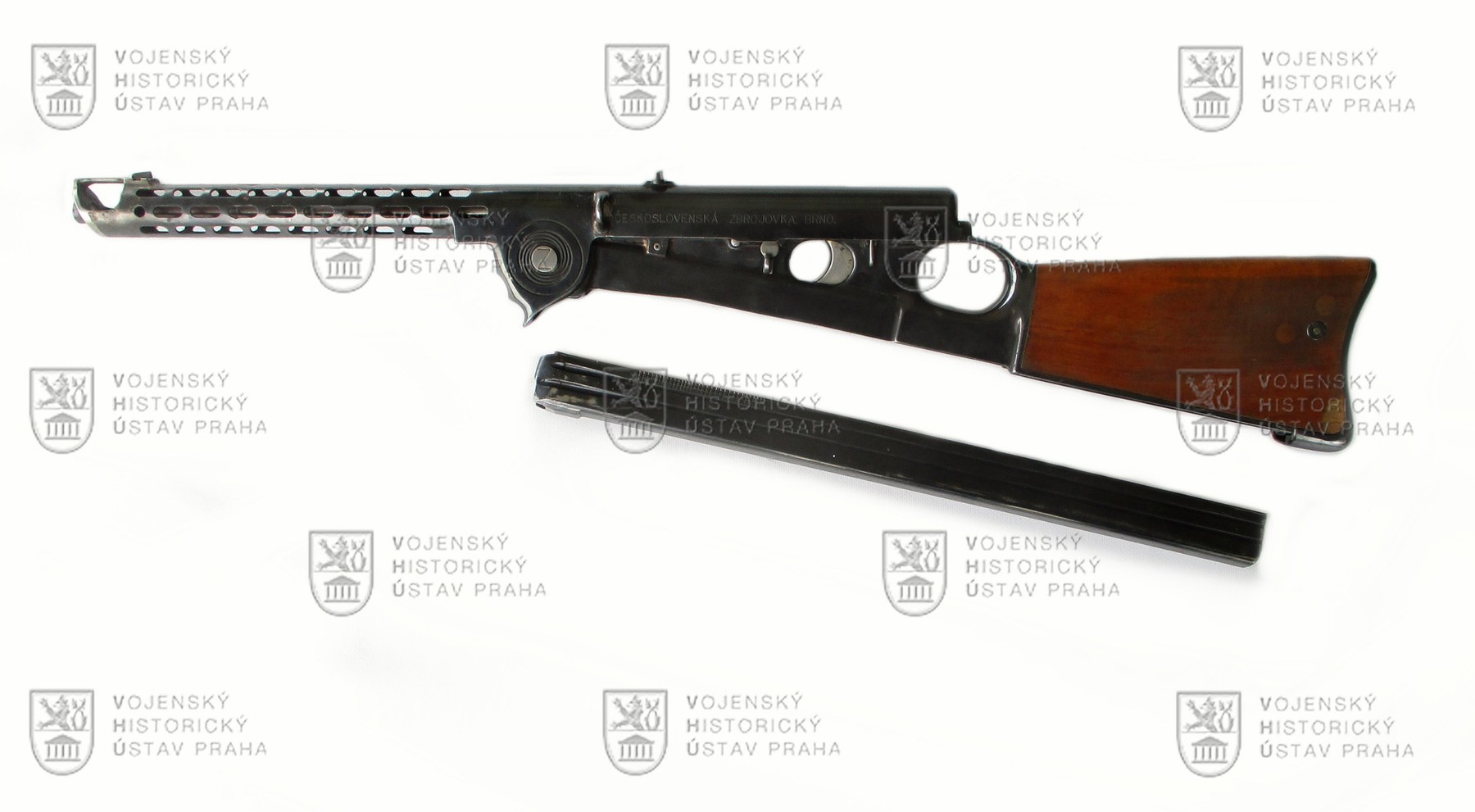
VHU describes the ZB 46 as a gun whose barrel “lay in a protective cylindrical shroud, which at its rear ran into a receiver with the profile of an inverted letter U”. A two-column 64-round box magazine went into the bottom of the stock.1 VHU’s figures are an overall length of 813 mm, a barrel of 250.5 mm, a sight radius of 323 mm, 3,280 g without the magazine, and a cyclic rate of 1,200 rounds a minute.1
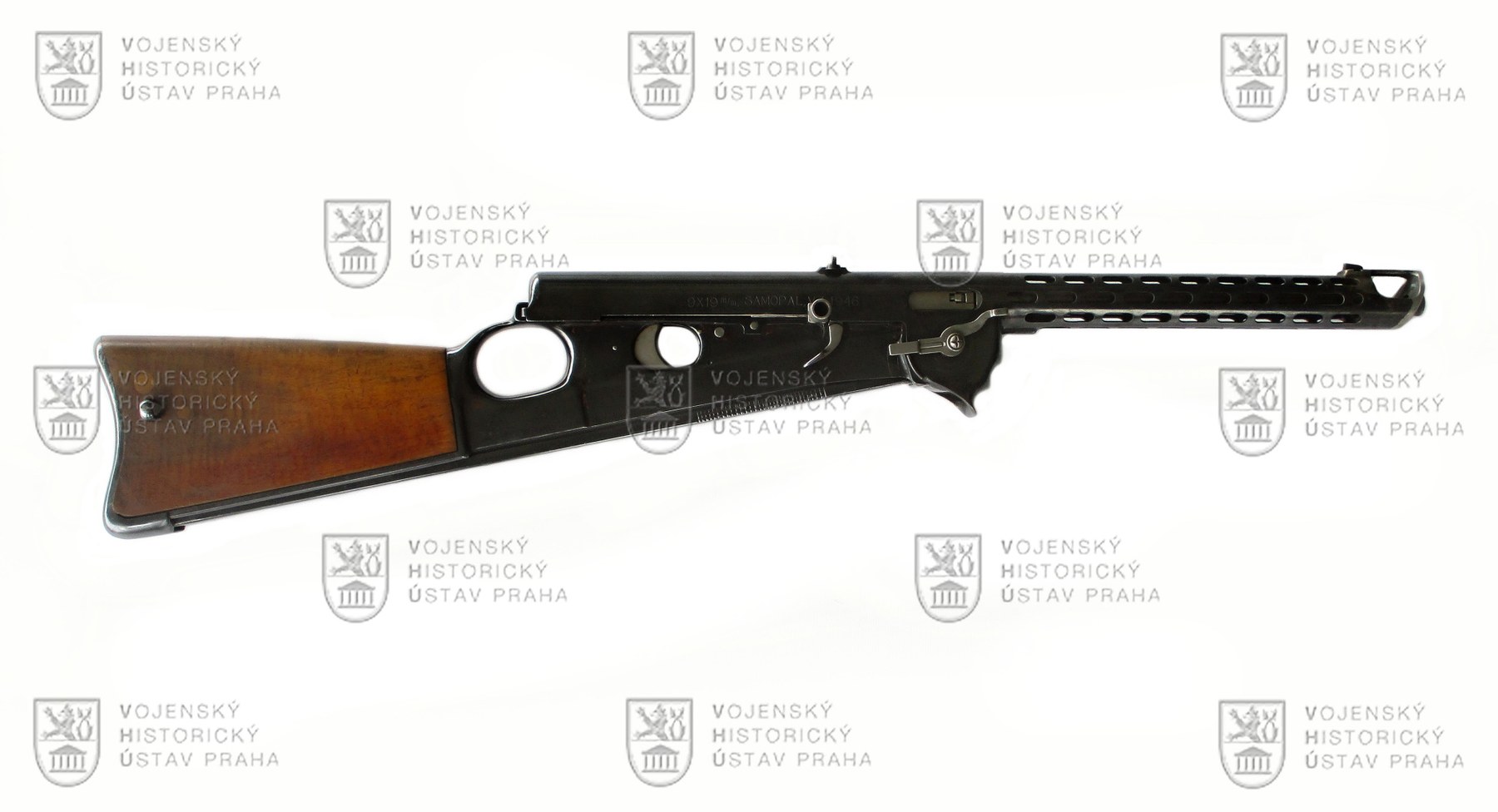
The takedown latch is described in detail, and it carries over to the ZB 47. The feeder’s eccentric shaft carried, on the right side, a two-armed operating lever. “By turning it the receiver moved forward far enough for a rib at the rear of the receiver to leave a recess in the trigger-housing body. Then it was enough to tip the receiver upward and with a simple movement remove the bolt with its return spring.”1 On the oldest surviving ZB 46 this latch is a two-armed lever joined to the eccentric shaft by a spring-loaded pin. “The other examples already have a latch in the form of a one-armed lever forming a single part.”1
2.5 The ZB 47, infantry version
The ZB 47 kept the layout and changed almost everything else. It is shorter, at 750 mm against 813 mm on VHU’s figures, and its barrel jacket is shorter, with fewer holes. The magazine grew from 64 to 72 rounds.31 The manual divides the gun into six groups: the barrel, the upper housing, the eccentric latch, the bolt, the return-spring rod and the lower housing. Together they contain “twenty-four parts that cannot be dismantled”, each listed and drawn (Volume 3).4 Those 24 are field-level parts. They are not the 79 production parts counted at the July 1947 meeting (Volume 1).3 The two production counts also disagree with each other. The manual says “there are sixteen pressed production parts in all, and many of them are welded together into assemblies”, while the July 1947 count gives 29 pressed parts.43 Either the gun changed between the two documents or they counted differently.
Both housings are pressed from sheet. The upper housing holds “the barrel with the ejector screw, the bolt with the feed lever, the extractor and the return spring”. The lower housing holds the ratchet-wheel feeder, the trigger mechanism and the magazine, which “reaches to the rear end of the stock”, so that the gun’s centre of gravity moves “as close as possible to the shooter’s shoulder”. The two housings are joined by the eccentric latch.4 The lower housing is also the stock: a long pressing with a thumb hole behind the grip, a wooden butt fixed to its rear, and the magazine lying in a groove along its underside, so that the magazine’s outer face completes the line of the stock. That last point is the claim of the 1946 patent (below).
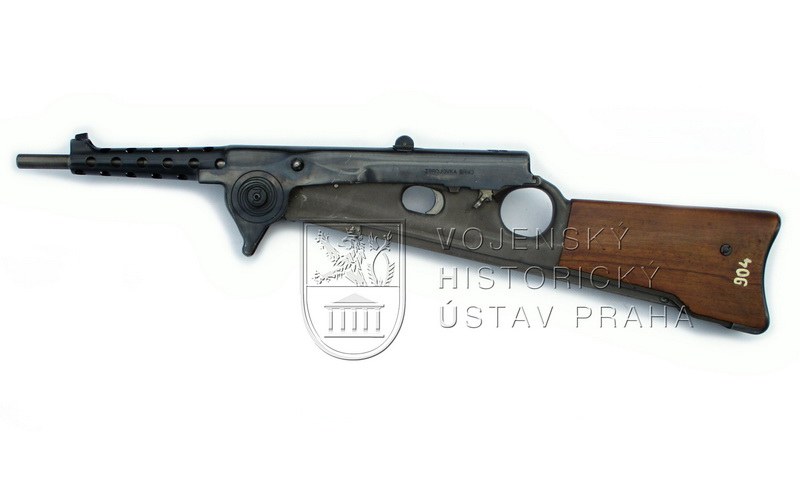
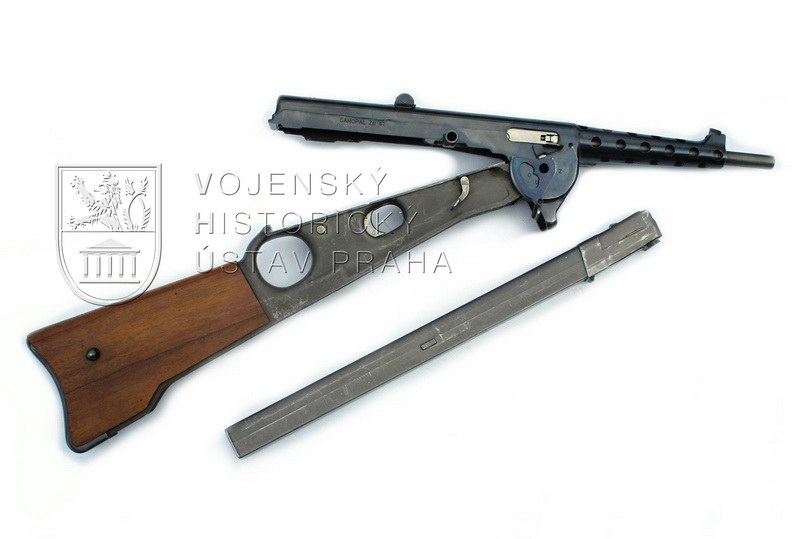
The manual says spare magazines and the cleaning rod were carried “in a light canvas pouch at the side on the belt”. Magazines were filled by hand with loose rounds or with “a simple loader” using rounds in strips. The loader weighed “only 100 g”.4
2.6 The ZB 47, paratrooper version, and the short magazine
The paratrooper gun replaces the wooden butt with a sliding shoulder rest. In VHU’s photographs of serial 1032 it is a single flat strut ending in a curved shoulder piece, sliding along the bottom of the stock pressing. The barrel jacket of 1032 has long slots where the infantry gun has round holes.2
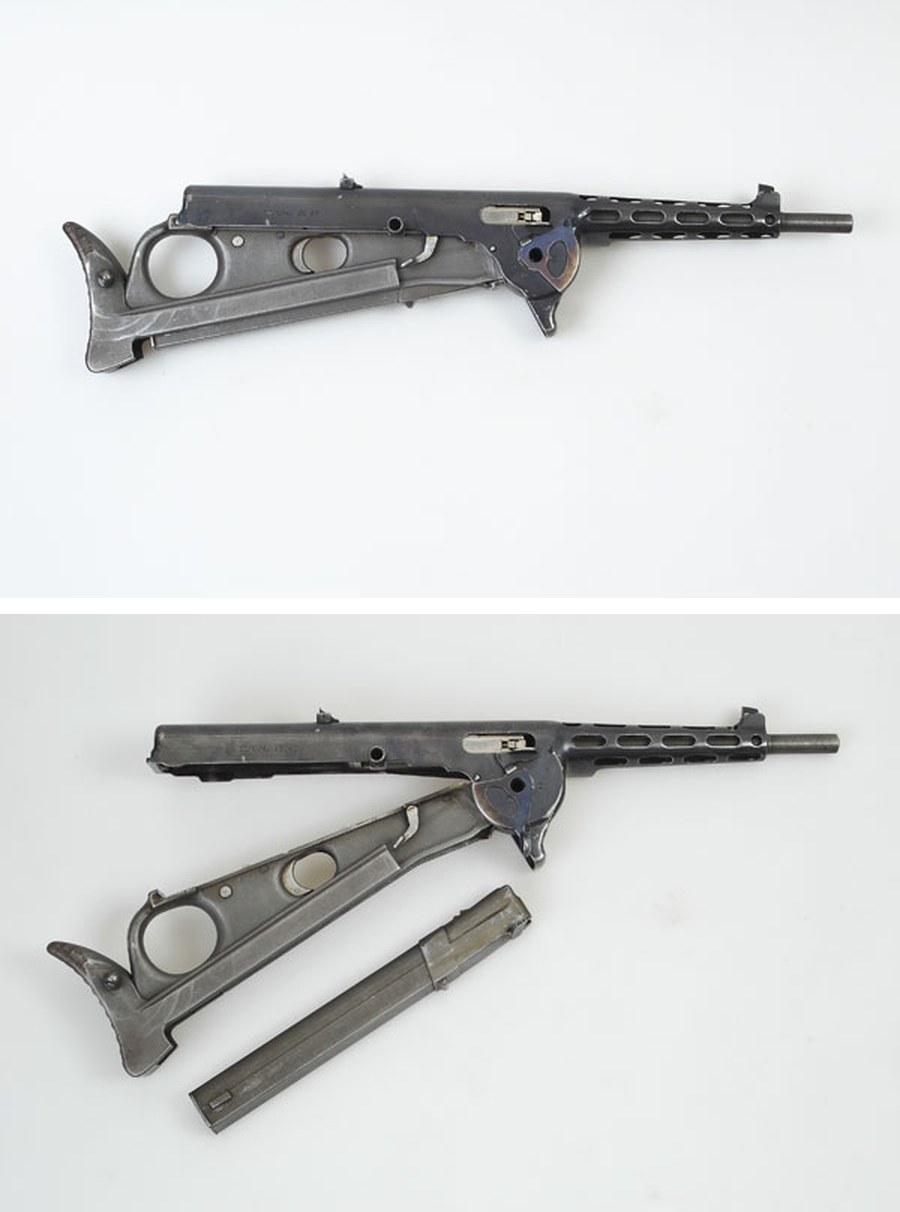
The short magazine’s capacity is given three ways:
Table 2 — The short magazine's capacity is given three ways
| Capacity | Source |
|---|---|
| 30 rounds | VHU exhibit page on serial 10322 |
| 32 rounds | M. Hessler, reply on palba.cz (2010), from memory, possibly from handling VHU’s gun. He adds that the short magazine “differed from the long one in nothing except the length of the body (and of course the follower spring)”, and that the magazines were interchangeable, but that with a long magazine fitted to the gun with the sliding rest, “the rest could not be pushed in"6 |
| "half length”, no capacity | Jiří Fencl, ATM 11/1990, p. 10, as quoted on palba.cz: “zkrácený zásobník poloviční délky”6 |
VHU’s 30 is the museum’s figure and is given first. Hessler’s 32 is a recollection and is not taken as fact. Russian Wikipedia’s “32 rounds” for the gun’s magazine cites only palba.cz, so it is the same recollection. Applied to the standard magazine, it is plainly wrong.
2.7 Markings
The surviving guns are marked simply.
- ZB 46 (VHU, unnumbered): the right side of the receiver reads ”…SAMOPAL VZ. 1946”. The beginning of the line is obscured by the watermark in VHU’s photograph. The left side reads “ČESKOSLOVENSKÁ ZBROJOVKA BRNO”.1
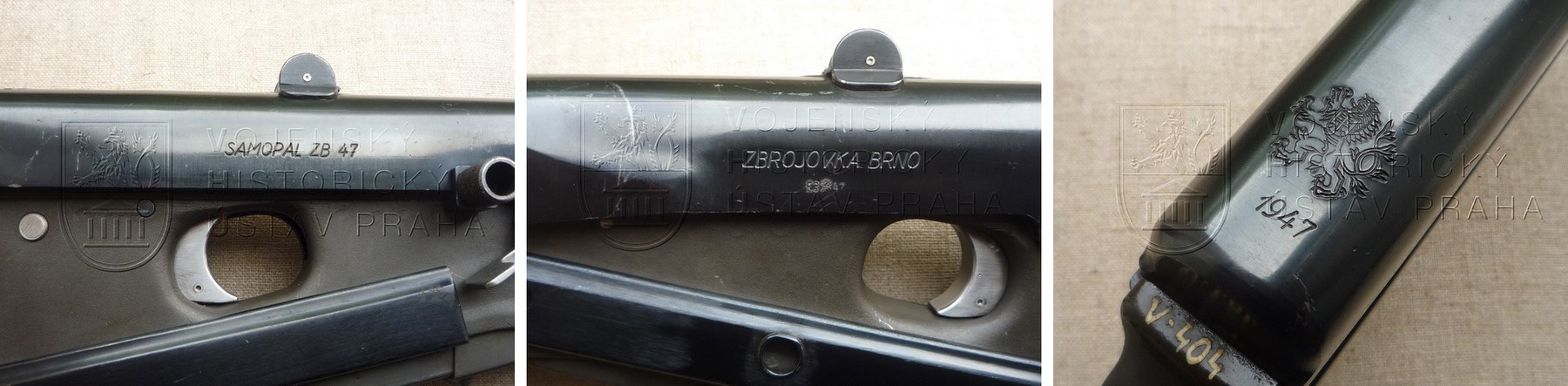
- ZB 47 infantry (VHU 2018 article’s gun): “SAMOPAL ZB 47” on the right, “ZBROJOVKA BRNO” on the left.3
- ZB 47 paratrooper, serial 1032: “SAMOPAL ZB 47” and “ZBROJOVKA BRNO”. On a flat surface of the housing VHU photographed the Czechoslovak lion with the Slovak cross on its breast and the date 1947 beneath it. The painted “V-404” beside it is a museum inventory number, not a factory mark.2
The lion and date on 1032 match the gun’s documented history. It came to VHU in October 1956 by transfer from the MNO’s artillery armament administration (MNO-SDV).2 An army property mark on a trial gun is to be expected. Whether every ZB 47 carried it is not known.
According to palba.cz, guns used in the cartridge trials carried a brass plate on the left side of the stock. It read “Jen pro náboje kuželové” (“for tapered cartridges only”) on guns for standard 9 mm Parabellum, or “Jen pro náboje válcové” (“for cylindrical cartridges only”) on guns for the experimental round.6 No photograph of either plate was found. The VHU infantry gun shows no plate on the side photographed.
2.8 Dimensions and rates of fire: every published figure
The published figures disagree. They are given with their sources and are not averaged.
Table 3 — Dimensions and rates of fire: every published figure
| Figure | Value | Source |
|---|---|---|
| Overall length | 740 mm | the manual, “Technické údaje”, item 34 |
| 750 mm | VHU specification box (Skramoušský 2018)3 | |
| Barrel | 265 mm | the manual, item 4 |
| 220 mm; 265 mm including the guide sleeve | VHU specification box | |
| Rifling | right-hand, one turn in 400 mm | the manual, item 12 |
| Sight radius | 308 mm | the manual, item 11 |
| 304 mm | VHU specification box | |
| Sights | folding, 100 and 300 m | the manual, item 10 |
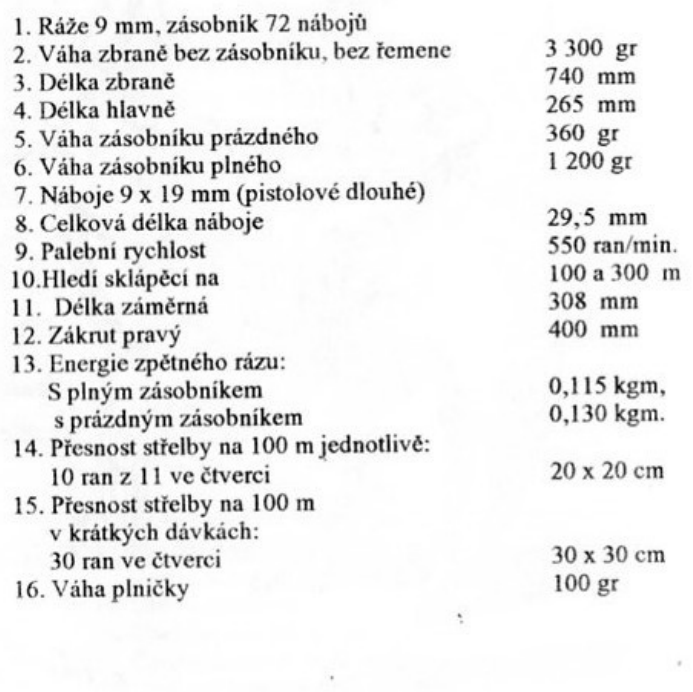
| Weight | 3,300 g without magazine or sling | the manual, item 2 |
| 3,520 g with empty magazine | VHU specification box | |
| 3.69 kg with empty magazine, 4.41 kg loaded | the 1947 troop-trial assessment, as quoted by Skramoušský3 | |
| Magazine | 72 rounds; 360 g empty, 1,200 g full | the manual, items 1, 5, 6 |
| Magazine loader | 100 g | the manual, item 16 |
| Cyclic rate | 550 rounds/min | the manual, item 9 (its cartridge table gives 0.11 s between shots) |
| 600 rounds/min, falling to 400 at −46 °C | Brno internal trials, as reported at the 18 July 1947 meeting3 | |
| ”reportedly 1200” | Forgotten Weapons (2024)7 | |
| Recoil energy | 0.115 kgm with full magazine, 0.130 kgm with empty | the manual, item 13 |
| Accuracy, 100 m | 10 of 11 single shots in a 20 × 20 cm square; 30 rounds in short bursts in 30 × 30 cm | the manual, items 14–15 |
| Muzzle velocity | 420 m/s, 7.5 g bullet | the manual, cartridge table |
The figures that circulate online (740 mm, a 265 mm barrel, 3,300 g, 550 rounds a minute, magazines of 360 and 1,200 g) are the manual’s. The palba.cz and armedconflicts.com entries copy them without saying so.468 VHU’s box was evidently measured from a museum gun, and its barrel note explains one difference: the 265 mm is the barrel with its guide sleeve, and the barrel itself is 220 mm.3 The 1,200 rounds a minute that Forgotten Weapons reports belongs to the ZB 46 as demonstrated in March 1946. The army asked for it to be lowered, and VHU says the ZB 47 samples “had a lower rate”.13 The weights describe different conditions. The manual’s 3,300 g excludes the magazine. VHU’s 3,520 g and the army’s 3.69 kg both include an empty magazine, which the manual weighs at 360 g. The manual’s figure plus its own empty magazine gives 3,660 g, close to the army’s 3.69 kg. The difference between 740 and 750 mm in length is not explained.
2.9 Single shots or bursts only?
The sources conflict on this point, and it is left open.
- VHU says ZB 46 serials 1003 and 1004, made by the end of 1946, “already had the selector for firing single shots and bursts solved”.1
- The army’s requirement of 18 July 1947 asked for easy handling “in firing single shots and bursts”.3
- Forgotten Weapons, which filmed two VHU guns, says the ZB 47 has no semi-automatic setting.7
- The manual’s parts list names the trigger (spoušť), the safety (pojistka), the trigger sear (spouštěcí západka), a guide rod, the trigger spring and the trigger pin. No part is called a selector (přepínač).4
- The manual’s instructions for firing say only that, after the safety is released, “pressure on the trigger opens fire”. Its accuracy figure for “single” shots (jednotlivě, 10 of 11 in a 20 cm square at 100 m) can be achieved with an open-bolt automatic by trigger control, so it is not evidence of a selector. No passage of the manual mentions a selector or a choice of single shots and bursts.4
On that evidence the ZB 47 described in the manual is a fully automatic gun with a safety, and the ZB 46’s selector was not carried into it. This is consistent with Forgotten Weapons. One thing prevents a firmer statement: the troop-trial guns and later guns may have differed from the brochure gun, and no trial report was read. Either way it is a machine gun in law (below).
2.10 The cylindrical 9 mm cartridge
The ZB 47’s long column of rounds standing side by side led Brno to an experimental cartridge. The source is the palba.cz article, which lists Skramoušský’s Střelecký magazín 8/1999 article, “Čs. experimentální náboj 9 mm”, among its sources. That article was found in the Czech digital library on pp. 26–28 of the issue, but it is locked (README).6
What palba.cz reports:
- The cartridge differed from the 9 mm Parabellum only in the case. Load, bullet and weight were unchanged. The case was cylindrical (válcový), that is, straight-walled, in place of the standard tapered (kuželový) case.6
- Its purpose: “the cylindrical cartridge was meant to remove the possibility of the round tipping downward from the axis and then being badly fed into the chamber”.6
- The rounds were made by Sellier & Bellot, at the Vlašim engineering works, which became plant 14 of the Zbrojovka Brno national enterprise on 1 January 1947. “At least 32,000 rounds were made, of which 16,000 were intended for the trials of the ZB-47.” The other half went to Strakonice, because the cylindrical round “was also tested in the Strakonice ČZ-247 submachine gun. Here too twenty guns were made for the trials, again divided in half.”6
- Guns were marked for one cartridge or the other by the brass plate described above.6
The ČZ 247 detail supports the account. VHU independently gives 20 ČZ 247 and 20 ZB 47 as the troop-trial orders (Volume 1).93 The words “again divided in half” imply that the 20 ZB 47 were also split, ten for each cartridge. That is the article’s implication, not an explicit statement, and it is not confirmed.
The manual knows nothing of it. Its cartridge table describes the standard 9 × 19 mm Parabellum, with a 7.5 g bullet at 420 m/s, and it says the gun “fires faultlessly all three kinds of 9 × 19 mm pistol cartridge”, with bullets of 6.4, 7.5 and 8 g.4 The cylindrical round therefore came after the brochure, consistent with palba.cz’s “somewhat later”.
The army rejected the cartridge. Forgotten Weapons says so, and the gun was adopted in no calibre.7 The underlying reasoning is mechanical. A column of tapered cases standing side by side is wider at the case heads than at the mouths, so a long straight stack of them tends to fan. Curved magazines for tapered cartridges are curved for exactly that reason. A straight-walled case stacks straight. This explanation is this dive’s own and is not taken from a source. The source’s stated reason is the tipping and misfeeding quoted above.
Kramerius also matches the 2016 Atlas nábojů do ručních palných zbraní (Book of small arms ammunition) on p. 213, which probably catalogues the round. That page could not be read.
2.11 The 7.62 mm Tokarev trial guns
VHU says the MNO tested the ZB 47 “not only in 9 mm Parabellum, but also for the 7.62 mm Tokarev cartridge”.2 According to palba.cz, two guns were made in 7.62 × 25 in spring 1948, and 9 × 19 was retained.6 Skramoušský records a ZB 47 “in the same calibre” at the Popovice firings of 20–24 April 1948, where it grouped better at 300 m in bursts than the winning 9 mm ČZ 447 (Volume 1).3 How the Tokarev guns differed externally is not recorded. No photograph of one was identified.
2.12 The patents, at home and abroad
VHU names three Czechoslovak patents. None of the Czech texts could be read (README).1
Table 4 — The patents, at home and abroad
| CS patent | Filed | Subject (VHU) | Foreign filings found |
|---|---|---|---|
| No. 65 548 | 1937 | Feed mechanism: the ratchet wheel | GB 502,782, convention date 20 Aug 1937, “Cartridge feed mechanism for automatic firearms”, Československá zbrojovka a.s., Brno10 |
| No. 77 558 | 1946 | The box magazine in the lower part of the stock | GB 625,789 (conv. date 17 June 1946; filed 15 May 1947; published 4 July 1949); FR 947,367 (filed 30 May 1947; published 30 June 1949); CH 264,338; a Belgian filing listed in the family5 |
| No. 80 735 | 1947 | Guiding the cartridge into the chamber | none matched |
The British abstract of 625,789 describes the stock magazine exactly. “The butt, which houses a magazine, delivering the cartridges to a rotary feed drum, is … provided with a groove-like longitudinal recess for the magazine, the latter being removably housed in the recess so that its external surface completes the outline of the butt.” The recess “may be formed in the side or … in the lower edge of the butt”. It ends at the rear in a support carrying a spring that bears on the magazine. In a modification, “the recess, with suitable intermediate supports, houses a plurality of magazines end to end”.5 The patent therefore claimed more than the gun used: magazines in the side of the butt, and several magazines in line. Neither appears on any ZB 47 found.
None of the abstracts names an inventor, and no drawings could be obtained, so the attribution to the Holeks rests on VHU’s statement and on the matching dates. A Swiss “feed drum for an automatic firearm” filed by Zbrojovka Brno four days after the stock-magazine patent (CH 260,112, priority 21 June 1946) may belong to the same family. No text was available to check.
2.13 The manual
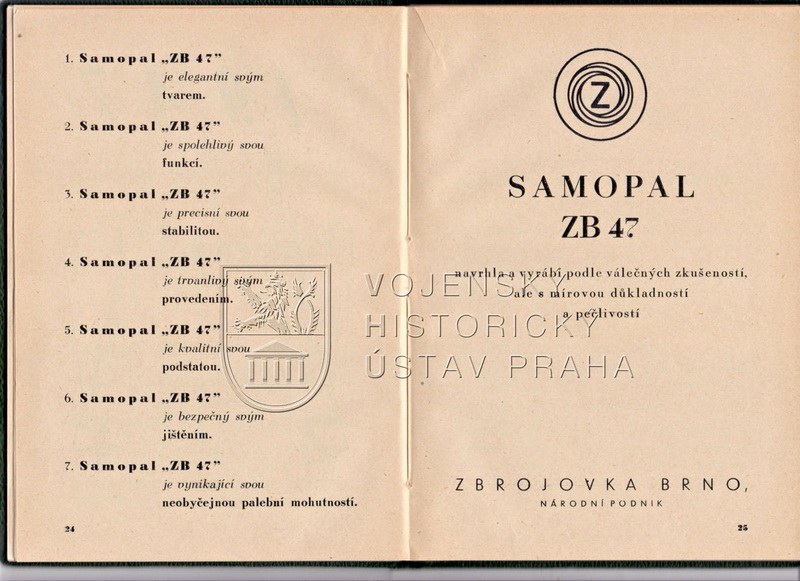
Zbrojovka Brno printed a user’s manual. VHU photographed an original copy for Skramoušský’s article. Its title spread reads “SAMOPAL ZB 47 / navrhla a vyrábí podle válečných zkušeností, ale s mírovou důkladností a pečlivostí / ZBROJOVKA BRNO, národní podnik”. In English: “designed and made according to wartime experience, but with peacetime thoroughness and care”. The page numbers in the photographs run at least to 63.3
Facing the title is a list of seven claims, each beginning “Samopal ‘ZB 47’ je …”. They are: elegant in shape, reliable in function, precise in stability, durable in construction, quality in substance, safe in its locking, and “with its uncommon firepower” (neobyčejnou palební mohutností).3 The tone is a sales brochure as much as an instruction book. That fits a gun the works was offering abroad from October 1947.
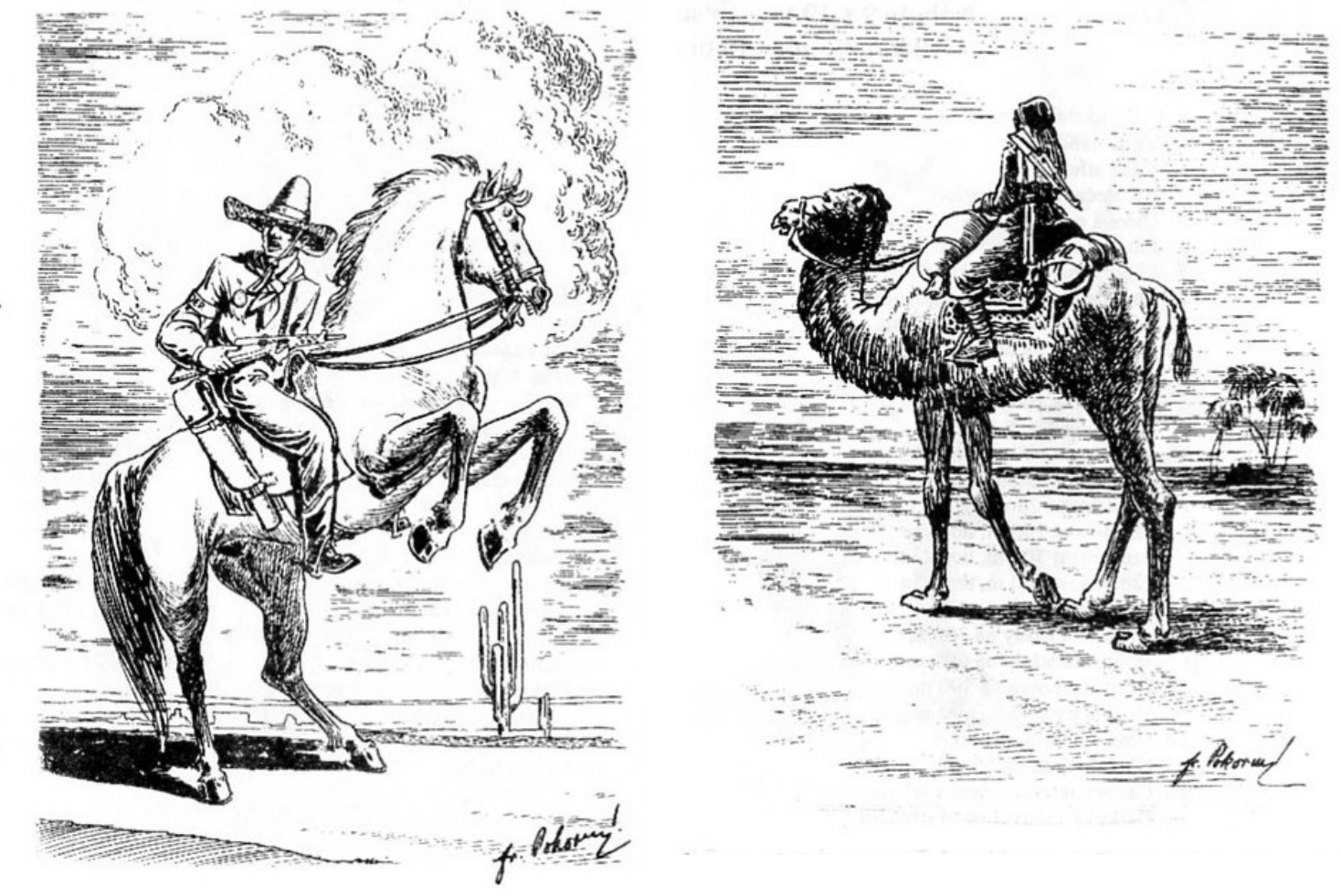
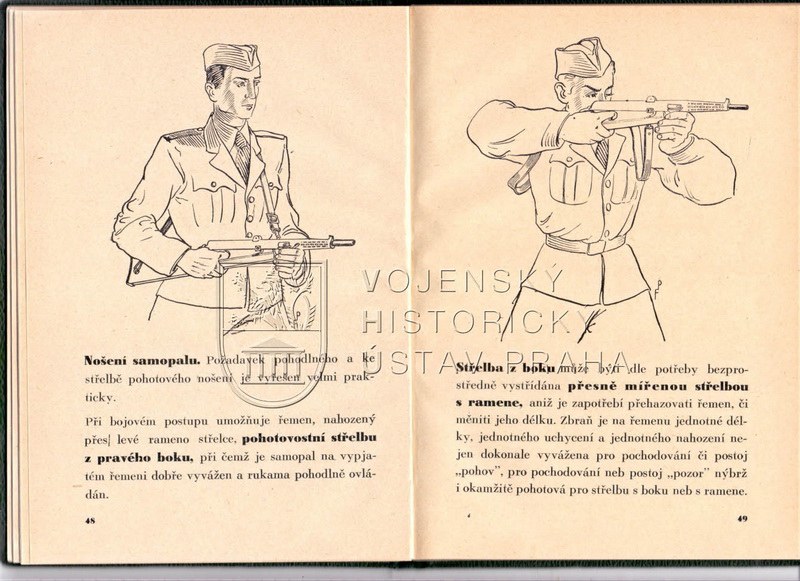
The line drawings on palba.cz come, by one reply’s account, “from the reprint of the user’s manual”.6 That reprint is Samopal ZB 47 Holek, subtitled “Odborný český překlad původního návodu k obsluze včetně vyobrazení”, published by Ofseta plus in 1997 in 56 pages. One copy was on sale on 19 October 2026 (README).11 The copy once posted on kinggun.cz is gone. A scan of the whole reprint, however, is still online on Jan Sladký’s site, where The Firearm Blog linked it in 2015. This dive read it from there.4
The reprint’s text is Czech. Its subtitle nevertheless calls it “a professional Czech translation of the original operating instructions, including the illustrations”, which is odd for a gun made in Brno. The illustrations suggest an explanation. Besides soldiers in battledress, the artist drew a rider in a sombrero and a man on a camel, figures that only make sense in a brochure meant for foreign buyers. Either the publisher used a stock subtitle, or the original was an export edition in another language and the reprint translates it back. VHU’s photographs of the original show Czech text, so the first is more likely, but this is not settled.34 The original’s page numbers (to at least 63) also do not match the reprint’s 56 pages. Volume 3 uses the manual throughout.
2.14 How many were made
The production figures do not agree. They are given here with their sources and are not averaged.
Table 5 — How many were made
| Figure | What it counts | Source |
|---|---|---|
| 4 | ZB 46 made (1001, 1003, 1004 and one more; 1001 lost) | VHU, ZB 46 page1 |
| 20 | infantry ZB 47 ordered by the MNO for troop trials, autumn 1947 | Skramoušský, VHU 20183; also the ČZ 247 article (“twenty of each type”)9 |
| “20 kusů?“ | the troop-trial lot, with the author’s own question mark | palba.cz (2010)6 |
| 2 | guns in 7.62 × 25, spring 1948 | palba.cz6 |
| 62 | ”these structurally very unusual weapons”, made by Zbrojovka Brno 1946–1948 | Skramoušský, VHU 20183; repeated by Forgotten Weapons (2024)7 |
The serial numbers seen fit a run starting at 1001. The ZB 46 serials are 1001, 1003 and 1004, and the ZB 47 serials photographed or recorded are 1018 and 1032.132 The 62 total plainly includes more than the 20 trial guns. It probably includes the ZB 46, since it covers 1946–1948, as well as paratrooper guns, Tokarev conversions and demonstration guns. VHU gives no breakdown, and none should be invented. Sixty-two is the only total with a named, specialist source. Twenty is an order, not a production figure.
The pre-1990 literature is a separate question. The 1980 Střelecká revue article, Fencl’s 1990 ATM article and Šáda’s book (2004 edition, pp. 49–53) may each give a figure. None could be read (README).
2.15 The survivors
Five examples are documented or photographed in Czech public collections. No other examples were found.
Table 6 — The survivors
| Example | Where | How documented |
|---|---|---|
| ZB 46, no serial number | VHU Praha (received 1995 from Prototypy a.s., Brno) | VHU exhibit page, photographs1 |
| ZB 47 infantry, serial 1018 | VHU Praha (received 1995 from Prototypy a.s., Brno) | Skramoušský, VHU 20183 |
| ZB 47 paratrooper, serial 1032 of 1947 | VHU Praha (received October 1956 from MNO-SDV) | VHU exhibit page, photographs2 |
| ZB 47 (version not determined) | Muzeum Policie ČR, Prague | forum photographs, 20128 |
| ZB 47 (version not determined) | Východočeské muzeum, Pardubice (castle weapons exhibition) | forum photographs, 20088 |
Forgotten Weapons’ 2024 video shows two VHU prototypes, an infantry and a paratrooper gun.7 Prototypy a.s., Brno, was the source of two of VHU’s guns in 1995. This suggests the Brno works kept its own prototypes into the 1990s. Where that collection’s other pieces went is not known. The Police Museum and Pardubice guns are known only from visitors’ photographs, and their serial numbers and versions were not established. The forum photographs carry no licence and are not reproduced here.
2.16 Collecting, and the law in the United States
There is no collector market for the ZB 47. Every example found is in a Czech public collection. No ZB 47 was found at any American auction, in any American museum, or in any reference to the US registry. A web search and a search of the Internet Archive’s index of one major auction house’s lot pages turned up nothing. This means none was found, not that none exists.
In US law the ZB 47 is a machine gun: a weapon “which shoots, is designed to shoot, or can be readily restored to shoot, automatically more than one shot, without manual reloading, by a single function of the trigger” (26 U.S.C. § 5845(b)). Private possession of a machine gun is lawful only if it was lawfully possessed and registered before 19 May 1986 (18 U.S.C. § 922(o)). The import of machine guns for private sale had already been closed by the Gun Control Act of 1968. For a weapon of which perhaps 62 were made in Czechoslovakia between 1946 and 1948, all of them army trial or factory guns, no route into the US registry is evident. This applies whichever version, calibre or cartridge is meant. Public Law 119-21’s $0 NFA tax reached short-barrelled rifles and suppressors, not machine guns.
The full federal treatment (the categories of machine gun, the transfer process, dealer samples) and Michigan’s machine-gun statute, MCL 750.224, are set out in the hub’s MP 40 dive, Volume 6. They are not restated here. The MP7 dive, Volume 8 applies them to another weapon no private American can own.
This dive contains no build, replica or conversion content, by the hub’s rule for select-fire weapons.
2.17 What could not be confirmed
- The short magazine’s capacity: 30 (VHU) against 32 (a recollection). VHU’s figure is preferred, but not proven.
- Whether the ZB 47 had a selector. The manual’s parts list suggests not, and Forgotten Weapons says not, but the ZB 46 had one.
- The breakdown of the 62, and whether the 20 trial guns were split ten and ten between the two cartridges.
- The 7.62 mm guns’ appearance and serial numbers.
- The inventors named on the patents, and their drawings. Only abstracts were read.
- Any foreign demonstration of the ZB 47 by country and date.
- The Police Museum and Pardubice guns: serials and versions.
- The tank-crew purpose in the Internet Movie Firearms Database, which is supported by no Czech source. A tank school was one of the trial units.
- Whether the manual reprint is a translation, as its subtitle says.
References
Footnotes
-
“Čs. samopal ZB 46”, VHU Praha, exhibit page, https://www.vhu.cz/exhibit/cs-samopal-zb-46/ (accessed 2026-10-19). Text, specification box, and five photographs. ↩ ↩2 ↩3 ↩4 ↩5 ↩6 ↩7 ↩8 ↩9 ↩10 ↩11 ↩12 ↩13 ↩14 ↩15
-
“Samopal ZB 47”, VHU Praha, exhibit page, https://www.vhu.cz/exhibit/samopal-zb-47/ (accessed 2026-10-19). Paratrooper version and short magazine, calibres, serial 1032; four photographs. ↩ ↩2 ↩3 ↩4 ↩5 ↩6 ↩7 ↩8 ↩9 ↩10
-
Jan Skramoušský, “Samopal ZB 47”, VHU Praha, https://www.vhu.cz/samopal-zb-47/ (published 2018-11-27; accessed 2026-10-19). Specification box, production total, serial 1018; nine photographs including three spreads of the original manual. ↩ ↩2 ↩3 ↩4 ↩5 ↩6 ↩7 ↩8 ↩9 ↩10 ↩11 ↩12 ↩13 ↩14 ↩15 ↩16 ↩17 ↩18 ↩19 ↩20 ↩21 ↩22 ↩23
-
Zbrojovka Brno, národní podnik, Samopal ZB 47 (1947), as reprinted in Samopal ZB 47 Holek (Ofseta plus, 1997, 56 pp.); scan at http://sa58kinggun.jansladky.cz/Podklady/Holek1.pdf (28 two-page spreads; archived by the Wayback Machine 2015–2026; fetched 2026-10-19). Sections cited: II (description), III (disassembly), V (technical data, items 1–16), VI (cartridge data). ↩ ↩2 ↩3 ↩4 ↩5 ↩6 ↩7 ↩8 ↩9 ↩10 ↩11 ↩12
-
GB 625,789, Zbrojovka Brno n.p., application 13163/47 (15 May 1947), convention date 17 June 1946, published 4 July 1949; abstract and family via https://patents.google.com/patent/GB625789A/en (read 2026-10-19). FR 947,367 and CH 264,338 bibliographic data from the same service. ↩ ↩2 ↩3
-
“sa58”, “Samopal ZB 47”, palba.cz, http://www.palba.cz/viewtopic.php?t=3998 (2010-04-05, with replies; accessed 2026-10-19). Cartridge, plates, groups and parts, short-magazine replies, manual drawings. ↩ ↩2 ↩3 ↩4 ↩5 ↩6 ↩7 ↩8 ↩9 ↩10 ↩11 ↩12 ↩13 ↩14
-
Ian McCollum, “ZB47: A Truly Weird Czech SMG”, Forgotten Weapons, https://www.forgottenweapons.com/zb47-a-truly-weird-czech-smg/ (2024-12-23; accessed 2026-10-18). ↩ ↩2 ↩3 ↩4 ↩5
-
“CZK - ZB 47”, armedconflicts.com / valka.cz, https://www.armedconflicts.com/-t74081 (accessed 2026-10-18). Specification (source: “Archiv autora”), the magazine pouch, and members’ photographs of the Police Museum (2012) and Pardubice (2008) guns. ↩ ↩2 ↩3
-
Jan Skramoušský, “Samopal ČZ 247”, VHU Praha, https://www.vhu.cz/samopal-cz-247/ (published 2018-10-29; accessed 2026-10-19). ↩ ↩2
-
GB 502,782, Československá zbrojovka a.s., Brno, convention date 20 August 1937; abstract via https://patents.google.com/patent/GB502782A/en (read 2026-10-19). ↩
-
Samopal ZB 47 Holek. Odborný český překlad původního návodu k obsluze včetně vyobrazení, kolektiv autorů (Ofseta plus, 1997), soft cover, A5; listing at Trh knih, https://www.trhknih.cz/kniha/ah0kzq934n29 (read 2026-10-19). ↩
Comments (0)