ZB 47 · Volume 1
The Competition, 1946–1948: Holek's Stock-Magazine Gun Against Strakonice
How the Holek brothers' ZB 46 became the ZB 47, how it fared in the largest submachine-gun competition the Czechoslovak army ever held, and why the army chose the ČZ 447, the future vz. 48 and Sa 23, instead
1.1 What this volume rests on
The ZB 47 has no English-language literature beyond a few web articles and one video. Every English account found traces back to the Military History Institute in Prague (Vojenský historický ústav, VHU), which holds three of the guns, or to a 2010 Czech forum article. This volume goes to the Czech sources themselves.
The spine is a set of articles that VHU published on its own website in 2018. Each describes one of the competing prototypes from the trial files. They are signed by Jan Skramoušský, the specialist who also wrote the 1999 Střelecký magazín article on the ZB 47’s experimental cartridge.1 Two shorter VHU exhibit pages, on the ZB 46 and on ZB 47 serial number 1032, supply the early history and the patents.23 The companion articles on the ZK 466, the ČZ 247, the ČZ 447 and the Sa 25 describe the same meetings and trials from the competitors’ side, and they do not always agree with the ZB 47 article. Where they differ, both versions are given.4567
The third source is Zbrojovka Brno’s own 1947 manual, Samopal ZB 47, which survives in a 1997 reprint and is online as a scan. It is the factory’s description of the gun, and also its sales brochure.8
The rest of the Czech print literature is listed in the references. All of it is either digitised and locked behind Czech library logins or available only on paper. The README sets out what can be bought and where.
1.2 Two factories, two traditions
After 1945 the Czechoslovak army wanted a modern submachine gun of its own. Two state arms works competed to supply it. One was Česká zbrojovka at Strakonice, with its branch at Uherský Brod. The other was Zbrojovka Brno, the former Československá zbrojovka, which became a national enterprise (národní podnik) after the war. VHU’s description of what followed is not modest. It says the prototypes that came out of the two design offices in 1945–1948 “represent, in terms of invention, a phenomenon that bears no comparison with developments in other countries”.2
Both works had relevant experience. Strakonice had designed the vz. 38, the first submachine gun adopted by the Czechoslovak army. Adoption came just before the 1938 Munich crisis, and the gun never went into series production. Its designer was František Myška (1899–1983), who was Strakonice’s chief designer through the postwar competition. Brno had made the ZK 383, the Koucký brothers’ submachine gun, in series during the occupation.73
The army’s own agency for this work was the Vojenský technický ústav (VTÚ), the Military Technical Institute. VTÚ ran the trials, and the Ministry of National Defence (Ministerstvo národní obrany, MNO) ordered the samples. Most of the guns in this story were known only by factory designations. Several were renamed during the trials, which is one reason the secondary literature confuses them. The ČZ 47/II, for example, became the ČZ 247, and the ČZ/47 became the ČZ 447.56
1.3 The Holeks and the 1937 feed patent
The ZB 47 was designed by two brothers. Václav Holek (1886–1954) was, in VHU’s words, the “creator of the ZB 26 series of machine guns”. The ZB vz. 26 light machine gun is the ancestor of the British Bren. His brother Ing. František Holek (1894–1951) was the engineer of the pair.2 Neither name needs an introduction to students of Czechoslovak arms. The hub’s M1 Garand dive records a Holek design among the foreign entries in the US Army’s 1929 rifle trials.
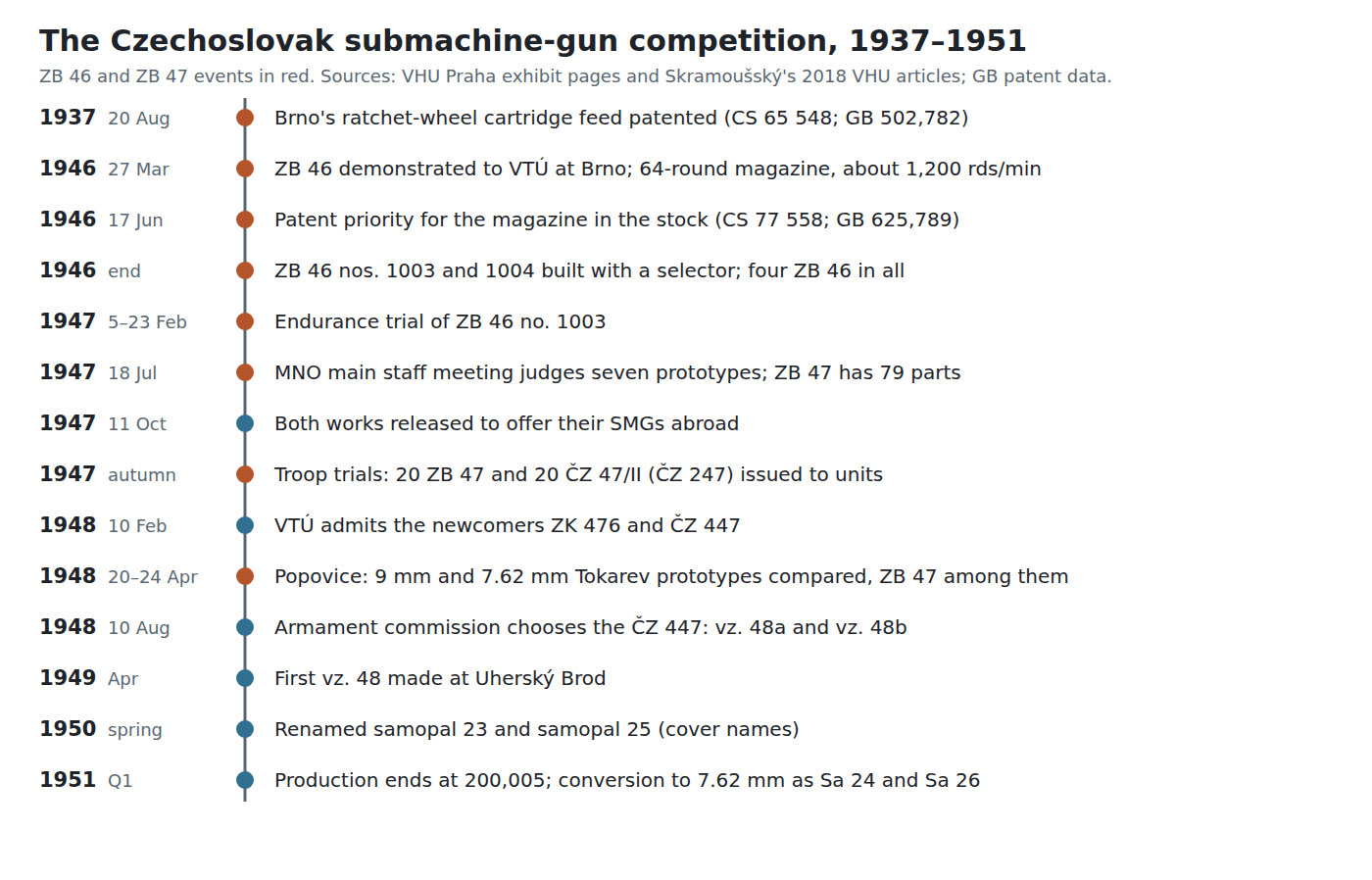
The idea the ZB 47 turns on was ten years older than the gun. According to VHU, the principle of its feed mechanism, a ratchet wheel (rohatkový kotouč), was already protected by Czechoslovak patent No. 65 548, filed in 1937.2 The Czechoslovak document was not read for this dive (Volume 3 gives the reasons). Its British counterpart, however, can be identified. British patent 502,782, “Cartridge feed mechanism for automatic firearms”, was filed by Československá zbrojovka akciová společnost of Brno on 8 August 1938 and claims a Czechoslovak convention date of 20 August 1937. The British abstract describes “a multi-sided drum … having a projection on each face to engage under the cartridges as they are fed to the drum in a path parallel to the bore”, and a ratchet wheel on the drum’s spindle that “the breech-block … actuates”, so that the drum “is rotated step-by-step at each reciprocation of the breech-block”. It names its intended use as “automatic firearms, particularly automatic pistols”.9
The British abstract does not name an inventor. That this is Holek’s 1937 patent rests on the matching dates, the matching mechanism, and the 1946 British filing for the ZB 47’s stock magazine, which cites 502,782 (Volume 2). The match is strong but inferred. In 1937, then, Brno already owned a way of turning a stack of cartridges lying across a magazine into a single round entering the chamber, driven step by step by the bolt. Nine years later the Holeks built a submachine gun around it.
1.4 March 1946: the ZB 46 is shown to the army
The first gun was called the ZB vzor 46. The MNO ordered two samples from Brno, together with two of Josef Koucký’s ZK 466. On the order they were simply called “Holek”. VTÚ’s representatives first saw the new weapon at a demonstration at the Brno works on 27 March 1946. This was before the army had formally opened a competition, as the palba.cz account points out.210
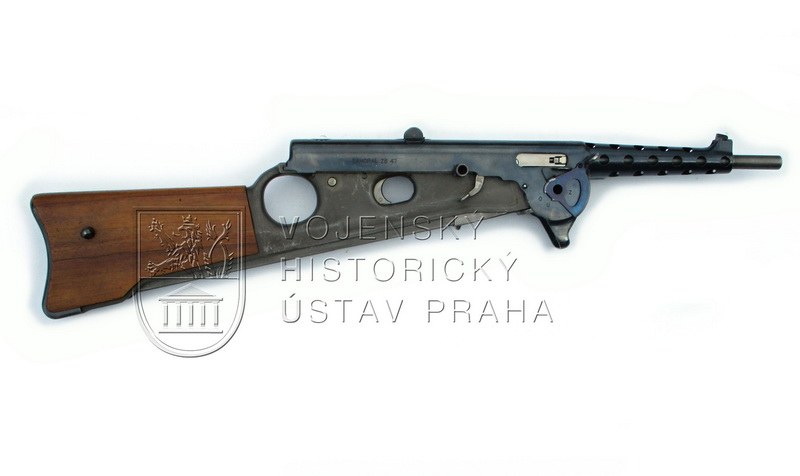
According to VHU, the demonstration gun “won the representatives over with a completely untraditional concept, different from every type known until then”. The barrel sat in a cylindrical protective shroud. At the rear the shroud ran into a receiver of inverted-U section. A two-column box magazine of 64 rounds went into the bottom of the stock, its mouth lying at the rotating ratchet wheel that served as the feeder.2
The concept’s purpose was stated plainly. Putting the magazine in the lower line of the stock “eliminated the unfavourable effect of the shift of the weapon’s centre of gravity as the rounds were used up in firing, and made it possible to raise the magazine’s capacity up to 72 rounds without increasing the overall dimensions”.2 The magazine projected from nothing. A full magazine also weighed down the rear of the gun, not a point ahead of the grip.
VTÚ had reservations. The demonstration gun had a high cyclic rate, “around 1,200 rounds a minute”, and was heavy. The recommendations covered a lower rate, a lower weight, and changes to the size of the trigger guard and of the hole for the firing hand’s thumb.2 The thumb hole was the opening in the steel stock pressing through which the shooter’s thumb passed. The manual’s own description of the hold appears in Volume 3.
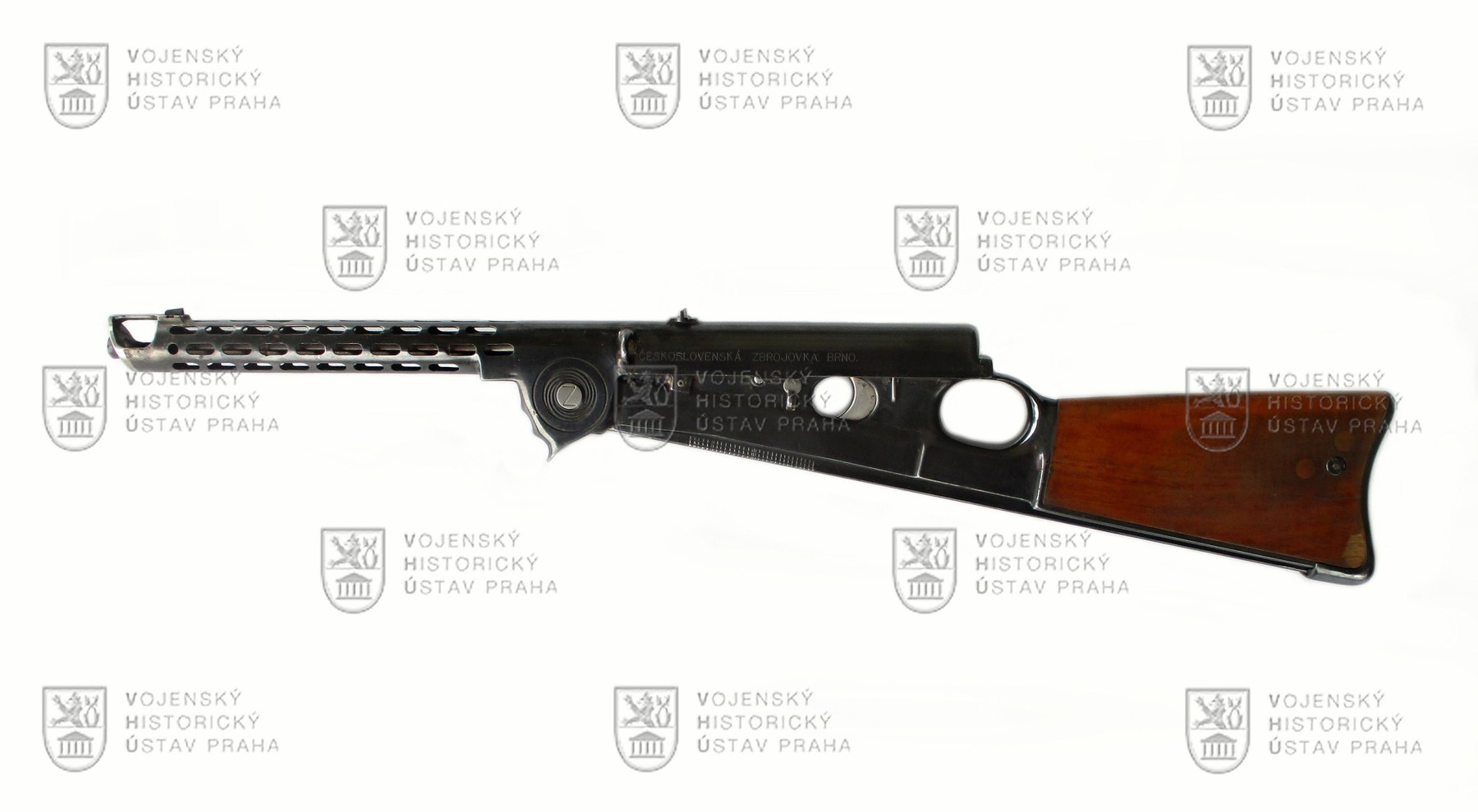
Two months later, on 17 June 1946, Zbrojovka Brno filed in Czechoslovakia for the arrangement that defines the gun: a magazine carried in a groove along the stock. It later filed abroad on the strength of that date (Volume 2).11 VHU identifies the Czechoslovak patent as No. 77 558 of 1946, “covering the box magazine in the lower part of the stock”.2
1.5 From ZB 46 to ZB 47
By the end of 1946 Brno had made two more ZB 46, numbered 1003 and 1004. These “already had the selector for single shots and bursts solved”. Gun 1003 then ran an endurance trial from 5 to 23 February 1947. During the trial barrels with two-groove and with standard six-groove rifling were also compared.2
Only four ZB 46 were made. Number 1001 has not survived. VHU holds an unnumbered example, received from Prototypy a.s., Brno, in 1995, and says that on “only the oldest surviving example” the takedown latch is a two-armed lever. “All the following guns produced were designated ZB 47.”2 Holek’s 1947 patent for guiding the cartridge into the chamber, CS No. 80 735, belongs to this stage.2
The rename went with a redesign. Skramoušský writes that the later samples, “already designated ZB 47, had a lower rate of fire”. The weight reduction the army kept asking for, however, “accompanied the weapon into the following period as well”. In other words, the army went on criticising the weight, and the reduction it wanted never fully arrived.1 The ZB 47 is shorter than the ZB 46: 750 mm against 813 mm on VHU’s figures. It takes a 72-round magazine where the ZB 46 took 64. Volume 2 sets out every published dimension with its source.
1.6 July 1947: the army states what it wants
The competition took formal shape at a meeting called by the MNO’s main staff for 18 July 1947. Its purpose was to assess the prototypes from both works and decide on further trials. Skramoušský’s account comes from the minutes. Plk. Ing. Zelinka opened the meeting with škpt. Hrubeš, and they set out what the army would require.1
- Safety above all. The gun had to be safe in any handling. It must not fire accidentally from a blow or a jolt. For an open-bolt weapon this is a real problem: a heavy bolt jarred rearward and released can run forward and fire. The Sa 25 article explains it in those terms, with bolts of “around 600 g”.7
- Simplicity and economy. The design was to be simple, made mainly from unalloyed steels available within the republic, with few production parts, so that it could be made “with the smallest number of workers and hours even in a state of war”.
- A low silhouette. The gun should not raise the shooter’s outline when he fired lying down, “while a magazine inserted into the weapon from below could form a natural rest”.
- Easy handling for single shots and for bursts, and a shape suited to natural movement over ground.1
The third requirement reads as if written with the ZB 47 in mind, and the troop reports later praised it on exactly that point. The second requirement is the one it failed.
The commission assessed seven designs: the ZB 47; Strakonice’s ČZ 47/I, ČZ 47/II and ČZ H/47; Brno’s ZK 471 and ZK 466; and the ČZ 47/p, which existed only as a wooden model and was promised for September. Each gun’s parts were counted and classified by method of manufacture.1
Table 1 — 18 July 1947: the army states what it wants
| Prototype | Parts | Pressed | Turned | Milled | Fourth category | Other |
|---|---|---|---|---|---|---|
| ZB 47 (infantry) | 79 | 29 | 25 | 16 | 9 “točených” | — |
| ZK 466 | 95 | 25 | 40 | 18 | 11 “vinutých” (wound, i.e. springs) | 1 aluminium casting |
Sources: Skramoušský, VHU 2018, ZB 47 and ZK 466 articles.14
The manual gives a third figure. It says the gun has “sixteen pressed production parts in all, and many of them are welded together into assemblies”.8 Whether the gun changed between the two documents or they counted differently is not known.
The ZB 47 article calls its fourth category “točených”, which also means “turned” and so duplicates the second column. The parallel ZK 466 article, describing the same meeting, uses “vinutých”, wound parts, which are springs. A slip for “vinutých” is likely, but it is not confirmed, and the figure is printed here as VHU gives it.
The ZB 47 came to the meeting with a favourable record from Brno’s internal trials. It had fired 80,000 rounds for endurance and been tested dirty with mud and sand. At −46 °C, “the weapon’s rate of fire fell from 600 to 400 rounds a minute”.1 The ZK 466 and the ČZ 47/II reported 80,000-round factory trials too, and the ČZ 47/II the same drop to 400 rounds a minute at −45 °C. The 80,000-round endurance run looks like the competition’s common standard, not a distinction.45
1.7 Troop trials, autumn 1947 to spring 1948
The meeting sent two designs forward to troop trials: the ZB 47 and Strakonice’s rotating-receiver ČZ 47/II, by then renamed ČZ 247. “For troop trials the MNO ordered a total of 20 infantry ZB 47 from the works, and Česká zbrojovka received an order for the same number of ČZ 47/II.”1 The ČZ 247 article dates the Strakonice order (čj. 10 445) to 2 December 1947.5
This settles a question the 2010 palba.cz account left open. Its author wrote that VTÚ ordered troop trials of the ZB 47 in mid-1947, “20 kusů?” (“20 pieces?”), with the question mark his own.10 Skramoušský’s figure removes the question mark.
Under orders čj. 6915 Dův. and 9464 Dův. from the infantry command of the main staff, the guns went in autumn 1947 to:
- infantry regiments 4 and 18;
- infantry battalions 33 and 41;
- artillery regiment 1;
- the infantry school, the tank school and the engineer school.
Trials were to be finished by the end of March 1948.1 The ČZ 247 article adds that the guns reached the units only at the end of 1947, and that first results were in by mid-January 1948.5
The tank school’s presence on the list may explain one persistent claim. The Internet Movie Firearms Database says the ZB 47 was “meant for crews of tanks and armored vehicles”, and search engines repeat it. No Czech source read for this dive says so. VHU describes an infantry gun with a paratrooper variant, and the 18 July requirements are infantry requirements. A tank school did try the gun, which may be where the idea started. The tank-crew purpose itself is unsupported.
These trials ran through the Communist seizure of power in February 1948. None of the sources read connects the coup to the ZB 47’s fate, and none is suggested here.
1.8 What the units said
Skramoušský summarises the unit reports as differing on many points and agreeing on others, “which can be put down to the specific requirements of the individual units that tested the guns”.1
In favour, the units praised the 72-round capacity, the magazine’s position in the gun, which gave the shooter good cover “above all when firing lying down”, and good handling in transport.1
Against, the long magazine was more likely to be deformed. So was the housing: its thin sheet-metal walls, “especially in the area where the magazine is housed, could be deformed fairly easily by a blow, which would make it impossible to insert the magazine. This was also later confirmed in the trials.” And the gun was too heavy. It weighed 3.69 kg with an empty magazine and 4.41 kg with a full one, while one of the requirements of the time was that a weapon of this type should not exceed 3 kg.1
The palba.cz account, drawing on the manual and Šáda, adds that the lower housing was made of thinner material than the upper. There was a fear that if it were bent, the gun would be unable to fire.10 The fragile-magazine complaint is the same one that Forgotten Weapons’ summary of the army’s verdict reports in English.12
On the vote, the two VHU articles do not agree. The ZB 47 article says: “In the trials five units spoke in favour of introducing it into service, whereas only three units did so for the ČZ 47/II.” It adds that infantry regiments 3 and 41 and artillery regiment 1 still proposed the ZB 47 for adoption after they had also tried the newer ZK 476 and ČZ 148.1 (The same article lists the trial units as infantry regiments 4 and 18 and infantry battalions 33 and 41, so the unit numbers in the two passages do not match. Both are printed as given.)
The ČZ 247 article, by the same author, says the opposite: “On the whole the ČZ 247 received a more favourable assessment than the ZB 47, but it must be said that the individual reports contradicted one another in the overall assessment.”5 The two statements can both be true. A count of units recommending adoption and an overall technical assessment are different measures. Without the trial files they cannot be reconciled further, and this volume does not choose between them.
VTÚ’s own conclusion was unambiguous: “VTÚ, however, considered the ZB 47 too complicated to manufacture for it to be introduced. The high number of production parts also told against it.”1
1.9 The newcomers: ZK 476 and ČZ 447
While the ZB 47 and ČZ 247 were with the troops, both works submitted new and more radical designs. Strakonice offered the ČZ 147 and ČZ 447. Brno offered Josef Koucký’s ZK 476. Both followed one idea, which began with Jaroslav Holeček (1923–1997), a lance-corporal whom VTÚ had posted into Strakonice’s design office during his national service. The idea was to shorten the gun by carrying most of the bolt’s mass forward over the barrel, and to put the magazine in the pistol grip, “as in self-loading pistols”.6 Česká zbrojovka and Holeček applied for a patent on the arrangement on 25 September 1947 (CS 79 574).6
At a VTÚ meeting on 10 February 1948 the newcomers were admitted to the running competition and allowed a short trial in March 1948. VHU’s comment is: “With that the future favourites entered the game for the army submachine gun.”6 In March Strakonice went further with the ČZ 447 univ., on which a fixed stock and a folding shoulder rest could be exchanged. VHU says no submachine gun in the world offered this at the time. VTÚ asked Brno to give the ZK 476 the same feature, and Brno did.6
The ČZ 447 and ZK 476 then went through a programme the ZB 47 article does not describe for its own gun. It included firing at −40 to −46 °C, mud, sand and artificial rain, drops onto concrete from five metres, and being run over by a 400 kg cart with steel tyres.6 The ZB 47’s sheet-metal housing had already failed the easier test of being knocked on the ground.
For the hub’s other dives, Holeček’s other contribution is worth noting. VHU says his idea for the ČZ 247’s rotating receiver came from the Sten Mk II, whose magazine housing could be turned to close the ejection port against dirt. Holeček made the whole receiver rotate, so the shooter could fire with the magazine horizontal when lying in the open.5 The ZB 47 and the ČZ 247 thus reached the troop trials with two different answers to the same requirement: a low prone silhouette with a long magazine. The STEN dive covers the Mk II’s rotating housing.
1.10 The calibre question, April and May 1948
VTÚ had not settled the cartridge either. The army preferred 9 mm Parabellum for its ballistics and penetration at range, but it tested samples in 7.62 mm Tokarev as well.7 The ZB 47 was among them. VHU’s ZB 46/47 page confirms that the MNO tried the ZB 47 “not only in 9 mm Parabellum, but also for the 7.62 mm Tokarev cartridge”. The palba.cz account says two guns were converted in spring 1948.310
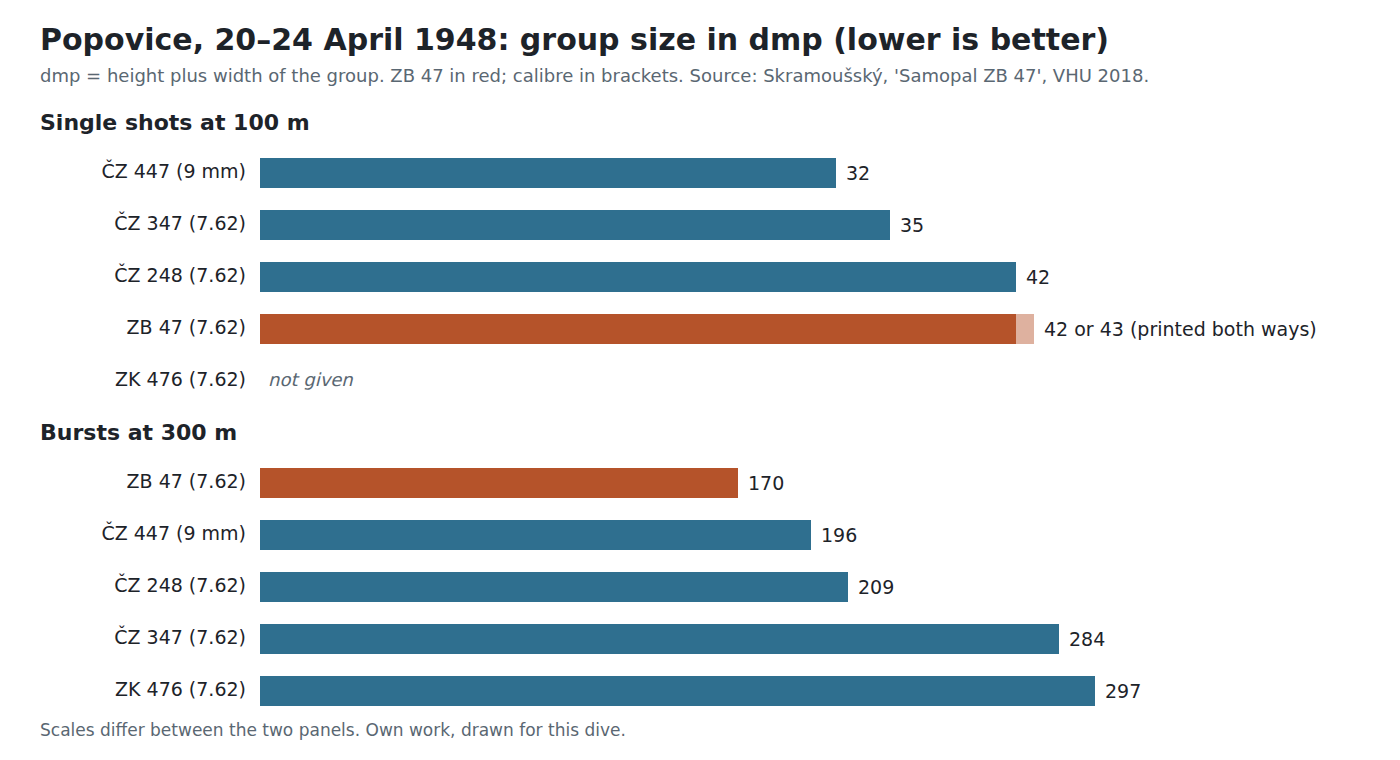
Skramoušský describes comparative firings on 20–24 April 1948 at the military unit in Popovice.1 The ČZ 248 and ZK 476 were tried in 7.62 mm with 350 mm and 300 mm barrels, and the shorter barrels grouped clearly better. Also fired were the ČZ 347 (the rotating ČZ 47/II reworked for Tokarev), a ZB 47 in 7.62 mm, and the ZK 476 in the Soviet calibre. A 9 mm ČZ 447 was fired alongside for comparison.
Dispersion was measured in dmp (demiperimetr), the height plus the width of the group, a unit no longer used.
Table 2 — The calibre question, April and May 1948
| Gun (calibre) | Single shots, 100 m | Bursts, 300 m |
|---|---|---|
| ČZ 447 (9 mm Para) | 32 dmp | 196 dmp |
| ČZ 347 (7.62 Tokarev) | 35 dmp | 284 dmp |
| ČZ 248 (7.62 Tokarev) | 42 dmp | 209 dmp |
| ZB 47 (7.62 Tokarev) | 42 or 43 dmp (see text) | 170 dmp |
| ZK 476 (7.62 Tokarev) | not given | 297 dmp |
Source: Skramoušský, VHU 2018, ZB 47 article. Values in the units printed there.1
The 100-metre figure for the ZB 47 cannot be stated as one number. In a single sentence the article gives the ČZ 248 and ZB 47 together as 42 dmp, and then says “the worst result appeared with the ZB 47: 43 dmp”.1 Both are reported here.
The 300-metre result is the most surprising number in the ZB 47’s record. In bursts at 300 m, the ZB 47 in Tokarev grouped better than the 9 mm ČZ 447, the gun that was about to win. Skramoušský’s word for it is “zcela neočekávaně”, entirely unexpectedly.1 Overall, the commission found the 7.62 mm guns much worse than the 9 mm ones, and “the idea of choosing the Soviet cartridge was then abandoned”.1
The ČZ 247 article places the ČZ 347’s comparative trials with the other Tokarev prototypes in May 1948, at the infantry school in Milovice.5 Either there were two events, or one of the two articles has the place and date wrong. Both are given here.
The irony became clear later. In May 1950 the MNO ordered the adopted 9 mm gun converted to 7.62 mm Tokarev, the cartridge the 1948 trials had rejected, because Czechoslovakia had agreed to adopt Soviet calibres. The result was the Sa 24 and Sa 26. VHU’s verdict is that the change “devalued … the best submachine gun of its time”.7
1.11 The verdict: vz. 48, then Sa 23
The trials, troop trials included, ran into the summer of 1948. “At their end the choice of a suitable type narrowed to the ČZ 447 submachine guns from Česká zbrojovka and the ZK 476 from Zbrojovka Brno. The MNO lost interest in the ZB 47, as in the other prototypes, and they never reached series production.”3
On 10 August 1948 the armament commission chose the ČZ 447. It proposed it for adoption as the “9mm samopal vz. 48a (pěchotní)”, the infantry version, and the “9mm samopal vz. 48b (výsadkový)”, the airborne version.7 Small Arms Review’s David Pazdera gives the same date for the approval.13 Production was authorised in February 1949, and the first 38 guns came from Uherský Brod in April. In spring 1950, for secrecy, the weapons were renamed samopal 23 and samopal 25. VHU stresses that these were cover names, not model designations. In all 200,005 were made before production stopped in early 1951.7
Two common English shorthands need correcting. Forgotten Weapons writes that the army adopted the “vz. 23”.12 The Czech record says the gun adopted was the ČZ 447, as vz. 48a and vz. 48b. It became the Sa 23 and Sa 25 only in 1950, and a palba.cz contributor adds that even then the correct form is “9 mm samopal 23/25” without “vz.”.710 The ZB 47 lost to a prototype that did not exist when its own troop trials began.
1.12 Offered abroad, sold nowhere
On 11 October 1947, while the ZB 47 was going out to the units, the main staff released both works to sell abroad. The order, as quoted by VHU, reads: “after considering the overall situation of the arms industry and its possibilities of placing products abroad, the main staff came to the conclusion that all types of submachine guns of Čs. zbrojovka Brno and of Česká zbrojovka in Strakonice and Uherský Brod may be released for promotion and sale abroad, i.e. to states to which the Foreign Ministry has no objection.” The ČZ 247 article adds the condition that the works offer the guns in the same form as for the trials.45
For the ZB 47, the result is summed up in one sentence: “Zbrojovka Brno did demonstrate and offer a number of them abroad, but without success.”1 No country is named. VHU’s companion article lists the guns Brno sent to Argentina’s 1947–1948 submachine-gun competition at Campo Mayo: the ZK 466 and two forms of the ZK 383, and in the second round the ZK 383 H and a ZK 476. The ZB 47 is not among them.4
The only documentary trace of a push abroad found for this dive is in the patent offices. Zbrojovka Brno filed its 1946 stock-magazine patent in Britain, France, Belgium and Switzerland in 1947 (Volume 2). No export customer, no named foreign demonstration and no foreign trial report was found.
The production total belongs to this period as well. “In all, in the years 1946–1948, it produced 62 examples of these structurally very unusual weapons.”1 This is the source of the “62” that Forgotten Weapons repeats. Volume 2 sets it beside the other figures: four ZB 46 and an order for 20 troop-trial guns.
1.13 Why it lost, in the army’s own terms
The record gives the reasons directly. Nothing has to be inferred.
- Too many parts, too hard to make. VTÚ “considered the ZB 47 too complicated to manufacture for it to be introduced”, and its high parts count told against it.1 The requirement of 18 July 1947 had asked for few parts and few man-hours, even in wartime.
- Too heavy. 3.69 kg empty and 4.41 kg loaded, against a ceiling of 3 kg.1
- Fragile where it mattered. The long magazine could deform, and so could the thin sheet housing around it, which would then refuse a magazine. “This was also later confirmed in the trials.”1
- Overtaken. The ZB 47 entered troop trials against the ČZ 247, but the competition was decided between two designs submitted in February 1948. Both had the bolt over the barrel and the magazine in the grip.6
The army’s complaints are not those of a failed idea. The units liked the 72-round capacity and the low prone profile, five of them by one count. The ZB 47 in Tokarev outshot the eventual winner at 300 m. What the army would not accept was a gun with this many parts that weighed this much and could be put out of action by a dent. The MP 40 dive shows the opposite trade a decade earlier, a design shaped from the start around presswork and few parts. The P90 dive shows a later answer to Holek’s problem: a high-capacity magazine laid along the gun so that it adds nothing below it.
Volume 2 describes the guns themselves, the variants, the experimental cylindrical cartridge, the production figures and the survivors. Volume 3 explains how the ratchet-wheel feed works.
References
Czech print sources not read (digitised but locked, or paper only; see README): Jiří Fencl, ATM 11/1990, p. 10; Jan Skramoušský, “Čs. experimentální náboj 9 mm”, Střelecký magazín 8/1999, pp. 26–28; Střelecký magazín 11/2004, pp. 52–53; Střelecká revue, 13 June 1980, pp. 1, 10–11; Miroslav Šáda, Československé ruční palné zbraně a kulomety (Naše vojsko, 2004), pp. 49–53; Lubomír Popelínský, Československé automatické zbraně a jejich tvůrci (Naše vojsko, 1999); Zdeněk Vimmer, “Československé samopaly ZB 47 a ZK 466” (place of publication not found).
Footnotes
-
Jan Skramoušský, “Samopal ZB 47”, Vojenský historický ústav Praha, https://www.vhu.cz/samopal-zb-47/ (published 2018-11-27; accessed 2026-10-19). Czech; translations in this volume are this dive’s own. Includes the 18 July 1947 meeting, the parts count, the internal trials, the troop-trial order and units, the verdicts, the Popovice firings, the production total and the specification box. ↩ ↩2 ↩3 ↩4 ↩5 ↩6 ↩7 ↩8 ↩9 ↩10 ↩11 ↩12 ↩13 ↩14 ↩15 ↩16 ↩17 ↩18 ↩19 ↩20 ↩21 ↩22 ↩23 ↩24
-
“Čs. samopal ZB 46”, VHU Praha, exhibit page, https://www.vhu.cz/exhibit/cs-samopal-zb-46/ (accessed 2026-10-19). The designers’ dates, the 27 March 1946 demonstration, the ZB 46’s layout, the three patents, serials 1003 and 1004, the February 1947 endurance trial, and the four ZB 46. ↩ ↩2 ↩3 ↩4 ↩5 ↩6 ↩7 ↩8 ↩9 ↩10 ↩11 ↩12
-
“Samopal ZB 47”, VHU Praha, exhibit page, https://www.vhu.cz/exhibit/samopal-zb-47/ (accessed 2026-10-19). Calibres tested, the paratrooper version, the end of the trials, serial 1032. ↩ ↩2 ↩3 ↩4
-
Jan Skramoušský, “Samopal ZK 466”, VHU Praha, https://www.vhu.cz/samopal-zk-466/ (published 2018-11-28; accessed 2026-10-19). The ZK 466 parts count, the 11 October 1947 export decree quoted, and the Argentine competition. ↩ ↩2 ↩3 ↩4 ↩5
-
Jan Skramoušský, “Samopal ČZ 247”, VHU Praha, https://www.vhu.cz/samopal-cz-247/ (published 2018-10-29; accessed 2026-10-19). The 20-gun orders, the overall assessment, the Sten Mk II origin of the rotating receiver, and the Milovice trials. ↩ ↩2 ↩3 ↩4 ↩5 ↩6 ↩7 ↩8 ↩9
-
Jan Skramoušský, “Samopal ČZ 447”, VHU Praha, https://www.vhu.cz/samopal-cz-447/ (published 2018-10-31; accessed 2026-10-19). Holeček, the 10 February 1948 meeting, the ČZ 447 univ., and the torture tests. ↩ ↩2 ↩3 ↩4 ↩5 ↩6 ↩7 ↩8
-
Jan Skramoušský, “9mm samopal 25”, VHU Praha, https://www.vhu.cz/9mm-samopal-25/ (published 2018-10-25; accessed 2026-10-19). The 10 August 1948 decision, vz. 48a/48b, the Sa 23/25 renaming, production totals, and the 1950 Tokarev decision. ↩ ↩2 ↩3 ↩4 ↩5 ↩6 ↩7 ↩8
-
Zbrojovka Brno, národní podnik, Samopal ZB 47 (1947), reprinted as Samopal ZB 47 Holek (Ofseta plus, 1997); scan at http://sa58kinggun.jansladky.cz/Podklady/Holek1.pdf (fetched 2026-10-19). Section II, description. ↩ ↩2
-
GB 502,782, “Cartridge feed mechanism for automatic firearms”, Československá zbrojovka akciová společnost, Brno; application No. 23393 of 8 August 1938, convention date 20 August 1937. Abstract as shown by Google Patents, https://patents.google.com/patent/GB502782A/en (read 2026-10-19 in a browser; no drawings available there). ↩
-
“sa58”, “Samopal ZB 47”, palba.cz forum article, http://www.palba.cz/viewtopic.php?t=3998 (2010-04-05, with replies; accessed 2026-10-19). Sources listed by the author: Šáda; Popelínský; the Zbrojovka Brno manual; Skramoušský, Střelecký magazín 8/1999; Vimmer. ↩ ↩2 ↩3 ↩4 ↩5
-
GB 625,789, “Improvements in automatic firearms”, Zbrojovka Brno, národní podnik; application No. 13163/47 of 15 May 1947, convention date 17 June 1946; published 4 July 1949. Abstract via Google Patents, https://patents.google.com/patent/GB625789A/en (read 2026-10-19). ↩
-
Ian McCollum, “ZB47: A Truly Weird Czech SMG”, Forgotten Weapons, https://www.forgottenweapons.com/zb47-a-truly-weird-czech-smg/ (2024-12-23; accessed 2026-10-18). Filmed at VHU. ↩ ↩2
-
David Pazdera, “Czechoslovak Model 48 Submachine Guns (SMGs 23 and 25)”, Small Arms Review V24N3 (March 2020), https://smallarmsreview.com/?p=43608 (accessed 2026-10-18). ↩
Comments (0)