Loading the .450 Bushmaster · Volume 4
Seating and Crimp Against a Single-Stack Magazine
The magazine is the binding constraint, the usual accuracy lever is unavailable, and the crimp everyone recommends is right for a reason nobody states correctly
Seating depth in most cartridges is a tuning variable. The loader has a specification at one end, a chamber throat at the other, and a working range in between within which they can move the bullet to find what the rifle likes. In .450 Bushmaster that range has been squeezed until it is barely a range at all, and the thing doing the squeezing is not the chamber. It is a magazine designed for a different cartridge.
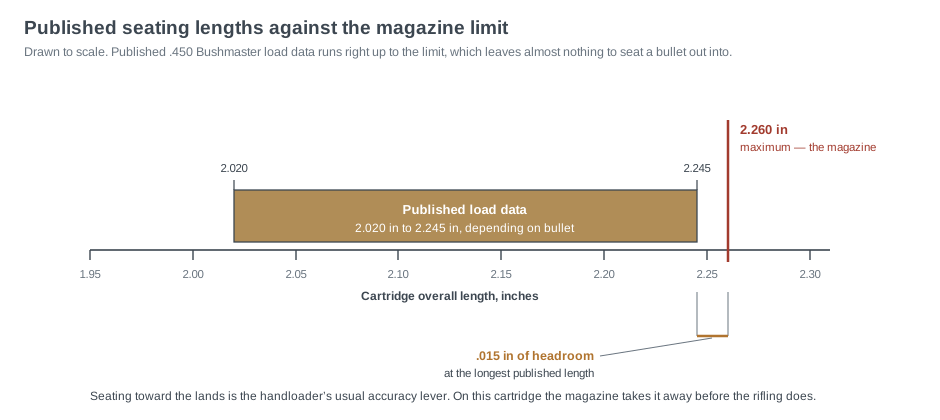
Two numbers describe the situation completely. Maximum cartridge overall length is 2.260 inches. The published load data occupies 2.020 to 2.245 inches, depending on bullet. The longest published seating in the entire body of data for the cartridge sits fifteen thousandths below the limit.
4.1 The Accuracy Lever That Is Not Available
The standard method for improving a rifle load, once powder and charge are settled, is to move the bullet toward the lands and test. The Reloading Bench’s Volume 20 sets out the method and the measurement it depends on — base to ogive rather than cartridge overall length, because overall length measures to a bullet tip that is not a controlled dimension. That method works because most cartridges have room in front of the bullet.
Here the room is gone. Anything at or near 2.245 inches has fifteen thousandths before it stops fitting the magazine, and 2.260 inches is not a target to be approached casually: it is a maximum, and a round built to it has no allowance for the tip variation Volume 20 describes, which on a soft-point or a polymer-tipped hunting bullet is itself worth several thousandths across a box.
The asymmetry is the part worth internalising. Seating deeper is always available. Seating longer usually is not. And seating deeper is not a free direction, because the case holds about 59.5 grains of water and is loaded with fast powders in the magnum-pistol and small-capacity-rifle class. Pushing a bullet further into a small case with a fast powder in it reduces the volume the charge occupies, which raises pressure. So the one seating direction the platform reliably permits is the one that moves pressure the wrong way, and it must be treated as a load change rather than as a length change.
That is a genuinely unusual position for a rifle cartridge and it reorders the development priorities. In .308 a loader tunes the charge coarsely and the seating depth finely. Here the seating depth is close to fixed by the magazine and the bullet chosen, and almost all of the available adjustment lives in the charge and the powder. A loader who arrives expecting to chase the lands will find that the lands are not the constraint and never were.
One further consequence is worth stating, because it looks like a loss and is not: the cartridge’s very slow rifling twist means that bullet stability is not a lever either. The AR-15 in .450 Bushmaster dive, Volume 2, explains why the slow twist is correct for short, fat, large-diameter bullets. What that means at the bench is that two of the three variables a rifle handloader normally plays with — jump and twist-matching — are closed off, and the remaining one, the charge, is the one with the thinnest published data behind it. Volume 5 is about that.
4.2 The Magazine Is a Different Machine
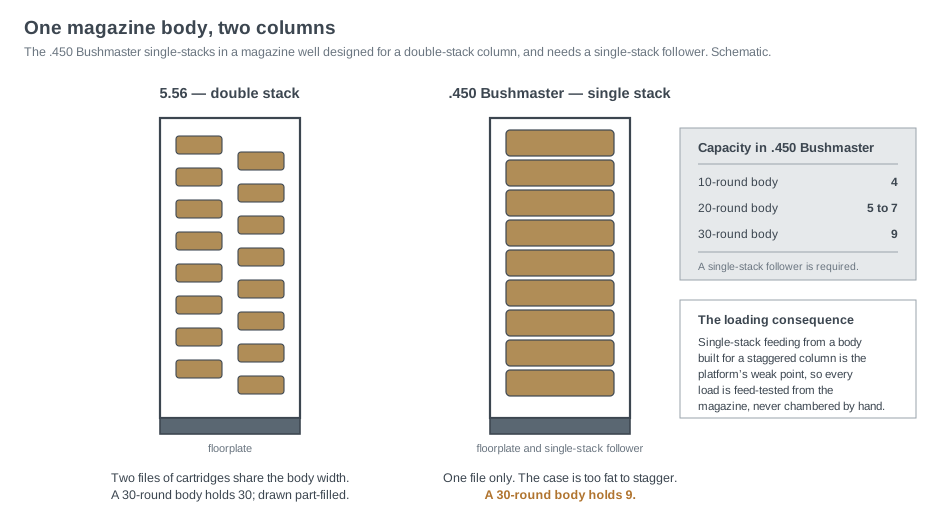
A .450 Bushmaster round is half an inch across the body and cannot stagger. It single-stacks in an AR-15 magazine body, in one vertical column, and it needs a single-stack follower cut for that column rather than the asymmetric double-column follower the body was designed around. Capacity falls accordingly: a ten-round body yields four rounds, a twenty-round body five to seven, a thirty-round body nine.
The rifle’s side of this is already covered in full and is not re-derived. The AR-15 in .450 Bushmaster dive’s Volume 4 treats the magazine problem from the rifle’s perspective — why the double-stack follower geometry fails, what nosediving and bolt-over-ride look like, which configuration the rifle documented there uses, and why the magazine that suits the rifle’s job happens to be the smallest one.
The load development consequence is what belongs here, and it is a single hard rule with a procedure attached.
4.3 Every Load Is Feed-Tested From the Magazine
A round that chambers when dropped into the chamber by hand has demonstrated nothing. Hand-chambering tests the chamber. Feeding tests the feed lips, the follower, the ramp angle, the bullet profile and the cartridge’s overall length all at once, and single-stack feeding from a body designed for double-stack is the platform’s known weak point. This is a rule, not a caution.
The procedure is short and should be run on dummy rounds first — no powder, no primer, assembled to the exact overall length and with the exact crimp under test, and marked so they can never be confused with live ammunition.
Load the magazine full. A round fed from the top of a full stack and a round fed from the last position see different spring force, different follower attitude and different feed lip geometry. Testing one round is testing one case out of four to nine.
Cycle the whole magazine slowly by hand, watching the round leave the lips and enter the chamber. This is where nosediving and tipping are visible. Do it a second time at speed, releasing the bolt from the catch rather than riding it, because a slowly closed bolt hides exactly the failures a released bolt produces.
Cycle the whole magazine again, ejecting each round instead of chambering it. A failure to feed and a failure to eject are different problems and a load can produce the second while passing the first, particularly with a long blunt bullet profile.
Measure the dummies afterwards. A round that has been chambered several times and measures shorter than it started has told you the crimp is inadequate, which is the next section. This is the cheapest setback test available and it costs one dummy round and a caliper.
Repeat the whole sequence with live ammunition before treating the load as settled, because a dummy weighs less than a loaded round and the stack behaves slightly differently under its own mass.
Repeat it for every change of bullet, every change of overall length, and every change of crimp setting. Not for every charge change — the charge does not alter the round’s shape — but any dimensional change invalidates the previous result.
4.4 Setback, and Why It Costs More Here
Setback is a bullet driven deeper into its own case by the feed cycle. The general mechanism and the general test belong to the Reloading Bench’s Volume 20, which covers neck tension, bullet pull, and why a crimp is not a substitute for either.
What makes it worse on this cartridge is a combination that has no equivalent elsewhere on a typical bench. The bullets are heavy — the published data runs from 200 to 395 grains — so the inertial force driving the bullet rearward as the round slams to a stop against the chamber is large. The case has almost no neck: there is very little brass gripping a half-inch-diameter bullet compared with a bottleneck cartridge of similar capacity. And the case is small, so a given amount of setback removes a larger fraction of the powder space than the same setback would in a .308.
The push test is the bench check: press the seated bullet firmly against a hard surface on the bench and measure the round before and after. A round that moves has failed. The chamber-and-extract check is the same test performed by the rifle, and it is the more realistic one — chamber a dummy, extract it, measure, and repeat ten times.
The operational rule that follows is worth stating in its own right: rounds that have been chambered and extracted repeatedly should be retired from the magazine rather than cycled indefinitely. On a hunting rifle this is not an abstraction, because the round at the top of the magazine is the round that gets chambered and unloaded at the end of every outing.
4.5 Crimp: The Right Answer, Reached by the Wrong Route
The question of what kind of crimp this cartridge takes has a settled answer in the field and a badly stated reason behind it, and the gap between the two is instructive enough to be worth working through properly.
The claim encountered in the research for this dive, from a discussion source, is that the .450 Bushmaster “headspaces on the rim, so roll crimping should not be used,” and that most die sets for the cartridge accordingly include a taper crimp die. The recommendation is right. The reason is wrong.
The rim cannot be the datum, because the rim is rebated. The case body is .500 inch and the rim is .473 inch — the rim is smaller than the body it sits under. A rebated rim stands proud of nothing and presents no annular face for a chamber to stop against; it exists so the cartridge can use a bolt face the industry already tools for, which the AR-15 in .450 Bushmaster dive’s Volume 2 sets out in full. It is a bolt-face dimension, not a headspace dimension.
The cartridge headspaces on the case mouth. That is established from the standard itself, in the sibling dive’s Volume 2, which places the .450 Bushmaster in the same block as the .30 Carbine — the other mouth-breeching straight-wall in the centerfire rifle standard. The Headspace dive’s Volume 11 covers what that classification means for a handloader in general terms, including the instruction not to roll a crimp into a mouth that is doing a headspacing job.
So the conclusion survives and the mechanism is replaced. A taper crimp is correct, and it is correct because the mouth is the datum surface and a roll crimp deforms it, not because the rim is a datum that must be protected. And the reason this matters rather than being a pedantic correction is that a wrong mechanism fails the moment a reader extrapolates from it. A loader who believes the cartridge headspaces on the rim will draw the obvious inference — that case length does not much matter, since the rim is doing the work — and that inference is not merely wrong, it is the exact inversion of the truth. On this cartridge case length is headspace. The wrong reason leads directly to the worst available trimming habit.
4.6 Why a Firm Crimp Is Needed at All
The crimp type is settled; the crimp being necessary is not in dispute and the reasons are all specific to this cartridge.
The bullets are heavy and the recoil is substantial. Rounds sitting in the magazine are subjected to a rearward acceleration on every shot fired, and a heavy bullet in a light case has the most inertia to resist. Bullet pull in the magazine — the opposite failure to setback, the bullet walking out — is the result.
The action is a semi-automatic that drives the round from magazine to chamber under spring force and stops it abruptly. That is the setback mechanism above.
Case neck tension alone is limited. A .452 bullet is gripped by a short length of case mouth on a case that is thin and tapered, and the grip available is less than a bottleneck cartridge’s neck provides.
Two constraints on how the crimp is applied follow from the cartridge rather than from general practice. The first is that crimp uniformity is length uniformity. A crimp die acts on the mouth at a fixed position relative to the shellholder, so a batch of mixed case lengths receives mixed crimps, which produces mixed bullet release and therefore mixed velocity. The Reloading Bench’s Volume 13 makes exactly this point about .450 Bushmaster in its trimming table and reaches a conclusion worth repeating: this is the cartridge that needs trimming least often, because at its low working pressure the case grows slowly, and simultaneously the cartridge where a sloppy trim shows up soonest, because the crimp depends on length. Trim rarely, but trim uniformly, and sort by measured length before crimping.
The second is that the crimp must not be pushed further in the belief that more is safer. Over-crimping is a real failure mode in its own right — it can cut a jacket, it can buckle a case, and it can make velocity less consistent rather than more by varying the release force round to round. On this cartridge it adds a third failure that the general treatment does not cover, and that is the next section.
4.7 Cannelured Bullets Are Close to a Requirement
A roll crimp turns the case mouth into a groove around the bullet, which requires a bullet with a groove to turn it into. A taper crimp does not. That much is general.
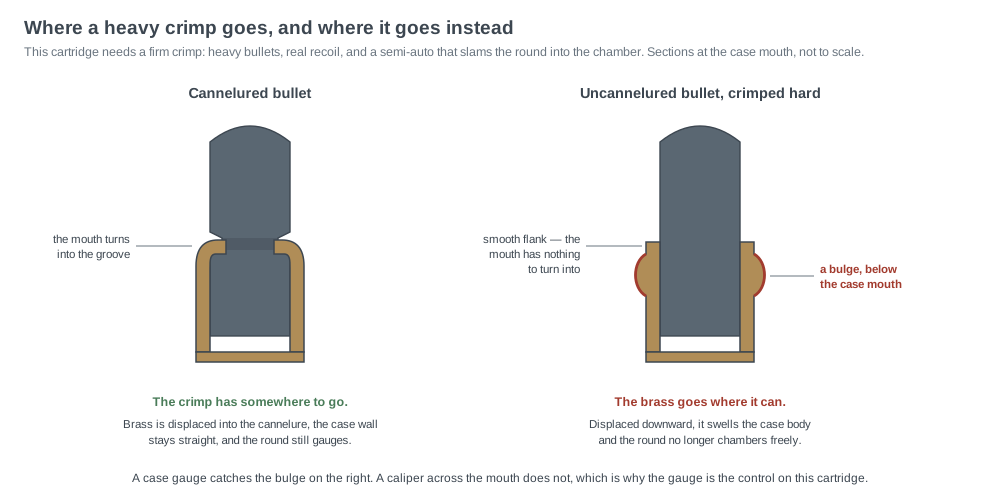
What is specific here is what a firm crimp does to an uncannelured bullet in this case. The brass at the mouth is being squeezed inward against a bullet that has no relief cut for it. The brass has to go somewhere, and where it goes is outward, immediately below the crimped band — the case bulges below the mouth. It is the same mechanism that punishes hard crimping of plated pistol bullets.
Three things make that bulge more serious on a .450 Bushmaster than on a .45 ACP target load.
It is a chambering failure, not a cosmetic one. The bulge sits on the largest-diameter part of a case that is already the largest-diameter thing the rifle handles, and it is exactly where the chamber has least clearance.
The rifle is a semi-automatic and will not tell the shooter about it gently. There is no camming handle to close on a tight round.
A caliper will not find it. Measuring at the mouth reads a mouth that is correctly crimped. The bulge is below the measuring point, and the case gauge described in Volume 3 is what catches it.
The practical upshot is that on a cartridge which genuinely needs a firm crimp, preferring a cannelured bullet stops being a preference and becomes close to a requirement. The cannelure gives the displaced brass somewhere to go, and it also fixes the crimp at a known position on the bullet rather than wherever the case length happens to put it.
4.8 The .452 Trap
.450 Bushmaster bullets are .451 to .452 inch, and the abundance of that diameter is the cartridge’s best handloading feature. The AR-15 in .450 Bushmaster dive’s Volume 6 makes that argument — the .452 is shared with the .45 Colt, .45 ACP, .454 Casull and .460 S&W Magnum, so a loader is buying into the deepest large-diameter component pool in North America, with more makers, more weights and better prices than a cartridge-specific diameter could offer.
That argument is about availability, and this is the other half of it.
The .450 Bushmaster and the .45 ACP share a bullet diameter and nothing else. A .45 ACP bullet leaves a pistol barrel somewhere under a thousand feet per second. A .450 Bushmaster’s published velocities are in a different class entirely — the sibling dive’s Volume 2 carries the figures and the important caveat that they come from barrels of three different lengths depending on who published them. What matters at the loading bench is only the ratio: a bullet designed to expand reliably at handgun velocity is being asked to arrive at roughly twice that speed.
The failure modes run in both directions. A soft handgun hollow point driven to rifle velocity may open violently and shed its jacket in the first few inches, which is a poor outcome on the game the cartridge exists for. A heavy solid or a hard-cast bullet intended for a revolver may hold together perfectly and expand not at all. And the interesting direction is the long one: a bullet designed for the .454 Casull or the .460 S&W Magnum is built for high velocity and heavy construction, and is a far better structural starting point than a .45 ACP bullet of the same weight.
The rule that falls out is simple and is a components question rather than a loading one: check the maker’s stated expansion velocity window against the velocity the cartridge actually delivers at the range intended. Most bullet makers publish that window. Most loaders buying on diameter and weight never look at it.
There is a load-development consequence too, and it is the bridge into Volume 5. Two bullets of the same weight and diameter but different construction do not behave the same in the case: a monolithic copper bullet is longer than a lead-core bullet of equal weight, which means more bearing surface and less powder space at the same seated length. In a cartridge with a dozen published tables that substitution is cross-checkable. Here it is not.
4.9 What a Bench Should Record
The three things this volume asks a loader to establish are all measurements that no publisher provides and that are specific to one rifle and one magazine:
The longest overall length that actually feeds from the magazine and follower in use — which is not 2.260 inches, is not published anywhere, and is the real upper bound on every load that rifle will ever fire.
Setback per chambering cycle, by crimp setting, measured on dummy rounds over ten cycles. This is the number that says whether a crimp is adequate, and it is measured in thousandths on a caliper.
Which bullets feed and which do not, by profile rather than by weight. Blunt is harder than pointed, and the difference is a property of the shape and the feed ramp rather than of the load.
All three are in the measurement list at the end of this dive.
Comments (0)