Loading the .450 Bushmaster · Volume 2
A Straight-Wall Shape and a Rifle Process
Twenty thousandths of taper, why no carbide sizer exists, and every consequence that follows from it
Pistol loaders are used to a particular bargain, and it is a good one. A straight-walled pistol case can be sized in a die whose working surface is a ring of tungsten carbide, and carbide is hard and slick enough that the case needs no lubricant. Dropping the lubricant step is what makes progressive pistol loading fast: no wax, no spray, no drying rack, no post-sizing tumble to get the lube back off. Cases go in dirty-ish and come out loaded, and the machine never stops.
The .450 Bushmaster looks exactly like a cartridge that bargain should apply to. It is short. Its walls are parallel to the eye. It takes a .452-inch bullet, which is the .45 ACP’s bullet. It works at a pressure that would be unremarkable in a magnum revolver. Every visual cue says this is a big pistol case.
There is no carbide sizing die for it, there never has been, and the reason is a dimension small enough to miss on a drawing and impossible to work around at the bench. The Reloading Bench states the fact in its Volume 9 and again in its Volume 12, and this volume does not present it as news. What follows here is the mechanism worked through to the end, because the mechanism is what determines the workflow — and because it is checkable by any reader holding a fired case and a carbide pistol die, without reference to anyone’s authority.
2.1 The Taper Is in the Standard’s Own Dimensions
The claim in circulation is that the .450 Bushmaster is “not a true straight-wall case” and carries “about .020 taper.” That claim reaches this dive through a forum post, which is a weak source for a dimensional assertion. It does not need to be taken on trust, because the industry standard’s own figures settle it.
The AR-15 in .450 Bushmaster dive, Volume 2, reads the cartridge and chamber drawing off the page image and prints the dimension table. Three of its entries are the relevant ones:
Table 1 — The AR-15 in .450 Bushmaster dive, Volume 2, reads the cartridge and chamber drawing off the page image and prints the dimension table. Three of its entries are the relevant ones
| Feature | Diameter |
|---|---|
| Base, at the head | .5000 in |
| Case mouth | .4820 in, with .4800 in also given on the drawing |
| Case length | 1.700 in |
Subtract. The case is between .0180 and .0200 inch larger in diameter at the head than at the mouth, depending on which of the drawing’s two mouth figures is taken, across a body 1.700 inches long. The forum’s “about .020” is not a rumour; it is a correct reading of the standard to within the ambiguity of which mouth dimension is meant.
Per side, that is nine to ten thousandths of an inch of fall over 1.700 inches — a slope of roughly one part in 170 to 190, or an included angle a little over half a degree. Put another way, about eighteen to twenty arcminutes per side.
That is why the taper is invisible. Half a degree is not something an eye detects on a piece of brass, and it is not something a caliper reveals unless someone deliberately measures the same case at two places and subtracts. The case reads as straight and is not.
2.2 Why a Carbide Ring Cannot Do It
A carbide sizing die is not a carbide die. It is a steel die body holding a ring of sintered tungsten carbide near the mouth, and that ring is the only part that touches the case. The ring is a through-bore of a single diameter with a radiused lead-in, and the case is drawn through it.
A bore of one diameter can only produce one diameter. Whatever length of case passes through the ring comes out cylindrical at the ring’s size, because there is nothing in the geometry that varies with axial position. To produce a taper, the die’s working bore must be a different diameter at every height, and a straight ring is by definition the same diameter at every height. This is not a limitation of carbide as a material — a taper can be ground into carbide — it is a property of the part that carbide dies are actually built from. No manufacturer tools a tapered carbide insert for this cartridge, and that is why every .450 Bushmaster sizing die on the market is a conventionally shaped steel die.
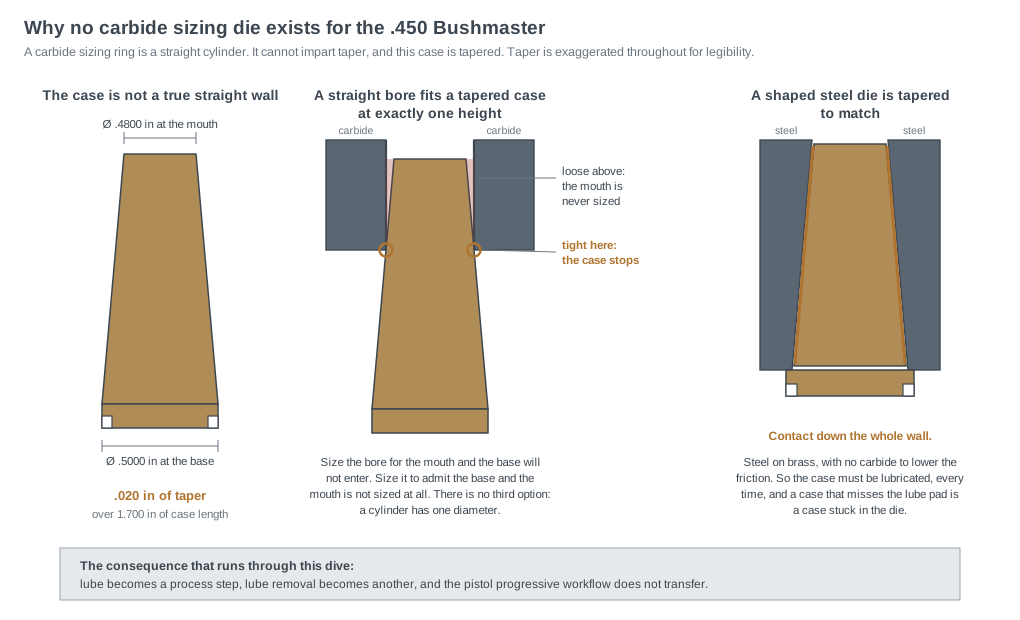
2.3 What a Straight Ring Would Do If One Existed
It is worth asking what would actually happen if someone did fit a straight carbide ring sized for this cartridge, because the answer shows that the taper is not a detail that could be quietly ignored.
A sizing ring has to be small enough to bring the largest part of the fired case back inside specification. On this case the largest part is the head end. A straight ring set to control the head would then also pass over the mouth end — which starts eighteen to twenty thousandths smaller — and would do nothing there at all, leaving the mouth end unsized and the neck tension unmade.
A straight ring set to control the mouth would be the more dangerous arrangement. It would reduce the head end of the case by the full amount of the taper. That is the thickest and most work-hardened brass on the case, sitting directly over the web, and it is the part that has the least reason to be moved. The result would be a cylindrical case being pushed into a tapered chamber, which is a different fit from the one the chamber was cut for.
Neither is a compromise a die maker would ship, and neither is a problem a loader could work around by choosing a different lubricant or a stronger press. The only correct tool is a die whose bore falls away as the case goes in, and that die is steel.
2.4 How Much Surface Is Being Drawn
The second half of the mechanism is the part that explains why this chambering is not merely a case that needs lubricant but the one most likely to punish a loader who forgets. Sizing is a drawing operation, and the force required scales with the area of brass in contact with the die.
Treating each case as a truncated cone and taking published nominal dimensions, the sized surface works out roughly as follows. The figures are first-order arithmetic from the dimension tables, not measurements: they use mean diameters, take the full case length, and ignore the extractor groove and the radius at the head. They are useful for comparison, not as specifications.
Table 2 — How Much Surface Is Being Drawn
| Cartridge | Case length | Head dia. | Mouth or shoulder dia. | Approx. sized surface | Carbide sizer | Lubricant |
|---|---|---|---|---|---|---|
| 9 mm Luger | .754 in | .391 in | .380 in | ~0.9 sq in | yes | none |
| .40 S&W | .850 in | .424 in | .423 in | ~1.1 sq in | yes | none |
| .45 ACP | .898 in | .476 in | .473 in | ~1.3 sq in | yes | none |
| .450 Bushmaster | 1.700 in | .500 in | .482 in | ~2.6 sq in | none made | every case |
| .308 Winchester (body) | 1.56 in of body | .4709 in | .4539 in at the shoulder | ~2.3 sq in, ~2.6 with the neck | not applicable | every case |
The comparison is the argument. The .450 Bushmaster presents roughly twice the sizing surface of a .45 ACP and nearly three times that of a 9 mm — and about as much as the whole of a .308 Winchester case. It looks like the cartridges in the top three rows of that table. Dimensionally, in the only respect that matters to a sizing die, it belongs in the bottom two.
So the friction load is a rifle cartridge’s, the die material is steel rather than carbide, and the case has the largest diameter on the bench. Those three things stack in the same direction. This is the reason the general advice about lubricant, which The Reloading Bench Volume 12 gives properly, has less margin here than anywhere else: an under-lubricated .45 ACP in a carbide die is a slightly stiff stroke, and an under-lubricated .450 Bushmaster in a steel die is a seizure waiting for a dry patch.
2.5 Therefore Lubricant, on Every Case, Every Time
The conclusion is not a refinement or a best practice. It is a process step with the same standing as seating a primer.
Steel-on-brass, run dry under drawing pressure, does not merely resist — it galls. Brass transfers onto the steel, the transferred material becomes a high spot, the high spot picks up more brass, and what began as friction becomes cold welding. That is the mechanism by which a case seizes in a die rather than simply requiring a harder pull, and it is also why a die that has stuck one case is more likely to stick the next until it has been cleaned properly.
Two rules follow, and both are absolute rather than graded:
Every case is lubricated. Not most, not the ones that feel tight. A batch is only as lubricated as its worst case, and the worst case is the one that stops the session.
The lubricant is removed afterwards. It is a step, not tidiness, and on this cartridge it carries a specific extra consequence that Volume 3 develops: a case that stops on its own mouth is unforgiving of anything left in the chamber.
The Reloading Bench Volume 12 covers the delivery systems — wax, pad, spray, dry film — and their trade-offs, and none of that is repeated here. What is specific to this cartridge is coverage rather than product choice. Two and a half square inches of large-diameter body is a lot of surface to wet evenly, and the failure mode of a pad or a quick spray is a dry band rather than a dry case. A case with a lubricated mouth end and a dry head is exactly the case that seizes, because the head end is where the die is doing the most work.
2.6 What the Sizing Die Does and Does Not Control
Having established that the die must be conventional shaped steel, it is worth being precise about what that die is actually responsible for, because the answer is narrower than a rifle loader will expect and it removes several familiar techniques from the bench.
There is no shoulder, so there is no bump. On any bottleneck cartridge the central adjustment of a full-length sizing die is how far back it pushes the shoulder, and the entire vocabulary of rifle die setting is built on it — the Headspace dive gives that method in its Volume 10, with the measurement, the amount, and the variables that move a setting without anyone touching it. None of it applies here. This case has no shoulder to move. The sizing die is screwed down to contact the shellholder in the ordinary way and there is no second parameter to dial.
There is no neck, so there is no neck sizing. Neck-only dies, bushing dies, partial sizing and the whole family of techniques a precision rifle loader uses to work brass less and make it last longer depend on a case having a neck distinct from its body. This case has a mouth, not a neck. Every sizing operation is a full-length operation on the whole body, every time.
That second point is the one with teeth, and it deserves stating plainly because it cuts against an assumption a reader is likely to carry in. It is often said that a straight-wall case at modest pressure should give long brass life, and the reasoning behind that is sound as far as it goes. But the brass-saving levers that a rifle loader would normally reach for are not available on this cartridge at all. There is no option to size only part of the case, no option to leave the body alone, no option to work the brass less this firing than last. Volume 3 returns to what that means for case life, and to the fact that no published life figure for this cartridge could be found.
What the die does control is diameter — and nothing about headspace. The sizing die sets the body’s diameters and, through the expander, the mouth’s inside diameter. What it cannot touch is the dimension the round actually stops on, because on this cartridge that dimension is case length. The headspace-critical dimension on a .450 Bushmaster is set by the trimmer, not by the sizing die. That inversion is the single most useful thing to carry out of this section: on a bottleneck cartridge the die sets headspace and the trimmer is housekeeping, and here it is the other way round. The Headspace dive, Volume 11, is where that principle is derived; the point here is only where it lands in the sequence of operations at the bench.
A last, mundane consequence of the geometry. A .473-inch rim needs the same shellholder family as a .308 or a .30-06, not a pistol shellholder, and a case head half an inch across with two and a half square inches of body being drawn through steel is felt at the handle. A press that is entirely comfortable with 9 mm will run this cartridge with a noticeably heavier stroke. That is the correct behaviour rather than a symptom, but it is worth expecting, because the temptation on an unexpectedly stiff stroke is to push harder — and pushing harder through a dry patch is how a case comes apart in the die.
2.7 Why This Cartridge Belongs Off the Progressive
The Reloading Bench reaches this conclusion from the press side, in its Volume 8, and keeps .450 Bushmaster on the precision press rather than the bulk one. The same conclusion follows independently from the case, and the case-side argument is the more general of the two.
A progressive press is a machine for removing handlings. Its throughput advantage comes from performing several operations per stroke so that a case is picked up once and put down once. Lubrication and lube removal cannot be folded into the stroke. Whatever the machine does, someone has to wet every case before it goes in and get the lubricant off every case after it comes out, and those are two handlings that the progressive was bought to eliminate. Most of the advantage is gone before the first stroke.
Spray lubricant and an open powder measure are a bad pairing. On a progressive the charged case is open at the top for several stations. Lubricant near that station is lubricant that can reach powder and primers, and contaminated powder is not a recoverable error — it is a batch thrown away, or worse, a batch not thrown away.
A stuck case on a progressive is an expensive stop. On a single-stage press a seized case ruins an evening: back the ram down, find the removal tool, tap, drill, thread, draw the case out, clean the die. On a progressive it does the same to a die that is mounted in a toolhead alongside four other dies whose settings are the reason the toolhead exists, in the middle of a production run with cases at every station. Since this is the chambering most likely to produce a seizure, putting it on the machine where a seizure costs the most is the wrong allocation.
The quantities do not justify it anyway. This is a cartridge that gets loaded in tens and hundreds, for a hunting rifle with a four-round magazine, from a component pool that offers one or two published tables per bullet. It is not the cartridge whose volume pays for a toolhead and a conversion.
The correct machine is a single-stage or a turret, alongside the bottleneck cartridges it actually resembles — and that recommendation, reached from the shape of the case, is the same one The Reloading Bench reaches from the shape of the press.
2.8 The Taper Is Not a Defect
It would be easy to read all of this as a design oversight: a cartridge that could have been drawn with parallel walls, and would then have been carbide-sizeable and pleasant to load. That reading is wrong, and correcting it is worth a paragraph because it changes how a loader thinks about the case.
Body taper is a deliberate feature in cartridge design, and its job is at the other end of the cycle. A tapered case begins to break free of the chamber wall as soon as it moves rearward at all, because any rearward motion immediately opens clearance around the whole body. A parallel case has to slide the full length of its own contact area under whatever friction remains. On a semi-automatic rifle, where the case is extracted while the chamber is still hot and the primary extraction stroke is short and violent, that difference matters. Taper is one of the standard answers to hard extraction, and it is not an accident that the most notably tapered service cartridges are found in gas-operated rifles.
The .450 Bushmaster is chambered in an AR-pattern semi-automatic. The taper that denies the handloader a carbide die is the same taper that helps the rifle extract, and the trade is one the cartridge’s designers were entitled to make. It is a handloading cost paid for a shooting benefit.
2.9 The One Pistol-Like Step That Survives
Everything above says the process is a rifle process. One step is the exception, and it is worth flagging because it is the step where a pistol habit is correct and a rifle habit is not.
A straight-walled case seating a flat-based bullet needs its mouth opened slightly, or the sharp edge of the case shaves jacket or lead off the bullet as it enters. Bottleneck rifle cases do not generally need this, because the expander ball on the decapping stem has already set the neck’s inside diameter and the bullet is usually boat-tailed. Straight-wall cases do, and whether the job is done by a separate expander die or by the expander on the sizing die’s stem depends on the set.
That step has a consequence unique to this cartridge, and it is the reason it belongs in this volume rather than being left to Volume 4. The mouth of a .450 Bushmaster case is the headspace datum. Opening it and then closing it again during seating and crimping means deliberately working the surface that the round stops on. The AR-15 in .450 Bushmaster dive, Volume 2, and the Headspace dive, Volume 11, both establish why that surface deserves care; the point here is simply that the pistol-derived belling habit is one of the very few pistol habits that transfers, and that even this one arrives with a rifle-cartridge caveat attached.
2.10 Checking It at the Bench
None of the above requires taking anyone’s word for it, and the check takes two minutes with tools already on the bench.
Measure one fired case at two heights. Put a caliper across the body just forward of the extractor groove, then across the body just behind the mouth, and subtract. Read the difference rather than the absolute numbers — a caliper on a curved surface is an imperfect instrument, but the difference between two readings taken the same way is reliable enough to show eighteen or twenty thousandths. A fired case has expanded to the chamber, and the chamber is tapered too, so the reading is a fair one.
Look into a carbide pistol die. Hold it up to a light with the decapping stem out. The carbide ring is visible as a band of different colour near the mouth, and the bore through it is plainly a cylinder. There is nowhere for a taper to be.
Then look into the .450 die. There is no ring, because there is no insert; the sizing surface is the steel of the die body itself, shaped along its length.
That is the entire argument, and it is visible in the parts. The rest of this dive is consequences: Volume 3 takes the lubricant, the stuck case and case life; Volume 4 takes seating and crimp against a magazine that is the cartridge’s real constraint; Volume 5 takes the thinness of the published data, which is a different kind of problem and an equally practical one.
Comments (0)