E-11 Stormtrooper Blaster · Volume 3
Donor Firearm Provenance — Sterling Mk 4 / L2A3
Patchett origin, Sterling production 1944–1988, variant catalog, legal status by US donor flavor, UK demil + US import, and the Bapty 1976 props
3.1 Contents
(Generated by build/inject_toc.py at build time. Section headers below are the source of truth.)
Correction (2026-10-24): § 3.2 gave “400,000+” Sterlings as fact; the maker’s 1984 handbook says more than 2 million Mark 4s, and both figures are now shown. Also, the § 3.3 variant table paired the wrong Mark numbers with the British designations and mis-described two variants. Sterling’s own nomenclature table (Mk 4 user handbook, history pages signed “DTEH 1984”) gives Mark 2 = L2A1, Mark 3 = L2A2, Mark 4 = L2A3; the table had Mk 3 = L2A1 and a “Mk 3 (refined)” = L2A2. The Mark 7 Para Pistol went into production in late 1983, not “post-1985”, and the Mark 8 is a closed-bolt, semi-automatic police carbine, not “various commercial refinements”. The same maker’s text dates the L2A3 adoption to 1954 and the L2A1/L2A2 to limited production between 1951 and 1953, against the 1953 / 1955 / 1956 dates § 3.1 gave; that conflict is set out in § 3.1 rather than resolved.
This volume is the canonical Sterling-platform reference for the E-11. It is also — at scaffold time — the canonical Sterling reference for the hub generally, until or unless a second Sterling-based prop is scaffolded and the Sterling earns its own real-firearm subdirectory (Sterling_L2A3/) parallel to the Mauser C96 dive. Future Sterling-derived prop builds in this hub will cross-link here for the donor questions — variant identification, legal status, demil-vs-active posture — rather than re-deriving them.
Three things go into this volume: the provenance (where the Sterling came from, who designed it, how it ended up in British Army service for thirty-five years), the variant catalog (what flavors of Sterling exist and which one the E-11 was built from), and the donor flavor map (how a US builder’s three legally-distinct paths to a Sterling — semi-auto clone, parts-kit / 80%-receiver, Class III registered transferable — connect to the historical platform). Full legal posture for each flavor is Vol 10’s job; this volume gives the donor-side reality the builder needs to choose a path.
3.2 The Patchett origin
The Sterling SMG begins with George William Patchett, a British engineer working at the Sterling Engineering Company (later Sterling Armaments Company) in Dagenham, Essex. Patchett designed a 9 mm sub-machine gun in 1942 as a wartime replacement candidate for the STEN — the STEN was cheap and effective but crude, prone to accidental discharge if dropped, and the British Army wanted something more refined for the post-Normandy era. Patchett’s submission to the General Staff was a tube-receiver gun with a curved 34-round side-feed magazine (heavily inspired by the German MP 28), a folding wire stock, and a more sophisticated trigger / sear arrangement than the STEN’s slot-and-bolt design.
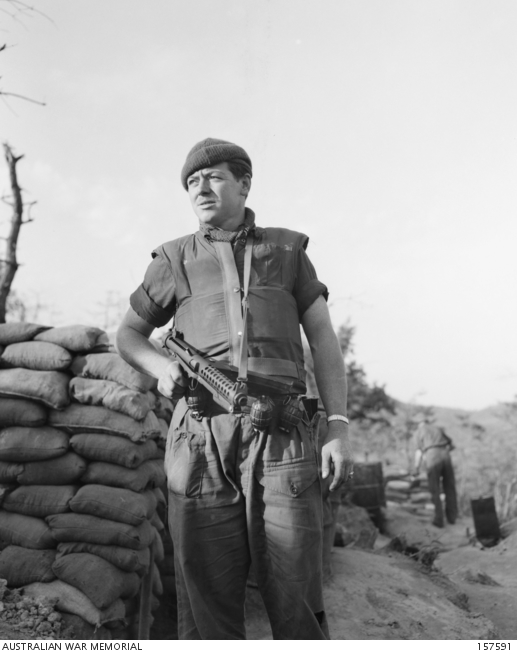
A small number of Patchett SMGs reached troops in combat. The most-cited deployment is Operation Market Garden (September 1944) — the Arnhem airborne operation — where Patchett prototypes were carried by elements of the 1st Airborne Division. The number is small (estimates run from a few dozen to about 120, depending on source) and the historical record is patchy. What is well-attested is that Patchett prototypes were in front-line combat hands during 1944 and that the design survived the war intact at Sterling.
After the war the design was refined at Sterling Armaments over the late 1940s and early 1950s. The British Army’s General Staff ran adoption trials in the early 1950s; the Patchett-Sterling design won against competing designs from BSA and Andrews. The L2A1 and L2A2 came first, then the L2A3, the definitive British Army Sterling, and that is the variant the rest of this volume calls home.
The dates are not settled here. Sterling’s own history, printed in its Mk 4 user handbook and signed “DTEH 1984” (D.T.E. Howroyd, the company’s Works Director), says the gun was “adopted as the standard weapon for HM Forces as the Sub Machine Gun 9mm L2A3 in 1954”, and that “L2A1 and L2A2 were earlier versions made in limited quantities between 1951 and 1953.” Earlier editions of this volume gave 1953 for the L2A1, 1955 for the L2A2 and 1956 for the L2A3, without a recorded source. The maker’s sentence may compress trials, approval and issue into one year, and the fuller chronology is in the 2020 company history (Laidler, Edmiston and Howroyd, A History of the Small Arms made by the Sterling Armament Company), which was not read for this volume. Both sets of dates are reported; neither is preferred.
3.3 Sterling Armaments production — 1944 to 1988
Sterling Armaments Company manufactured the gun in Dagenham (then in greater London / Essex) from 1944 (Patchett prototypes) through to 1988, when the factory closed as the British Army transitioned to the L85A1 SA80 bullpup rifle and the Sterling went out of front-line UK service. How many were made is disputed. Sterling’s own 1984 handbook says “More than 2 million Mark 4’s have been made”; secondary sources (Dillon’s Blue Press, 2011, and the English-language Wikipedia) give about 400,000 Sterlings, without a stated source. The maker’s figure comes from a sales handbook and may count licensed production in India and Canada. Neither is adopted here; the Sterling Mk 7 dive, Volume 1 sets out both. Production also took place under license:
- India — Indian Ordnance Factories Board produced the 1A1, a near-clone of the L2A3, from the late 1950s. Indian production continued past 1988.
- Canada — Canadian Arsenals Limited produced the C1 (L2A3 equivalent) and C2 (heavy-barrel automatic-rifle role), supplying the Canadian Forces and police agencies.
- Other licenses / Sterling-pattern production — various Commonwealth and Middle Eastern users (Australia in small numbers, several Gulf states) acquired Sterlings or Sterling-pattern guns.
The vast majority of Sterlings that reach the US civilian market today are UK service-pull L2A3s, demilled at one of the UK demil facilities and imported as parts kits — see § 3.6.
3.4 The variant catalog
Sterling Armaments numbered their commercial variants with Mk designations; the British Army used L numbers. The two systems run in parallel. The complete Sterling family is broader than most builders need to know, but the variants worth keeping in mind are:
Table 1 — Sterling Armaments numbered their commercial variants with Mk designations; the British Army used L numbers. The two systems run in parallel. The complete Sterling family is broader than most builders need to know, but the variants worth keeping in mind are
| Variant | British designation | Year | Distinguishing feature | Relevance to the E-11 |
|---|---|---|---|---|
| Patchett (Sterling SMG Mk 1) | SMG Patchett 9 mm | 1942–1944 | Original Patchett SMG; combat-issued in small numbers | Historical interest; not on the donor market |
| Mk 2 | L2A1 | 1951–1953 (maker: limited quantities) | First British designation | Pre-L2A3 collector piece |
| Mk 3 | L2A2 | 1951–1953 (maker: limited quantities) | Second British designation | Pre-L2A3 collector piece |
| Mk 4 | L2A3 | 1954 (maker) or 1956 (other references); see § 3.1 | The definitive British Army Sterling — the canonical Sterling SMG | Yes — this is the E-11 donor |
| Mk 5 | L34A1 | 1966 | Silenced variant (integral suppressor, ported barrel) | Different silhouette; not E-11-compatible without major rework |
| Mk 6 | — | not dated in the maker’s text | Semi-automatic carbine, identical in appearance to the Mk 4 except a barrel lengthened to meet US regulations; made for the US civilian market | Period-correct for some semi-auto Sterling clones |
| Mk 7 | — | late 1983 | Para Pistol: A4 and A8 (open bolt, single shot or automatic; 4 in and 7.8 in barrels) and the closed-bolt, semi-automatic Pistol C4 and C8 | Not E-11-compatible (shorter casing, no folding stock geometry) |
| Mk 8 | — | not dated in the maker’s text | Carbine for police use: closed bolt, semi-automatic only, with scope-rail locating buttons | Out of scope for screen-accurate E-11 |
Mark numbers, British designations and the Mk 6, Mk 7 and Mk 8 descriptions are from Sterling’s “Comparative reference numbers and nomenclature” table and history pages in the Mk 4 user handbook (DTEH 1984). The Mk 5 date and the Patchett dates are not from that source.
The Mk 4 / L2A3 is the only variant a screen-accurate E-11 build should target. Other Sterlings are visually distinct enough — silencer can on the Mk 5, shorter receiver on the Mk 7 / Para — that they read wrong on screen.
3.5 The L2A3 / Mk 4 specifically
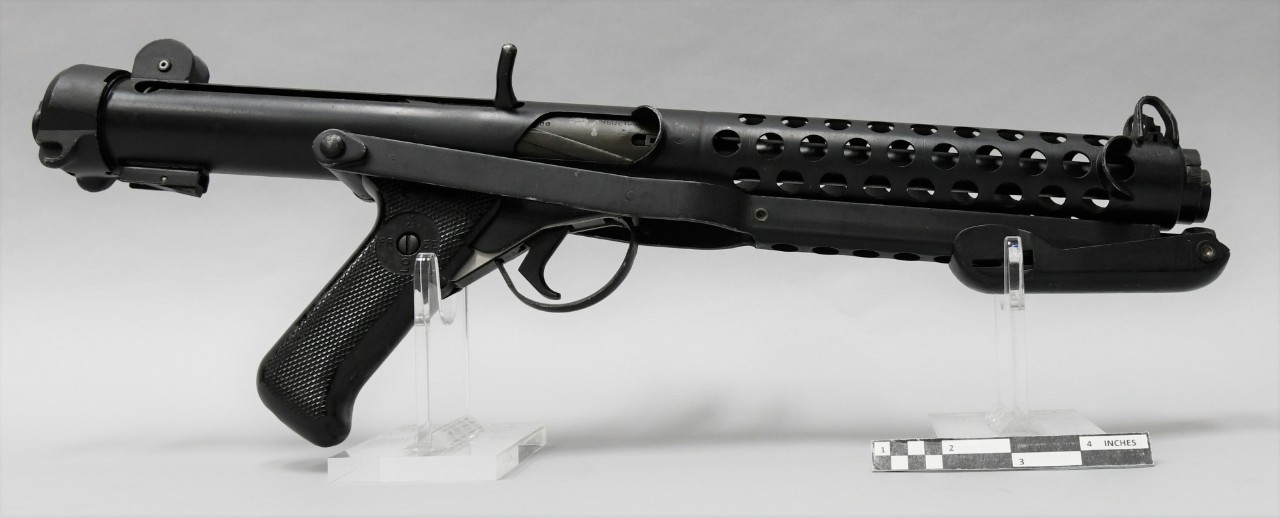
The L2A3 / Sterling Mk 4 has these factory specifications — every one of them is inherited by an authentic-donor E-11 build:
Table 2 — The L2A3 / Sterling Mk 4 has these factory specifications — every one of them is inherited by an authentic-donor E-11 build
| Specification | Value |
|---|---|
| Caliber | 9×19 mm Parabellum |
| Action | Open-bolt, blowback, select-fire (semi / full-auto) |
| Cyclic rate | ~550 rpm |
| Magazine | Curved 34-round side-feed (left side) |
| Barrel length | 198 mm (7.8″) |
| Overall length, stock extended | 690 mm (27.2″) |
| Overall length, stock folded | 481 mm (19″) |
| Weight, empty | 2.7 kg (6.0 lb) |
| Receiver | Wrapped + welded sheet steel tube, ~38 mm OD, with the helical cooling-hole pattern |
| Stock | Folding wire stock, hinged left-side |
| Sights | Hooded blade front, flip aperture rear |
| Markings (military) | “STERLING SMG”, L2A3 + serial, broad arrow (UK government ownership), proof marks |
The wrapped + welded sheet-steel receiver is the defining manufacturing characteristic. Sterling rolled a flat steel blank into a cylinder, welded the seam closed, and then drilled the helical cooling-hole pattern. This receiver geometry is what every Path C from-scratch build needs to reproduce in the lab — and it is the reason Path C is genuinely on the table for a sheet-metal-capable lab (Vol 6).
The bottom-mounted fire-control housing — cast aluminum on the L2A3, containing the trigger group, pistol grip, and magazine well — is the second-most-distinctive feature. The fire-control housing attaches to the receiver via lugs on the underside; it is not welded or pinned, but bolted, which is one of the things that distinguishes the Sterling from the more crude STEN.
3.6 Legal status by US donor flavor
A US builder approaching an E-11 has three legally-distinct paths to a Sterling. Each is a different posture under federal (and state) law:
3.6.1 Flavor A1 — Semi-auto Sterling clone (Wise Lite / IO Inc)
Wise Lite Arms (Texas) and Indianapolis Ordnance Corp. (Indiana) manufacture US-made semi-auto rifles on the Sterling platform — Sterling-pattern receivers (US-made), Sterling-pattern small parts (mix of US-made and 922(r)-compliant imports), and Sterling-pattern fire-control housings re-engineered around a closed-bolt semi-auto sear.
Federally these are Title I rifles, not NFA items. They are not Sterlings under federal law — they are US-made semi-auto rifles styled like Sterlings. State laws vary substantially:
- “Assault weapon” states (CA, NY, NJ, MA, HI, CT, MD) may classify a Sterling-clone semi-auto rifle as a regulated assault weapon by feature list (pistol grip + folding stock + threaded barrel + magazine capacity).
- Some states impose magazine-capacity limits below the Sterling’s factory 34-round mag (CA 10, NY 10, MA 10, NJ 10).
Vol 10 § 10.2 has the state-by-state matrix. For Vol 3’s purposes: Path A1 is the most-practical US donor — semi-auto, available, range-capable — but state-of-residence rules must be cleared before purchase.
3.6.2 Flavor A2 — Sterling parts-kit on a US-made 80%-receiver host
The Sterling parts-kit market is supplied by demilled UK Sterling parts kits imported through US dealers (Royal Tiger Imports, Apex Gun Parts, and others). A parts kit ships with: a Sterling fire-control housing, fire-control parts, the bolt, the magazine, the folding stock, and a demilled (cut) receiver tube — the receiver is cut transversely to render the original firearm “destroyed” under US import-law definitions.
The builder then sources a US-made 80% or 100% semi-auto Sterling-pattern receiver (Wise Lite spec is the canonical) and assembles the parts kit onto the US receiver. 922(r) parts-count compliance applies: a US-made semi-auto rifle built from imported parts must contain no more than 10 imported “regulated parts” (as defined in 27 CFR § 478.39 and the implementing list). Sterling parts kits typically need 5–7 US-made substitutions — the receiver itself, the magazine body, the trigger, the hammer, etc. — to land at 10-or-fewer imported parts.
Vol 4 § A2 documents the build. Vol 10 § 10.4 documents the 922(r) count.
3.6.3 Flavor A3 — Class III registered transferable Sterling SMG
A fully-transferable registered Sterling SMG — full-auto, NFA Class III, with a transferable ATF registration tag dated before May 19, 1986 (the Hughes Amendment closure date) — is the most authentic and most expensive donor.
Federal posture: NFA Class III machine gun. Transfer is via ATF Form 4 through a Class III dealer or to a qualified individual transferee; the transferee must be in a state that permits civilian ownership of registered machine guns (most states do; CA / NY / NJ / MA / HI / IL / DC do not, or only by special license).
Market: limited supply because the Hughes Amendment closed new civilian registrations in 1986. Sterlings registered before 1986 trade on the C&R / NFA secondary market; pricing has tracked the broader transferable-MG market and currently runs $30,000 to $50,000+ for a clean Sterling with a registered tag, depending on configuration and condition.
For an E-11 build this is the most authentic donor (it is a real Sterling, in active configuration, with the original receiver and markings) and the highest legal complexity. Most E-11 builders never see this flavor; it is documented here and in Vol 4 § A3 for the rare collector who comes to the project with a transferable Sterling already in hand. Vol 10 § 10.3 has the full NFA posture.
3.7 UK demil + US import reality
The Sterling parts-kit market exists because the UK demilled its Sterlings in bulk as it cycled them out of service. Most Sterlings that reach the US market are UK service-pull L2A3s demilled to UK 1995 / 2007 / 2017 standards (the standards have been progressively tightened) and imported as parts kits.
UK demilitarization standard for SMG-class firearms:
- Receiver cut transversely (typically through the magazine well)
- Bolt face / firing pin permanently obstructed
- Barrel chambered and welded plug at chamber
- Trigger and sear may or may not be rendered inoperable depending on demil cohort
Under US federal law (27 CFR § 478.11 definition of “firearm”), the demilled receiver — once cut beyond functional restoration — is no longer a firearm. The parts kit can be imported and resold as parts.
State import / possession rules vary. California specifically restricts possession of certain demilled SMG parts; state law should be verified before buying a parts kit in any regulated state.
The import dates matter for a couple of reasons:
- Earlier import cohorts (1990s, 2000s) have generally been more lightly demilled and may have more usable original parts (matching numbers, less butchered receivers).
- Recent cohorts (post-2015) have been demilled to tighter standards and may have less usable parts.
- Some pre-1986 imports were brought in not as parts kits but as live Sterlings; those that were registered with ATF before May 1986 are now transferable Class III items — Flavor A3.
For builders: any current parts-kit purchase is going to be a recent-cohort UK demil. The receiver is unusable as a firearm; the rest of the kit is the build’s starting material.
3.8 The Bapty & Co. 1976 production Sterlings
The Sterlings used in A New Hope (and through the rest of the OT) came from Bapty & Co., the London-based film-industry armorer. By 1976 Bapty had an established inventory of Sterling SMGs — most likely deactivated UK-spec L2A3s acquired as the British Army began cycling out individual examples. UK deactivation in the 1970s was less strict than modern UK demil — a Bapty Sterling from that era would have had the firing pin removed, the barrel obstructed, and the bolt face possibly altered, but the receiver tube and external geometry were intact.
This is why the Bapty hero E-11s read so cleanly as “real Sterlings” on screen — they were. The internal action was inert; the external geometry was factory L2A3. The greeblies — scope rail, scope pod, M38 tube, Hengstler counter (on some pieces), Sandtrooper T-track and pouch — were added on the outside, bolted to the receiver and the fire-control housing.
A few of these Bapty hero pieces survive:
- The Museum of Pop Culture (Seattle, formerly the EMP Museum) has held Bapty hero E-11s on display in its Star Wars exhibitions.
- The Lucasfilm archives retain hero pieces from all three films.
- A small number have appeared in major prop auctions (Profiles in History, Bonhams) over the past two decades, typically achieving five-figure or low six-figure prices.
Bapty itself continues to operate today (now headquartered in Hayes, Middlesex, west of London) and is still in the film-industry armorer business.
3.9 Identification handles — is this Sterling actually a Mk 4 / L2A3?
A builder evaluating a Sterling parts kit, a Wise Lite clone, or (rare) a transferable Sterling should check these handles:
- Markings on the receiver — an L2A3 will bear “STERLING SMG”, the broad arrow (UK government property), “L2A3”, and a serial number on the right side of the receiver, typically just behind the magazine well.
- Folding stock geometry — the L2A3 stock folds along the left side of the receiver; a compact Mk 7 will look different, and a Mk 6 differs mainly in its longer barrel.
- Magazine well orientation — the L2A3 magazine well is on the left side at a ~15° forward angle. A right-side magazine well is not a Sterling Mk 4.
- Cooling-hole pattern — six helical rows of holes running along the receiver. A receiver without this pattern, or with a different hole layout, is not an L2A3 (could be a different Sterling variant, or a non-Sterling SMG entirely).
- Bolt geometry — open-bolt, blowback, with a recess on the bolt face for the cartridge head. Closed-bolt = a semi-auto clone or a factory semi-automatic Sterling (the maker’s Mk 7 C-series and Mk 8 are closed-bolt), not an original L2A3.
For Wise Lite / IO semi-auto clones: the receivers will be marked with the US manufacturer’s name and “9MM” plus serial. They are not Sterlings in the markings sense; they are Sterling-pattern semi-auto rifles.
3.10 What this volume is not
- Not the full Sterling family encyclopedia. The Patchett-Sterling family is large (Mk 1 through Mk 8, plus license-produced Indian 1A1s and Canadian C1 / C2s); only what the E-11 builder needs is here — primarily the Mk 4 / L2A3.
- Not the legal-posture deep dive. Vol 10 owns the legal posture for each flavor; this volume describes the donor reality.
- Not the build walk-through. Vol 4 covers Path A (donor modification), one section per Path A1 / A2 / A3 flavor.
- Not a Sterling appraisal guide. Authentic-Sterling appraisal (for a Class III transferable purchase) is provenance-driven and beyond this volume’s scope.
3.11 References (Vol 3)
- Hobart, F.W.A. The Sterling Story. Sterling Engineering Co., 1995 — the standard Sterling collector reference.
- Walter, John. The Sterling Sub-Machine Gun. (Small Arms Profile 12.) Profile Publications, 1971 — the period reference.
- Sterling Armaments Company technical manuals (UK MoD declassified) — operator and armorer references.
- Sterling Armament Co. User Handbook, Sterling Sub-Machine Gun 9-mm. Mk 4 (S.M.G. 9mm. L.2.A.3.), with the history pages “Brief history of submachine guns and carbines” and “Comparative reference numbers and nomenclature”, signed DTEH 1984. Scan at pdf.textfiles.com/manuals/FIREARMS/sterling_mk4_smg.pdf; page renders read 2026-10-24. Source of the Mark-to-L-number pairings and the Mk 6, Mk 7 and Mk 8 descriptions in § 3.3 and the 1951–1953 and 1954 dates in § 3.1.
- Laidler, Edmiston and Howroyd. A History of the Small Arms made by the Sterling Armament Company. Pen & Sword, 2020. Not read; cited in § 3.1 as the fuller chronology.
- 27 CFR § 478 — US firearms regulations under the Gun Control Act. The “firearm” definition (§ 478.11) is the legal handle for the parts-kit / demilled-receiver question.
- 27 CFR § 479 — NFA implementation. Class III posture (§ 478.40 / § 479.85) for Flavor A3.
- 18 USC § 922(r) — the parts-count rule for Flavor A2 builds; implementing list in 27 CFR § 478.39.
- Bapty & Co. —
baptys.com— current operating armorer, historical context. - Wise Lite Arms —
wiseliteinc.com— Flavor A1 commercial source. - Indianapolis Ordnance Corp. —
indianapolisordnance.com— Flavor A1 commercial source. - Vol 4 — Build Path A — the per-flavor build walk-throughs.
- Vol 10 — Legal & Regulatory Posture — the per-flavor legal posture.
- Full bibliography consolidated in Vol 12.
Comments (0)