E-11 Stormtrooper Blaster · Volume 1
Overview & Decision Tree
What the E-11 is, the five build paths, and how to read this series
1.1 Contents
(Generated by build/inject_toc.py at build time. Section headers below are the source of truth.)
The BlasTech Industries E-11 Blaster Rifle is the iconic Imperial Stormtrooper sidearm across the original Star Wars trilogy — A New Hope (1977), The Empire Strikes Back (1980), and Return of the Jedi (1983). The screen props were built around a real firearm: the Sterling Mk 4 / L2A3 sub-machine gun, the standard British Army SMG from 1953 until 1988, supplied as deactivated UK specimens by Bapty & Co. (the London-based armorer who supplied the 1976 ANH production), dressed with a custom scope rail and scope pod, an M38 grenade-launcher tube along the top of the receiver, and a small kit of bolt-on greeblies. It is the second canonical “Star Wars prop built from a real firearm” build in this hub (after the DL-44 / Mauser C96) and, by a wide margin, the most-troop-built blaster of the original trilogy — every Stormtrooper, Sandtrooper, and Death Star Trooper carries one, so the surface area of community knowledge around it is enormous.
This series has a clear primary audience and two secondary ones. It is written first for the 501st Legion / FISD trooper builder who needs a prop that passes Costume Reference Library (CRL) review and survives a full convention day of handling, photo ops, and the occasional drop. It is written second for the lab fabricator who has the means to make most of the prop in-house — sheet-metal receiver wrap, machined fire-control, 3D-printed greeblies — and wants the from-scratch volume treated at machinist depth, not hand-waved. It is written third for the collector who wants the donor-firearm provenance, the per-film hero-vs-stunt variation, and the legal pivot points laid out cleanly because they intend to own a Sterling, not just a prop.
It is written assuming an experienced maker / gunsmith reader. Don’t expect explanations of parkerizing, sheet-metal wrapping, TIG welding, or what 922(r) parts-count compliance is at the definition level. Do expect close treatment of the things that are niche or contested: the canonical Bapty hero-prop dimensions per the RPF community, the Hengstler-counter question, the three legally-distinct US Sterling-donor flavors, the Sandtrooper T-track-and-pouch, and the heaviest legal-posture volume in this hub so far.
1.2 What the E-11 actually is
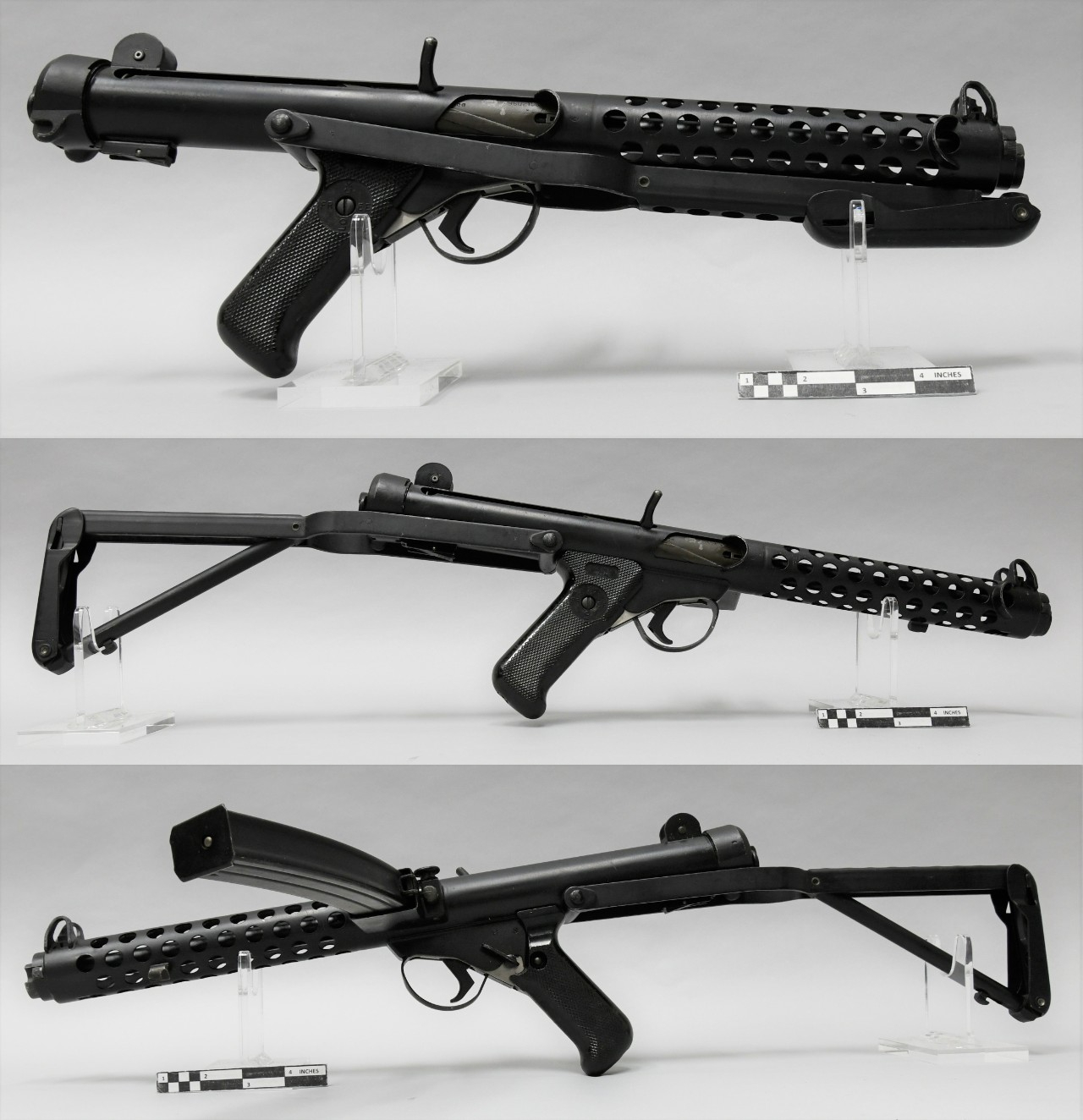
The E-11’s defining features are visible at a glance and are the reason it reads as itself on sight:
- a Sterling-pattern receiver tube — a ~7.75″ long, ~1.5″-diameter wrapped-and-welded sheet-steel tube with a distinctive helical pattern of cooling holes running along its length, the most-identifying visual feature of the Sterling family;
- a bottom-mounted fire-control housing — pistol grip + trigger group + magazine well — that orients the gun like an SMG, not a rifle;
- a curved 34-round side-feed magazine projecting from the left side of the fire-control housing, the canonical Sterling mag silhouette;
- a folding wire stock along the left side of the receiver, normally shown folded along the receiver in screen use;
- the defining E-11 greeblies: a top-mounted scope rail carrying a stylized scope pod, and an M38 grenade-launcher tube running parallel to the scope rail; on some hero pieces, a small Hengstler-style mechanical counter sits on the receiver (contested — see § 1.9 and Vol 7);
- on the Sandtrooper variant: an underslung T-track along the magazine well with an attached ammo pouch — the single clearest identifier vs the standard Stormtrooper E-11.
It is, fundamentally, a Sterling SMG with a prop kit bolted to it. The action was not substantially modified for the screen props (the Bapty Sterlings were deactivated UK military specimens — internally still Sterlings, externally dressed). That choice matters for the donor-modification build path: most of the gunsmithing is bolt-on greeblie work and surface refinishing, not action work.
1.3 The role of this series
Table 1 — 1.2 The role of this series
| Audience | What they take from this series |
|---|---|
| The trooper builder (501st Legion / FISD) | All three Path A flavors + Path B + Path C (Vols 4–6), the defining sub-assemblies (Vol 7), the screen-accuracy reference (Vol 2), the Stormtrooper / Sandtrooper / Death Star Trooper variant deltas (Vol 2 + Vol 7), the parkerized-and-weathered finishing recipe (Vol 8), and the 501st CRL alignment treatment (Vol 9). |
| The lab fabricator | The Sterling donor reference (Vol 3), the dimensioned-drawing source catalog (Vols 2 + 7), the from-scratch lab walk-through (Vol 6), materials + finishing (Vol 8), the operational and legal posture (Vols 10 + 11). |
| The collector | The Sterling provenance volume (Vol 3) — variant catalog from Patchett through Mk 6, US legal status by donor flavor, UK demil + US import history, the Bapty & Co. 1976 props. |
1.4 The five build paths
Per the hub’s deep-dive protocol § 4, every firearms deep dive in this hub treats build-from-parts and build-from-scratch as mandatory volumes. The E-11 is the first build in the hub to take three Path A donor flavors as first-class — driven by the fact that the Sterling has three legally-distinct US donor flavors that each warrant a separate walk-through:
Table 2 — Per the hub's deep-dive protocol § 4, every firearms deep dive in this hub treats build-from-parts and build-from-scratch as mandatory volumes. The E-11 is the first build in the hub to take three Path A donor flavors as first-class — driven by the fact that the Sterling has three legally-distinct US donor flavors that each warrant a separate walk-through
| Path | Vol | Donor / source | Skill | Lab use | Legal posture | Time |
|---|---|---|---|---|---|---|
| A1. Semi-auto Sterling clone | 4 | Wise Lite Arms or Indianapolis Ordnance semi-auto Sterling | Medium | Low (surface refinish + bolt-on) | Semi-auto rifle — state-dependent | 30–60 hr |
| A2. Sterling parts-kit / 80%-receiver | 4 | Imported demilled Sterling parts kit + US-made 80% semi-auto receiver | High | Medium (receiver wrap + weld + drill) | 922(r) parts-count compliance | 60–120 hr |
| A3. Class III registered full-auto Sterling | 4 | Real registered transferable Sterling SMG (~$30K+, ATF Form 4) | Medium | Low (surface refinish + bolt-on) | NFA Class III — full posture in Vol 10 | 20–40 hr |
| B. Off-the-shelf parts | 5 | Doopydoo resin kit, Anovos / Rubies replica, airsoft Sterling SMG + greeblies, community 3D-printed kits, deact-shell + greeblies | Low–medium | Low | Not a firearm (orange-tip rule may apply) | 5–30 hr |
| C. From scratch | 6 | Raw sheet steel, billet aluminum, 3D-print filament/resin, laser stock | Very high | Full — sheet wrap + TIG weld + CNC + 3D print + laser + finishing | Manufacturing-for-self law (semi-auto) | 100–250+ hr |
1.5 Decision tree — which path
- Goal: a 501st-approval-spec trooping E-11 as fast as possible. → Path B with Doopydoo’s resin kit. Community-canonical, fastest to a finished E-11, fits a Stormtrooper / Sandtrooper / Death Star Trooper costume on the standard CRL spec. Most trooper builders go this way; it is not a lesser choice.
- Goal: an E-11 that fires semi-auto on a range day. → Path A1 (Wise Lite or IO semi-auto Sterling clone). The most-practical US donor. Real firearm, real magazine, real recoil — and the only path that allows shooting it. State-of-residence rules apply.
- Goal: the build itself is the point — make the prop in the lab. → Path C. Sheet-metal wrap + welded receiver + CNC fire-control + 3D-printed greeblies + laser-cut details map onto a well-equipped home lab cleanly. Honestly assess the sheet-metal capability first (Vol 6 § 6.2). This is also where the from-scratch volume gets first-class machinist treatment because a capable lab can actually execute it.
- Goal: an authentic full-auto Sterling that happens to be dressed as an E-11. → Path A3, for builders who already have or can afford a registered transferable Sterling. Not a practical entry path; documented for completeness and for the collector who comes to this series with the Sterling already in hand.
- Goal: a parts-kit project with the Sterling’s actual parts in it, semi-auto for legal sanity. → Path A2. This is the middle ground: real Sterling small parts + a US-made semi-auto receiver, with 922(r) parts-count compliance as the defining legal constraint (Vol 10 § 10.4). Parts-kit availability has fluctuated heavily; check vendor stock before committing.
1.6 Era scope — original trilogy only
This series covers only the original trilogy E-11: A New Hope (1977), The Empire Strikes Back (1980), Return of the Jedi (1983). Three OT variants are in scope:
- Standard Stormtrooper E-11 — the canonical configuration carried by Imperial Stormtroopers across all three films. Some per-film variation in handling wear and minor greeblie placement (Vol 2 § 2.4).
- Sandtrooper E-11 — Stormtrooper E-11 + underslung T-track along the magazine well + attached ammo pouch. The clearest identifier vs the standard piece. Deployed Tatooine-side in ANH. (Vol 2 § 2.3, Vol 7 § 7.6.)
- Death Star Trooper E-11 — visually close to the standard Stormtrooper variant but with subtle finish differences (closer to factory-fresh, less handling wear). Carried by the Imperial Navy crew aboard the Death Star and aboard Star Destroyers in ANH and ESB.
Out of scope at scaffold time: sequel-era and prequel-adjacent variants (F-11D, E-11D), Rogue One / Solo one-off configurations, The Mandalorian / Andor TV-era variants. The Sterling-donor build paths transfer in principle, but the greeblie kits and finishing recipes differ. These can be added later as a dedicated callout volume if the project warrants it — they are not woven through the series.
1.7 Lab capability — and what it shifts
The series is written for an experienced maker with access to a capable home fabrication lab: multiple CNC machines, multiple 3D printers, a 100 W large-format laser cutter / engraver, a full gunsmithing toolset, and a working background in firearms and gunsmithing. For the E-11, that shifts the build-path defaults in two specific ways:
- Path C (from scratch) is genuinely on the table. The Sterling-pattern receiver tube — a wrapped + welded sheet-steel cylinder with the helical cooling-hole pattern — is the load-bearing fabrication challenge, and it is the kind of fabrication a sheet-metal-capable lab can actually do. The fire-control housing milled from billet, the scope pod printed in resin, and the M38 tube turned on a lathe are all in-bounds. So Vol 6 gets the same first-class machinist treatment that Mauser_C96 Vol 9 got, rather than the hand-wave most prop guides give the from-scratch path.
- Path A1 (semi-auto clone) is the realistic shooter path. A Wise Lite or IO Sterling clone is a real firearm, range-capable, and within an experienced gunsmith’s bolt-on-greeblie depth. Most prop builders skip this option because they want a non-firing prop; for a gunsmith, it is the most engaging Path A flavor.
The from-scratch volume will not be presented as “the right answer.” A Doopydoo kit (Path B) is faster, cheaper, and 501st-approval-equivalent. The lab capability simply means Path C can be authored at executable depth rather than aspirationally.
Caveat: specific lab tooling — CNC mill model + travels + spindle, sheet-metal wrapping / bending capability, TIG welder, printer count + max build volume, laser bed size + cuttable-material list, parkerizing-bath setup — is not yet captured in the lab-capability catalog (TBD). The Vol 6 from-scratch walk-through will treat lab capability as a load-bearing input but will not commit to specific machine claims until that catalog exists.
1.8 Volume-by-volume index
Table 3 — 1.7 Volume-by-volume index
| Vol | Title | What’s inside |
|---|---|---|
| 1 | Overview & Decision Tree | This volume |
| 2 | Screen Accuracy Reference | The canonical hero E-11; hero vs stunt; the three OT variants; per-film deltas; the RPF-consensus dimension sheet |
| 3 | Donor Firearm Provenance — Sterling Mk 4 / L2A3 | Patchett origin → Sterling Armaments production 1944–1988; Mk 1–6 variant catalog; legal status by donor flavor; UK demil + US import history; the Bapty & Co. 1976 props |
| 4 | Build Path A — Donor Modification | Three sub-paths: A1 semi-auto Sterling clone; A2 parts-kit / 80%-receiver with 922(r) compliance; A3 Class III full-auto registered Sterling |
| 5 | Build Path B — From Off-the-Shelf Parts | Doopydoo resin kit; Anovos / Rubies replica; airsoft Sterling + greeblies; community 3D-printed kits; deact-shell + greeblies |
| 6 | Build Path C — From Scratch | CNC sheet-metal receiver + machined fire-control housing + 3D-printed greeblies + laser-cut details; material list, op sequence, fixture / jig design |
| 7 | Sub-Assemblies & Greeblies | Scope rail + scope pod; M38 grenade-launcher tube; folding wire stock; the Hengstler counter question; T-track + pouch for Sandtrooper; the 34-rd Sterling magazine |
| 8 | Materials & Finishing | Parkerized base; Stormtrooper worn / handled weathering; Sandtrooper sun-bleached / dust-pattern weathering; 1976 Bapty finish reality |
| 9 | Use Cases & Display | 501st Legion / FISD CRL compliance; costume use; photography; display; range work (Path A1 only); care + maintenance |
| 10 | Legal & Regulatory Posture | The heaviest legal volume in this hub. NFA / Class III for A3; semi-auto clone legality by state for A1; 922(r) parts-count for A2; orange-tip federal rule for non-firing; state imitation-firearm laws (CA / NY / NJ / MA / HI / DC); the constructive-intent trap |
| 11 | Operational Posture | Storage / transport / costume play / 501st conventions / LE-encounter posture / insurance |
| 12 | Cheatsheet | Laminate-ready synthesis — dim sheet, legal pivots, 501st quick-ref, vendor reference, full bibliography |
1.9 Reading order
- Building a trooping E-11 via Path B (Doopydoo kit, most common): Vol 2 → Vol 5 → Vol 7 → Vol 8 → Vol 9 → Vol 11. Skim Vol 10 for the orange-tip rule and the state imitation-firearm summary.
- Building Path A1 (semi-auto Sterling clone, range-capable): Vol 3 → Vol 4 § A1 → Vol 7 → Vol 8 → Vol 10 (state-specific) → Vol 11.
- Building Path A2 (parts-kit / 80%-receiver): Vol 3 → Vol 10 first (the 922(r) posture is load-bearing; discovering a non-compliant build halfway through is an expensive mistake) → Vol 4 § A2 → Vol 7 → Vol 8 → Vol 11.
- Building Path A3 (Class III registered full-auto): Vol 10 first (NFA posture; transferable-Sterling market) → Vol 3 → Vol 4 § A3 → Vol 7 (greeblie work is the only modification — the action stays factory) → Vol 8.
- Building Path C (from scratch in the lab): Vol 3 → Vol 6 → Vol 7 → Vol 8 → Vol 10 (semi-auto manufacture-for-self posture).
- Here for the donor question (collector or future Sterling-derived prop): Vol 3 → Vol 10. Vols 2 / 7 only as needed.
1.10 What this series is not
- It is not a machine-gun conversion guide. The Sterling SMG is a federally-registered Class III machine gun in its original full-auto configuration. This series documents that posture (Vol 3, Vol 10) but never describes converting a semi-auto Sterling clone or an 80% receiver to full-auto. Doing so is a federal felony under the Hughes Amendment (1986) and is categorically out of scope.
- It is not a Hengstler-counter argument. The contested presence/absence of the small mechanical counter on hero pieces is a real RPF-community disagreement; Vol 7 catalogs the per-piece variation (which hero pieces have it, which don’t, when it was painted over) rather than dictating one canonical answer.
- It is not a 501st CRL substitute. The 501st Legion / FISD maintains separate CRLs for each Stormtrooper variant, and those are the authoritative trooping-approval specs. Vol 9 cites the relevant CRLs but does not reproduce them in full — they are maintained by 501st leadership and revised over time.
- It is not a Bapty hero-prop dimensional rulebook. The hero Sterlings used at Bapty & Co. in 1976 are in private hands and museum collections, and their exact dimensions are RPF-community-consensus estimates from photographs and the few hero pieces that have been measured. Vol 2’s dimension sheet is the consensus, not a Bapty-blessed canonical.
- It is not legal advice. Firearms law is jurisdiction-dependent (Vol 10, the hub’s legal-posture notes). State-of-residence rules override the federal-only framing repeatedly. Cite primary sources (
27 CFR, ATF Determination Letters, state statutes) for any build that crosses a legal pivot.
1.11 Sourcing & copyright note
Factual content here is synthesized from public sources — Sterling Armaments factory documentation (where accessible), the Sterling collector literature (Hobart’s The Sterling Story, Walter’s Small Arms Profile 12), the Replica Prop Forum (RPF) community archives for prop-specific dimensions, and the 501st Legion / FISD Costume Reference Library entries for trooping-approval specifications. Where a source is itself copyrighted, only facts are used — facts are not copyrightable — and its text and images are not reproduced.
Photographs sourced from Wikimedia Commons are reproduced verbatim with creditLine attribution per the shared Photo Helper’s standing rule. Photographs of hero pieces, auction-house lot shots, and museum-exhibit photos are typically copyrighted; this series does not autonomously fetch from copyrighted sources. Where a hero-prop photo would help, the series describes the reference and points to community-documented dimensions instead of embedding a copyrighted shot.
1.12 References (Vol 1)
- the hub’s deep-dive protocol (§ 4 mandatory volumes, § 10 website-builder contract).
- the hub’s legal-posture notes — hub-wide legal posture. Vol 10 is the build-specific tail-end.
- The hub’s cross-build comparison — the matrix, and the Sterling-donor index row.
- the build’s context notes — E-11 build context, 12-volume plan, lab-capability framing, important decisions.
- The build’s fabrication workflow — workflow and build-path matrix.
- The design spec this series was scaffolded from (project-internal).
- Full bibliography (Sterling collector literature, RPF dimension threads, 501st CRL pointers, ATF citations) consolidated in Vol 12.
Comments (0)