DL-44 "Heavy" Blaster · Volume 10
Legal & Regulatory Posture (MANDATORY)
Correction (2026-10-24): § 10.5 cited “Penal Code § 12550” for California. That is the pre-2012 number: the definition of an imitation firearm is now Penal Code § 16700(a) and the rules are in Division 4, §§ 20150–20180. The New York City entry was a summary that used New Jersey’s wording (“other than black, blue, silver, or aluminum”) and left out that the city bans possession, not just public transport; it now follows the text of Administrative Code § 10-131(g). § 10.5.1 and § 10.5.7 advised a removable or screw-on orange muzzle cap, but the Consumer Product Safety Commission names “a plastic, orange plug that has threading” as its example of a marking that is not permanent, and in California and New York City an orange tip does not make a black replica lawful in public anyway. The Hawaii entry cited HRS § 711-1112, which is the offence of interfering with the operator of a public transit vehicle; it is removed. New Jersey’s 2019 sale law (C.56:17-1) and the federal rule’s move to 16 CFR part 1272 are added; the Massachusetts and D.C. entries are narrowed to what the texts say.
This is a hub-wide mandatory volume. Per the hub’s deep-dive protocol § 4, every firearms deep dive in this hub includes a build-specific legal-and-regulatory volume. The general posture lives in the hub’s legal-posture notes; the subject here is the DL-44-specific pivot points — what’s different about this build versus the general framework.
Not legal advice. Cite primary sources, not memory. Re-read before any operation that touches a real firearm or any cross-state shipment of replica or real hardware.
10.1 The path-by-path posture summary
Table 1 — 10.1 The path-by-path posture summary
| Build path | Federal posture | Most relevant federal rule | Most relevant state-level concern |
|---|---|---|---|
| A. Donor mod (real C96) | Real firearm; full GCA applies; C&R or antique reduces some restrictions | 18 USC §§ 921-931 (GCA), 27 CFR Part 478 | State firearm-modification rules, magazine capacity, state assault-weapon rules |
| B1. Kit-builder package | Imitation firearm; not a firearm federally | 15 USC § 5001 (Toy Gun Marking Act) | State and city imitation-firearm rules (CA / NY / NYC / NJ / CT; § 10.5) |
| B2. Denix replica conversion | Imitation firearm; not a firearm federally | 15 USC § 5001 | State imitation-firearm rules |
| B3. Airsoft conversion | Airsoft; not a firearm federally (BB gun) | 15 USC § 5001, state airsoft rules | State airsoft + imitation-firearm rules; some restrictions on transport |
| C. From scratch | Imitation firearm if no functional firing capability; otherwise full firearm rules apply to whatever functionality is built | 15 USC § 5001 (replica path); 18 USC §§ 921-931 (functional path) | State imitation-firearm rules |
Each path’s specific pivot points get their own section below.
10.2 Federal antique status — pre-1899 C96s
Under 18 USC § 921(a)(16):
The term “antique firearm” means— (A) any firearm (including any firearm with a matchlock, flintlock, percussion cap, or similar type of ignition system) manufactured in or before 1898.
A pre-1899 (i.e. “in or before 1898”) C96 is therefore not a firearm under federal law. Practical consequences:
- Sale and transfer: Not subject to GCA. Can be sold person-to-person across state lines without FFL involvement (federally; state law may impose additional rules).
- Interstate shipment: Can ship via USPS or common carriers without FFL involvement (federally).
- Background check: Not required for federal antique purchases.
- Records: Not required to be kept under federal law.
- Antique status is permanent even if the antique firearm is heavily modified — the date-of-manufacture is the determining factor, not the current configuration.
Caveats:
- State law may treat antiques differently. California, New York, New Jersey, Massachusetts, and Washington DC treat antique firearms similarly to modern firearms in many regulatory contexts. Verify state-of-residence rules.
- Pre-1899 C96 production includes the Cone Hammer variant (production 1896-1899) plus a small slice of early Small Ring Hammer C96s (1899 production, depending on exact date). Specific serial-range cutoffs for antique status are published by ATF.
- An antique C96 modified to be the DL-44 remains antique — the modifications don’t alter the date-of-manufacture-based antique status.
For a builder, a pre-1899 antique C96 is the most-legally-flexible donor. The donor cost premium ($1500-3000 vs $800-2500 for a C&R-eligible post-1899) buys legal simplicity.
10.3 Curio & Relic (C&R) status — post-1899 C96s
Under 27 CFR 478.11:
Curios or relics. Firearms which are of special interest to collectors by reason of some quality other than is associated with firearms intended for sporting use or as offensive or defensive weapons. To be recognized as curios or relics, firearms must fall within one of the following categories: (a) Firearms which were manufactured at least 50 years prior to the current date… [other categories]
All C96s are at least 50 years old (Mauser production ended 1937; Spanish copies into the 1940s; Chinese copies into the 1950s) and are therefore C&R-eligible.
Practical consequences for a C&R-eligible post-1899 C96:
- The firearm remains a “firearm” under federal law — GCA applies in all its provisions except some interstate-transfer rules.
- Type 03 FFL (Curio & Relic) license holders can ship and receive C&R firearms directly to and from other licensees and (in some configurations) to and from each other, without the C&R firearm passing through a local FFL.
- Non-licensee buyers still must abide by GCA rules — interstate purchase generally requires shipment to a local FFL for transfer.
- C&R buyers retain their right to do FFL transfers — having a C&R license doesn’t strip any normal-buyer rights.
Getting a C&R license: ATF Form 7CR. Cost: $30 for three years. Application asks for fingerprints, photographs, demographic info, and a notice to the state-of-residence Chief Law Enforcement Officer.
For a builder doing serious DL-44 work, a C&R license substantially eases donor acquisition. Beyond DL-44 specifics, a C&R license enables interstate purchases of other collector firearms (period rifles, period pistols) which is convenient for the broader build hub.
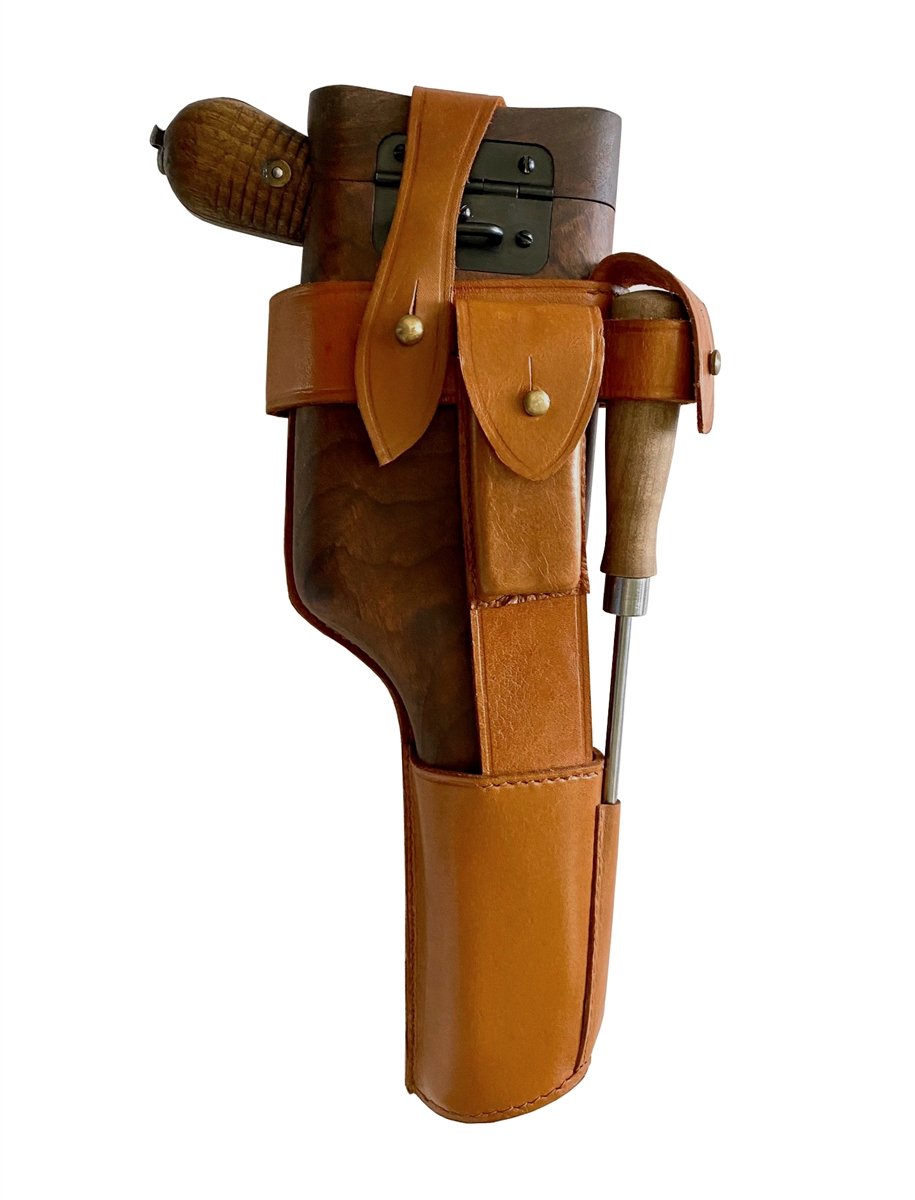
10.4 The shoulder-stock holster — the famous NFA pivot point
The most-asked-about legal question in DL-44 builds:
“I want to build a DL-44 from a real Mauser C96. My donor came with the original wooden shoulder-stock holster. Is this an SBR?”
The answer is nuanced.
10.4.1 The general rule
Under 27 CFR 479.11 and 26 USC § 5845(a), a “short-barreled rifle” includes any firearm:
- That has a barrel less than 16 inches in length, AND
- That is designed or redesigned, made or remade, and intended to be fired from the shoulder.
A standard 5.5″ barrel C96 plus a wooden shoulder-stock holster — when assembled — has a sub-16″ barrel and is designed to be fired from the shoulder. On the face of the statute it is an SBR, unless the pistol-and-stock combination is one ATF has removed from the NFA as a collector’s item (§ 10.4.3). Most genuine Mauser-made C96s with their original stocks are in that category.
10.4.2 The constructive possession risk
Even without assembly, owning the parts can constitute constructive possession of an SBR:
- C96 pistol (under-16″ barrel)
- Wooden shoulder-stock holster (capable of being attached to make the pistol shoulder-fireable)
Owned together = constructive possession of an SBR. This applies only outside the collector’s-item listings in § 10.4.3: a listed pistol with its listed original stock is not an NFA firearm at all, assembled or not.
10.4.3 What actually exempts an original stock: ATF’s Curios or Relics list
Correction (2026-10-18). Earlier editions of this section cited an “ATF Open Letter 2014” and quoted a synthesized summary of it. No such letter could be found, and the summary was wrong on two points: it said a post-1899 C96 with its original stock is an SBR, and it credited the exemption to the pistol’s antique status. The real authority is ATF’s Curios or Relics list, quoted below.
The NFA’s definition of “firearm” in 26 USC § 5845(a) excludes any weapon that the Secretary “finds by reason of the date of its manufacture, value, design, and other characteristics is primarily a collector’s item and is not likely to be used as a weapon.” ATF publishes those findings in its Firearms Curios or Relics List (ATF P 5300.11; the current electronic edition covers January 1972 through April 2025). Two sections of the list cover the C96 with its stock.
Section III, “Firearms removed from the provisions of the National Firearms Act and classified as curios or relics, still subject to the provisions of 18 U.S.C. Chapter 44, the Gun Control Act of 1968,” lists:
Mauser, Model 1896, semiautomatic pistol, as produced by Mauser prior to 1940 accompanied by original German mfd. detachable holster/shoulder stocks, any cal.
The same section has separate entries for the Model 1896 pistol-carbine with its accompanying stock and a barrel of 11-3/4 to 16 inches, for the Model 1902 with an original stock, and for “Spanish mfd. copies of the Mauser, Model 1896, semiautomatic pistol produced prior to 1946 … accompanied by original Spanish mfd. detachable wooden holster/shoulder stock.”
Section IIIA, “Firearms manufactured in or before 1898, removed from the provisions of the National Firearms Act and classified as antique firearms,” opens with a general entry, “Any pistol or revolver, mfd. in or before 1898, originally designed to accept a shoulder stock, and accompanied by an original shoulder stock,” and has a C96-specific entry: a Model 1896 with a detachable stock-holster, “mfd. on or before December 31, 1898,” with the early trigger, safety, extractor and firing-pin retaining lug, a Cone or Large Ring hammer “and serial number under 15,000.”
What the listings mean:
- The exemption comes from the collector’s-item finding in § 5845(a), not from the pistol’s antique status. The GCA’s antique definition (18 USC § 921(a)(16)) does not control the NFA. The NFA’s own antique definition (§ 5845(g)) is narrower for cartridge guns: it reaches one only if its ammunition is no longer made in the US and not readily available, and 7.63×25 Mauser is still sold.
- A Mauser-made C96 from before 1940, with its original German-made stock, is not an NFA firearm, whether it was made before or after 1898. If it was made after 1898 it is still a GCA firearm (a curio or relic) and transfers like any other C&R pistol. If it was made in or before 1898, Section IIIA also classes it as an antique.
- Outside the listings, the plain § 5845(a) rule applies. A reproduction stock on any C96, a non-German stock on a Mauser pistol (other than a Spanish copy with its original Spanish stock), and any stock on a pistol the list does not name (Chinese copies, post-1940 production, modern firing replicas) make a short-barreled rifle.
- The list does not say how a stock is shown to be “original German mfd.” Provenance matters. Treat a doubtful stock as a reproduction.
10.4.4 What this means for DL-44 builders
The DL-44 prop is a pistol, not a stocked carbine — Han Solo’s blaster doesn’t have a shoulder-stock. So for most DL-44 builders the SBR concern only arises if the donor came with its original stock-holster as a separate accessory.
Practical guidance:
- If the donor is a Mauser-made C96 from before 1940 and the stock is an original German-made stock-holster: not an NFA firearm under the Section III listing (and under Section IIIA as well if the pistol was made in or before 1898). No registration or tax stamp is required. Verify that the stock is original, not a reproduction.
- If the stock is a reproduction, or the pistol is not covered by a listing: constructive possession risk. Options:
- Sell the stock-holster separately before completing the build (recommended).
- Register the configuration as an SBR on an approved ATF Form 1 before assembly. The making tax has been $0 since Public Law 119-21 (4 July 2025); the application, approval and registration are still required.
- The long-barrel Model 1896 pistol-carbine (11-3/4 to 16 inch barrel) with its accompanying stock has its own Section III entry. A long barrel alone does not help an ordinary pistol: a rifle with a barrel under 16 inches is an SBR whatever its overall length.
- If only the pistol came with the donor (no stock-holster included): no SBR concern. Most donors come this way.
- If reproducing a stock-holster for the build (e.g. for completeness of a Path C from-scratch presentation): the reproduction is functionally still a shoulder stock and the SBR concern applies regardless of authenticity. Either keep it separated from the pistol or register the configuration on an approved Form 1 first.
Vol 4 § 4.10 covers the workflow caution; this section is the authoritative reference.
10.5 State imitation-firearm laws
Several states have rules on “imitation firearms” or “replica firearms” — even for non-functional builds. The screen-iconic DL-44 silhouette is visually recognizable as a firearm, so these rules apply to most DL-44 builds (Paths B and C as non-functional replicas; Path A donors are real firearms under GCA regardless).
10.5.1 California — Penal Code § 16700, § 20165, § 20170
California’s imitation-firearm law was renumbered in 2012. The definition is Penal Code § 16700(a): “any BB device, toy gun, replica of a firearm, or other device that is so substantially similar in coloration and overall appearance to an existing firearm as to lead a reasonable person to perceive that the device is a firearm.” The rules are in Division 4, §§ 20150–20180:
- § 20165 — purchasing, selling, manufacturing, shipping, transporting, distributing or receiving an imitation firearm for commercial purposes carries a civil fine of up to $10,000 a violation, unless it is solely for export, for theatrical productions, for a certified sporting event, for military or ceremonial use, or for school displays. § 16700(b)(5) takes a device out of § 20165 if its entire exterior is white or one of seven bright colours, or it is transparent or translucent. That exclusion is written for § 20165 only.
- § 20170 — no person may openly display or expose an imitation firearm in a public place, a list that includes streets, sidewalks, parking lots, front yards and an automobile. § 20175(a) exempts one packaged or concealed so that it is not subject to public viewing.
- § 20150 makes it a misdemeanor to change or remove a required marking so the device looks more like a firearm; § 20155 makes a manufacturer, importer or distributor that fails the federal marking rule guilty of a misdemeanor.
For a DL-44 builder in California:
- For convention / cosplay use: a black DL-44 would very likely meet the § 16700(a) test, and no text read here makes an orange tip an exception to § 20170. Carry it to and from a venue cased or covered (§ 20175(a)). Whether a convention floor counts as a public place, and whether the venue’s own rules allow the prop, was not confirmed here.
- For private display: nothing in these sections reaches display inside a private home.
- For sale or transfer: a commercial sale of a realistic DL-44 inside California falls under § 20165; a private one-off transfer is not addressed by the text read.
10.5.2 New York City — Administrative Code § 10-131(g)
The city code makes it unlawful “to sell or offer for sell, possess or use or attempt to use or give away” any toy or imitation firearm that can reasonably be perceived to be a real one unless all of these hold: the entire exterior is white or one of seven bright colours, or the gun is transparent or translucent; the barrel is closed with the same material for at least ½ in from the front; the maker’s name or mark is stamped on it; and no laser pointer is attached. The exemptions are dealers shipping out of the city, film, television and theatre with a waiver, pre-1898 collector replicas and miniatures. The city’s own inspection checklist puts it plainly: “Fake guns with brightly colored red or orange tips are illegal if the rest of the gun is dark-colored.”
For a DL-44 (matte black) in New York City: the prop may not be possessed in the city at all, in public or in private, and an orange tip does not change that. The only compliant DL-44 would be bright-coloured or clear all over with a closed barrel and a maker’s mark, which no longer reads as a DL-44. Keep a black one out of the city.
New York State has a parallel sale law, General Business Law §§ 870–873, with the same four conditions; it bars importing, making, selling or distributing a non-compliant imitation weapon within the state, but does not reach possession.
10.5.3 New Jersey — N.J.S. 2C:39-1(v), C.56:17-1
New Jersey defines an imitation firearm in N.J.S. 2C:39-1(v) as “an object or device reasonably capable of being mistaken for a firearm” (wording as quoted in the state’s model criminal jury charge; the statute was not read on the legislature’s site). Its 2019 sale law, C.56:17-1 (P.L. 2019, c. 481, approved 2020-01-21), bars selling, transferring or assigning a toy gun or imitation firearm unless it is a colour other than black, blue, silver or aluminium, carries a non-removable orange stripe at least 1 in wide along the full length of each side of the barrel, and has a barrel at least 1 in in diameter closed ½ in from the front, or conforms with the federal marking rule, which the act cites as “15 CFR 272.1 et seq.” and which is now 16 CFR part 1272 (§ 10.6). The earlier citation here to N.J.A.C. 13:54-1.4 could not be checked and is withdrawn.
10.5.4 Massachusetts and Boston
No statewide Massachusetts statute on imitation-firearm sale or colouring was found. General Laws Chapter 269 § 12B governs air rifles and BB guns held by minors, not imitations. The City of Boston’s Code § 16-5B bars selling, possessing, using, displaying or giving away a replica firearm on public property unless it is bright-coloured or transparent, has a blaze orange plug closing the barrel for ½ in, carries the maker’s name and has no laser pointer. A black DL-44 fails that list.
10.5.5 Hawaii
No Hawaii statute on imitation firearms was confirmed. The section cited here before, HRS § 711-1112, is “Interference with the operator of a public transit vehicle”, and HRS § 134-16 is shown on the legislature’s site as repealed (L 2021, c 183, § 8).
10.5.6 Washington DC
D.C. Code § 22-4504(b) makes it a crime to possess a firearm “or imitation firearm” while committing a crime of violence or dangerous crime. No D.C. sale or public-display rule for imitation firearms was confirmed; verify before convention attendance.
10.5.7 Practical builder guidance
- Know the state-of-residence rules before completing a build that will be used (carried, displayed, photographed in public, sold) in that state.
- For travel-and-display use: case it in transit. A removable orange muzzle cap is not a compliant marking for a maker or seller: the federal rule requires a plug or band “permanently affixed”, and the CPSC gives “a plastic, orange plug that has threading” as its example of a non-permanent fixture. In California, New York City and on Boston’s public property an orange tip does not make a black replica lawful in public view anyway.
- For sale across state lines: research the buyer’s state’s rules. New York, New Jersey and Connecticut (General Statutes § 53-206c, which also bars giving a realistic facsimile) restrict sale or transfer; some imitations legal to own in one state can’t legally be sold into another.
10.6 Federal 15 USC § 5001 — Toy Gun Marking Act
For purely-imitation builds (Path B replicas, Path C without functional firing capability) federal Toy Gun Marking Act applies:
- Under 15 USC § 5001, “look-alike firearms” must have certain markings — blaze orange or otherwise brightly colored muzzle, or other markings identifying the device as a non-firearm. The approved markings are now in the Consumer Product Safety Commission’s 16 CFR § 1272.3 (effective 2023-06-26); the old Commerce copy at 15 CFR part 272 was removed on 2026-02-19.
- Exceptions: traditional B-B, paintball, or pellet firing air guns; non-firing antique replicas of original firearms manufactured prior to 1898; or non-firing replicas of original firearms designed prior to 1898 and recognized as antique firearms.
The “antique replica” exception is the relevant DL-44 hook: a Mauser C96 was designed in 1895 and produced from 1896, so a non-firing C96 replica falls within the antique-design exception. The DL-44 visible-greeblies modifications don’t alter this.
In practice: a Denix C96 (Path B2) and a from-scratch C96-pattern frame (Path C) both qualify for the antique-design exception and don’t require orange tip under federal law. State law is the binding constraint.
10.7 80% receivers and modern construction
For a fully-from-scratch build that includes machining a functional firearm receiver (Path C with functional internals), federal “80% receiver” rules apply:
- Pre-2022: An 80% receiver was not a “firearm” federally until machined to functionality.
- ATF Final Rule 2021R-05F (effective Aug 2022) expanded the definition of “readily” — some configurations of unfinished receivers are now defined as firearms at the point of sale.
For DL-44 builds:
- Path A (real donor): not affected; the donor is already a firearm.
- Path B (replica): not affected; the kit/Denix/airsoft is not a firearm.
- Path C-display-only: not affected; no functional firearm receiver is being made.
- Path C-functional-internals: potentially affected. A functional-internals C96 from-scratch build approaches “manufacturing a firearm” under federal definitions. Consult an attorney for the specific build configuration if Path C-functional is the chosen path.
Recommended: stick to display-only Path C builds. Functional internals on a from-scratch firearm receiver opens federal manufacturing rules that don’t add to the prop’s value as a prop.
10.8 Demilitarization (demill) — when applicable
Under federal demill rules:
- A demilled firearm is no longer a firearm under federal law if it meets specific demill criteria — typically cut through the chamber, weld the bolt closed, and other specific operations.
- Demill criteria are specific and not negotiable. ATF Demilitarization Guidelines (published) detail the operations required.
- For state-level demill: rules vary; some states have stricter demill requirements than federal.
For DL-44 builders, demill is usually not the right path:
- With a real C96 donor intended for a non-firearm prop, the modifications to make a DL-44 don’t necessarily satisfy demill criteria. The bolt might still cycle, the chamber might be intact.
- Demilling specifically — cutting the chamber, welding the bolt closed — produces a permanently non-functional piece but doesn’t make the DL-44 build’s prop modifications easier.
- The Path B (replica) and Path C (from-scratch) routes avoid the need for demill entirely.
If a builder specifically wants a demilled C96 as a donor for ultra-clean Path A legal posture, contact a gunsmith for the actual demill operation and verify the result meets ATF criteria.
10.9 Shipping and transfer
10.9.1 Shipping a real C96 donor
- Within-state: per state law. Some states (e.g. California) require FFL transfer even for within-state firearm sales.
- Interstate: federal rules require shipment to an FFL in the buyer’s state for transfer, unless both parties are C&R-licensed and the firearm is a C&R-eligible firearm.
- Antiques: pre-1899 antiques can ship person-to-person interstate federally; state law may still require FFL.
10.9.2 Shipping a replica DL-44 (Path B or C)
- Replicas are not firearms federally — no FFL transfer required.
- State imitation-firearm rules may apply to importation into certain states.
- Common carriers (UPS, FedEx, USPS) ship replicas without issue in most configurations. UPS in particular has specific restrictions on items that “look like firearms” — verify current policy.
10.9.3 Crossing state lines with a real DL-44 (Path A)
Federal law generally protects interstate transport of legally-owned firearms through stricter-rule states (the Firearm Owners Protection Act of 1986, 18 USC § 926A) if the firearm is unloaded, in a locked container, and inaccessible from the passenger compartment. This is the “peaceably traveling through” exemption. Verify state-by-state if traveling through specifically-restrictive states.
10.9.4 International travel
International transport of replica or real firearms is highly regulated at both export (Department of Commerce export controls; for firearms, often Department of State ITAR) and import (destination country’s import rules) levels. Do not attempt without specialized legal advice.
10.10 Insurance and liability
10.10.1 Property insurance
- Homeowner’s / renter’s insurance typically covers replica firearms under personal property limits.
- High-value builds (Path A real-donor builds, Path C with real Ziel-Dialyt scope) may exceed standard policy limits — schedule individually.
- Collectibles-specialized insurance (e.g. Collectibles Insurance Services) offers replica-firearm-specific policies.
10.10.2 Liability — accidental damage / injury
Even an imitation firearm can cause injury (impact, dropped on foot, broken acrylic case shards). Standard premises liability coverage typically applies. Verify policy if the build is taken to conventions or other public venues.
10.10.3 Liability — law-enforcement encounter
A realistically-built DL-44 carried in public could be mistaken for a real firearm by law enforcement, with severe consequences. Most builders avoid public carry of un-marked DL-44s for this reason regardless of state legal status. The orange-tip practice for convention travel addresses this risk.
10.11 Decision tree — legal posture by use case
Will this DL-44 be:
│
├── Carried in public (convention, cosplay, etc.)?
│   │
│   ├── In CA, New York City or on Boston public property?
│   │   │
│   │   └── An orange tip does not cure a black replica. Case it in
│   │       public (CA); keep it out of NYC entirely (§ 10.5).
│   │
│   └── In a permissive state?
│       │
│       └── Generally fine; verify the specific venue (convention prop rules).
│
├── Privately displayed?
│   │
│   └── No legal action needed for replica builds.
│       For real-donor builds, normal firearm storage law applies.
│
├── Sold or transferred?
│   │
│   ├── Replica (Path B or C without firing capability)?
│   │   │
│   │   └── No FFL needed; verify buyer's state imitation rules.
│   │
│   └── Real firearm (Path A)?
│       │
│       ├── Within-state buyer in a state that doesn't require FFL?
│       │   └── Direct transfer permitted.
│       │
│       ├── Within-state buyer in a state that requires FFL?
│       │   └── FFL transfer required.
│       │
│       └── Out-of-state buyer?
│           └── Ship through an FFL.
│
└── Range-fired (Path A only)?
    │
    └── Verify the donor's mechanical condition + state firearm range rules.
        Vol 9 § 9.4 strongly recommends not range-firing.
10.12 References (Vol 10)
- 18 USC § 921 — definitions (firearm, antique firearm, etc.).
- 18 USC § 922 — prohibited persons, interstate transfer rules.
- 18 USC § 926A — Firearm Owners Protection Act interstate transport.
- 27 CFR Part 478 — Gun Control Act implementation.
- 27 CFR Part 479 — National Firearms Act implementation.
- 27 CFR 478.11 — Curio & Relic definition.
- 15 USC § 5001 — Toy Gun Marking Act / imitation firearm marking.
- 26 USC § 5845 — NFA definitions (SBR, SBS, suppressor, MG, AOW, DD).
- ATF, Firearms Curios or Relics List — January 1972 through April 2025 (ATF P 5300.11, electronic edition), https://www.atf.gov/media/19856/download — Section III (Mauser Model 1896 and Spanish copies with original stocks) and Section IIIA (pre-1899 stocked pistols; the Model 1896 serial-under-15,000 entry). Read 2026-10-18 from the Internet Archive copy of that PDF. (Replaces a cited “ATF Open Letter 2014” that could not be found; corrected 2026-10-18.)
- ATF Final Rule 2021R-05F — frame/receiver definition update.
- 16 CFR part 1272 — CPSC marking rule (eCFR, read 2026-10-24); direct final rule 88 FR 30226, effective 2023-06-26 (federalregister.gov, read 2026-10-24). 15 CFR part 272 removed by 91 FR 7824, 2026-02-19 (federalregister.gov, read 2026-10-24).
- CPSC, “Toy, Look-Alike, and Imitation Firearms” FAQ — cpsc.gov/FAQ/Toy-Look-Alike-and-Imitation-Firearms, read 2026-10-24.
- California Penal Code § 16700 and §§ 20150–20180 — leginfo.legislature.ca.gov; § 20165 read 2026-10-24 (Internet Archive copy of the legislature’s page), §§ 16700, 20150, 20155, 20170, 20175 read 2026-10-20. Former § 12550 as the old definition section: Senate Bill 798 (2011), amended 2011-06-29, leginfo.ca.gov, read 2026-10-24.
- NYC Administrative Code § 10-131(g) — codelibrary.amlegal.com, read 2026-10-20; DCWP “Inspection Checklist: Fake, Toy, or Imitation Guns” (updated 08/2022), nyc.gov, read 2026-10-24.
- New York General Business Law §§ 870–873 — nysenate.gov, read 2026-10-20 and 2026-10-24.
- New Jersey P.L. 2019, c. 481 (C.56:17-1) — pub.njleg.gov, read 2026-10-24.
- Connecticut General Statutes § 53-206c — cga.ct.gov, read 2026-10-24 (Internet Archive copy).
- Massachusetts General Laws c. 269 § 12B — malegislature.gov, read 2026-10-24; Boston Code § 16-5B — codelibrary.amlegal.com, read 2026-10-20.
- Hawaii Revised Statutes § 711-1112 and § 134-16 (repealed) — capitol.hawaii.gov, read 2026-10-24.
- D.C. Code § 22-4504 — code.dccouncil.gov, read 2026-10-24.
When citing this volume’s claims in practice, cite the primary source (e.g. “27 CFR 478.11”) rather than this volume. Re-verify any statutory citation before action — federal rules update periodically, state rules update frequently.
Comments (0)