Blunderbuss Kits Compared · Volume 2
The Entry Kit: Traditions KR500 & KR510
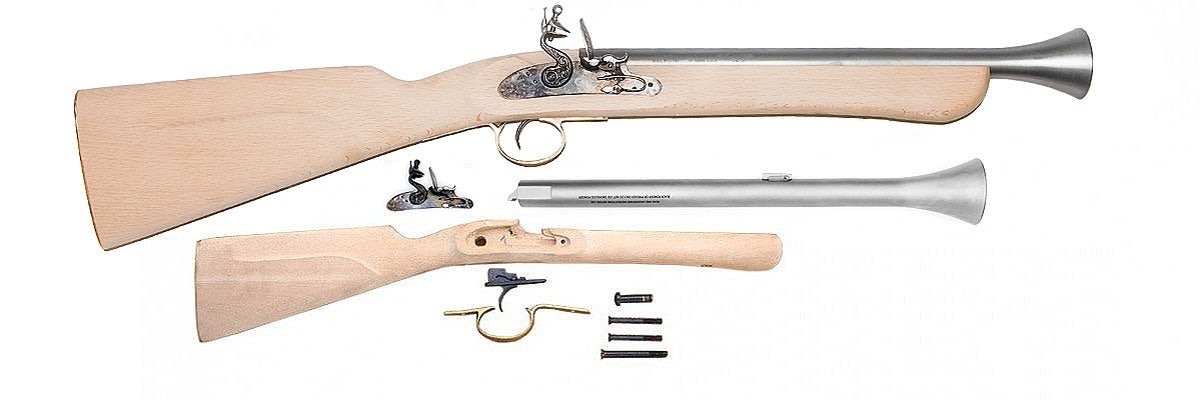
Start here, because for most first-time blunderbuss builders this is the right answer and the rest of the ladder is aspiration. The Traditions kit is the only complete, pre-inlet, off-the-shelf blunderbuss kit anyone sells. It is cheap, it is in stock, and it goes together on the kitchen table. Whether it is the right buy depends entirely on what you want the finished gun to be - so this volume is as much about managing expectations as it is about the kit.
2.1 What it is
Traditions sells the same gun in two ignition flavors. The KR500 is percussion; the KR510 is flintlock. Both are made in Spain by Ardesa, Traditions’ long-time manufacturing partner, and both ship as a box of parts you assemble and finish yourself.
The specifications are identical apart from the lock. The bore is .54 caliber, a 16.75-inch trumpet-style flared smoothbore barrel delivered white - that is, in the bare steel, ready for you to brown or blue. A single-stage trigger, a brass trigger guard and buttplate, a select hardwood stock, and 29.25 inches overall. There are no sights, which is correct for the type and a reminder of what this gun is: a point-and-shoot close-range piece, not a target arm.
Pricing runs around $469 for the KR500 percussion and $529 for the KR510 flintlock, retailing near those numbers at muzzle-loaders.com and Midway. The flintlock costs the extra roughly sixty dollars because a flint lock is simply a more complex mechanism - a frizzen, a frizzen spring, more parts to fit. Dixie Gun Works resells the identical flintlock kit under its own SKU (FK0778) and the finished gun as FR0770, but it is the same Ardesa buss either way.
2.2 What the build is really like
This is the whole appeal and the whole limit: it is a beginner build. The stock is pre-inlet, the holes are drilled, and the parts are designed to drop into place with minor hand-fitting. You are not cutting a barrel channel or inletting a lock from a plank. The real work is cosmetic - whiskering and staining the wood, browning or bluing the bare barrel, and dressing the parts so the finished gun looks like something you are proud of rather than a hardware-store project.
That makes it a genuinely low-risk way to learn muzzleloader assembly and black-powder shooting. A patient beginner finishes one over a few evenings and comes away understanding lock, stock, and barrel well enough to take on something harder next. The companion build dive, “Traditions Blunderbuss Kits,” walks the entire process end to end - unboxing and inventory, barrel and lock fitting, the trigger and furniture, stock finishing, barrel browning, and loading and firing a .54 smoothbore safely. This volume deliberately does not repeat those steps; if you buy this kit, that dive is your bench manual.
2.3 The honest caveats
Two things about this kit are worth stating plainly, because the catalog never will.
On period accuracy. The flintlock KR510 sits squarely in the blunderbuss’s real heyday, roughly 1700 to 1820, and if you want a gun that reads as the eighteenth-century coaching piece it imitates, the flintlock is the one to buy. The percussion KR500 is a mild anachronism - percussion ignition did not become common until the 1820s to 1840s, by which point the blunderbuss was already being retired. Genuine percussion busses exist as a late transitional oddity, but they are not a common historical pattern. The percussion kit is not a bad gun; it is easier to shoot and needs no flint-knapping. It just is not the “1700s coach gun” the flintlock is.
On scale and fidelity. This is a .54 - a single ball around 230 grains, or a modest shot charge. It captures the blunderbuss silhouette faithfully: the flare, the brass, the stubby length. What it does not capture is the mass of a real blunderbuss, which threw a fistful of buckshot from a bore you could drop a walnut into. Compared to the big-bore builds further up this ladder - the .75-caliber Pecatonica, or the 4-gauge Stonewall Creek with its roughly 1,750-grain ball - the Traditions is a scaled-down evocation. Builders on the forums are blunt about this: it is a cosmetic, fun, functional wall-hanger you can boom off at the range, not a historically correct piece.
2.4 Who it is for
Buy the Traditions if you want a first blunderbuss, a cheap blunderbuss, a fast blunderbuss, or a gun to learn muzzleloader assembly on before committing real money and real bench time to a parts set. Buy the KR510 flintlock specifically if period feel matters to you at all; the extra sixty dollars is the best value on this entire ladder. Look higher up the ladder only if you have decided you want big-bore scale, iron or correct-brass furniture, and a build that will genuinely test your gunsmithing - which is exactly where the next volume goes.
Sources
Traditions Performance Firearms; muzzle-loaders.com; Midway USA; Dixie Gun Works; Ardesa.
Comments (0)