Mauser C96 Broomhandle · Volume 4
Variant Survey & Identification
Cone hammer through Bolo, M30 and Schnellfeuer — plus contracts, copies, and which C96 makes a prop donor
Contents
The C96 evolved continuously across ~40 years of production, so “which C96 is this” is answered by reading a stack of small features against the serial number (Vol 5 handles dating proper). This volume is the canonical variant reference for the hub — the DL-44 and future Mauser-derived prop builds link here rather than re-deriving it, and it seeds ../variant_survey/.
4.1 The fastest visual handle: the hammer
The single quickest dating/ID handle is the hammer, which evolved in a clear sequence:
| Hammer | Era | Tell |
|---|---|---|
| Spur (prototype) | 1894–95 | Pre-production only; pointed spur |
| Cone hammer | 1896–~1899 | Concentric rings forming a cone on each side of the grasping area; earliest production |
| Large ring hammer | ~1899–~1904 | Open ring, large diameter |
| Small ring hammer | ~1904 onward | Open ring, smaller diameter; the long-run standard |
The cone→large-ring→small-ring progression maps roughly to serial ranges (Vol 5) and is the first thing to read.
4.2 The main production lineage
4.2.1 Pre-production & cone hammer (1896–~1899)
The earliest guns (spur then cone hammer) carried features later dropped: a stepped barrel, checkered grips, and originally a single locking lug engaging the bolt (two lugs were adopted very early — see Vol 2 §2.5, Vol 5). Made in 6-, 10-, and 20-shot magazine versions plus a carbine. Chamber marked “SYSTEM MAUSER” on the earliest guns. The 20-shot was discontinued after 1898; the 6-shot persisted as a niche.
4.2.2 Large ring hammer & the “Flat Side” (~1899)
Around serial ~15,000 the receiver sides, previously milled with decorative panels, were left plain — the “Flat Side” variation — beginning with an Italian Navy contract (its own serials 1–5,000; the 15,000–20,000 commercial skip was never backfilled). The firing pin’s retaining plate was replaced by a single locking lug machined on the firing-pin head in this era. Later large-ring guns show the “shallow-milled” side panels (~30,000 range) and the narrow rear panels that were eventually used to stamp the Mauser name and address.
4.2.3 Small ring hammer (~1904 onward)
The long-run commercial standard. Shorter extractor, lengthened external barrel-extension ribs, and — around serial ~40,000 — the rifling changed from four grooves to six. The most-encountered pre-war commercial 10-shot lives in the 40,000–275,000 range. The Mauser banner trademark appears on the chamber of a subset (~10,000 guns).
4.2.4 The “Bolo” (~1901–02, and post-war)
The Bolo (a compromise model) kept the 6-shot external dimensions but a 10-shot magazine, with a short 99 mm (3.9″) barrel and smaller grip. Offered originally in the ~29,000 range; the name (“Bolo” = Bolshevik) attaches to the post-WWI short-barrel guns widely sold to/used in revolutionary Russia. Post-war Bolos (1920s) are common.
4.2.5 1920 Versailles reworks
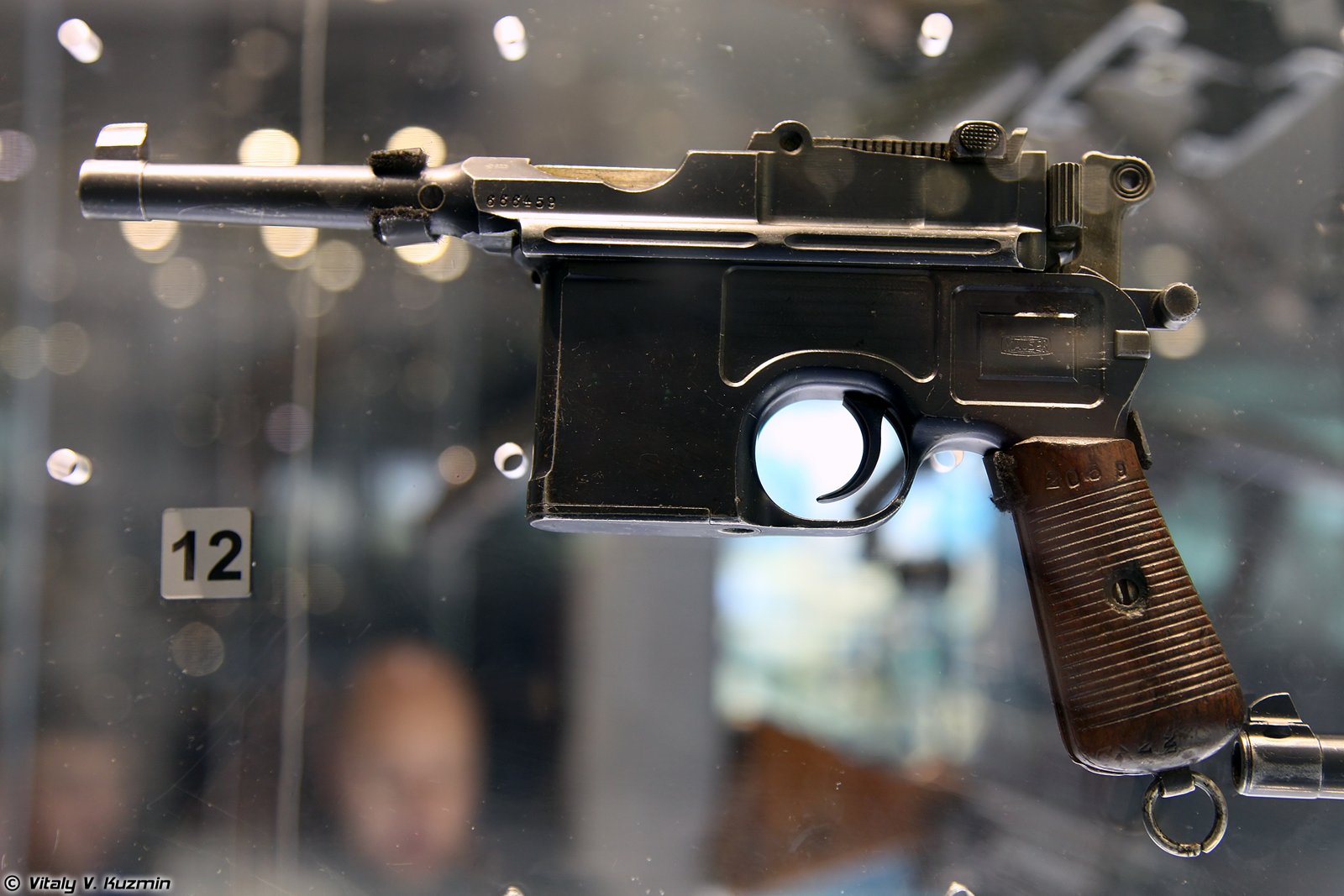
To comply with the Treaty of Versailles, many long-barrel guns were cut to under 4″, the tangent sight removed, the top of the barrel extension milled flat, and a new front sight welded on. These usually carry a “1920” stamp on the barrel extension or frame. Many also got new proof/unit marks (e.g. Finnish “SA”, French Gendarmerie contracts), and a host of hybrid rebarreled oddities exist (e.g. 7.65 mm Luger-barreled guns).
4.2.6 Model 1930 (M30)
A simplification/improvement of the 1920s commercial gun (~serial 800,000): the Universal Safety (allows lowering the hammer on a loaded chamber), a transitional stepped barrel early on, and the D.R.P.u.A.P. marking (design protected by German + foreign patents) with the Mauser banner. Made until ~1939. A few were built on the frame prepared for the selective-fire model but as ordinary semi-autos.
4.2.7 Schnellfeuer / “M712” (1932–38) — select-fire
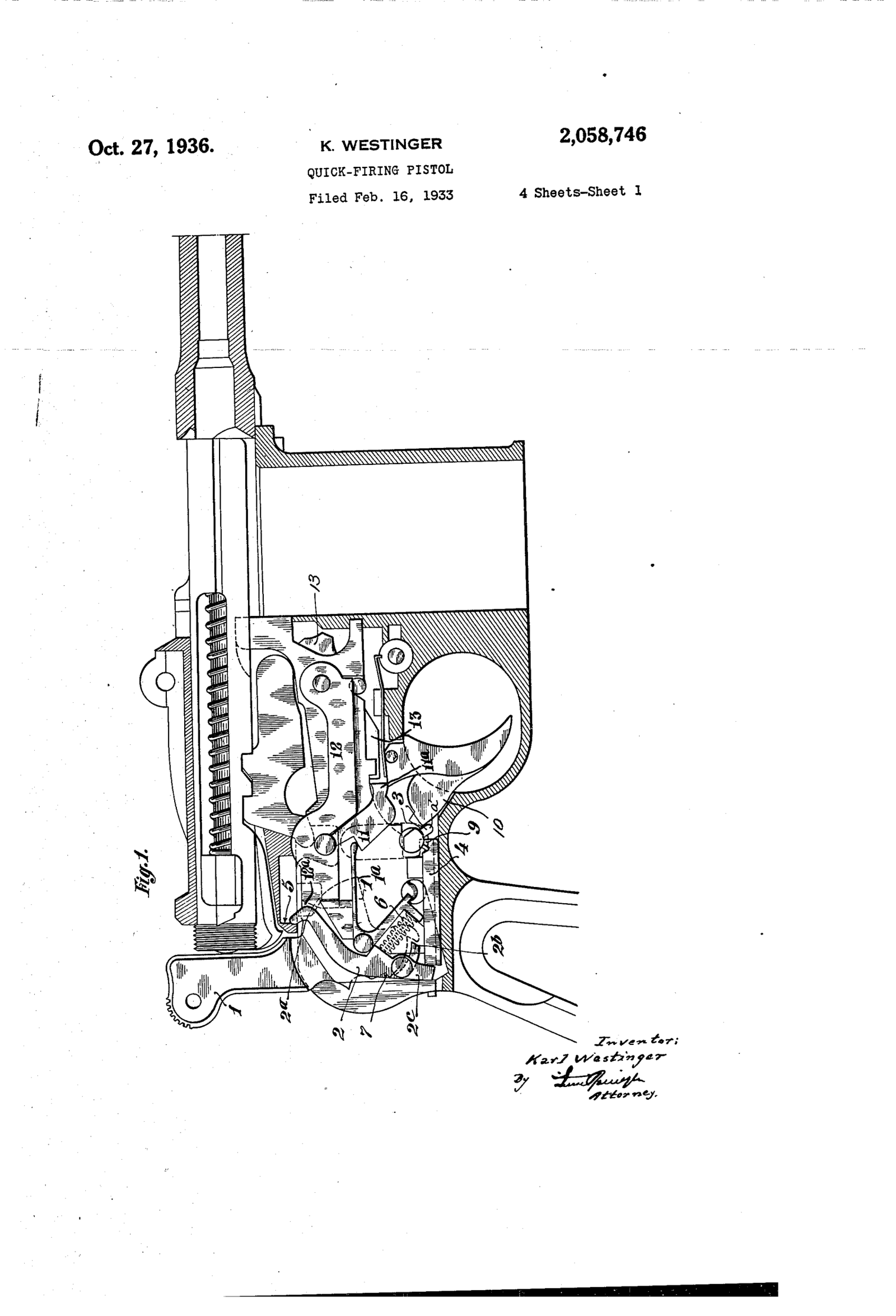
Originating with a 1917 select-fire carbine prototype (40-round magazine — an SMG forerunner), the production select-fire C96 came in two patterns: the Nickl model (US 1,980,874; reliability issues, ~4,000 made) and the common Westinger model (US 2,058,746, 1936). “Model 712” is a Stoeger catalog name, not a factory designation; “Model 711” is the M30 with a detachable magazine but no rapid-fire. ~100,000 Schnellfeuers were made, mostly exported to China (“Made in Germany” in Chinese characters on the magazine well). Select-fire = NFA machine gun; this series documents it but never a conversion (Vol 11).
4.3 Contracts & foreign copies
| Type | Origin | Tell |
|---|---|---|
| Italian Navy | Mauser, 1899 | Flat-side, large ring; serials 1–5,000; “DV”/“AV” Italian proofs |
| Persian / Turkish / other contracts | Mauser | Crest engraving on the (squared) left-rear panel |
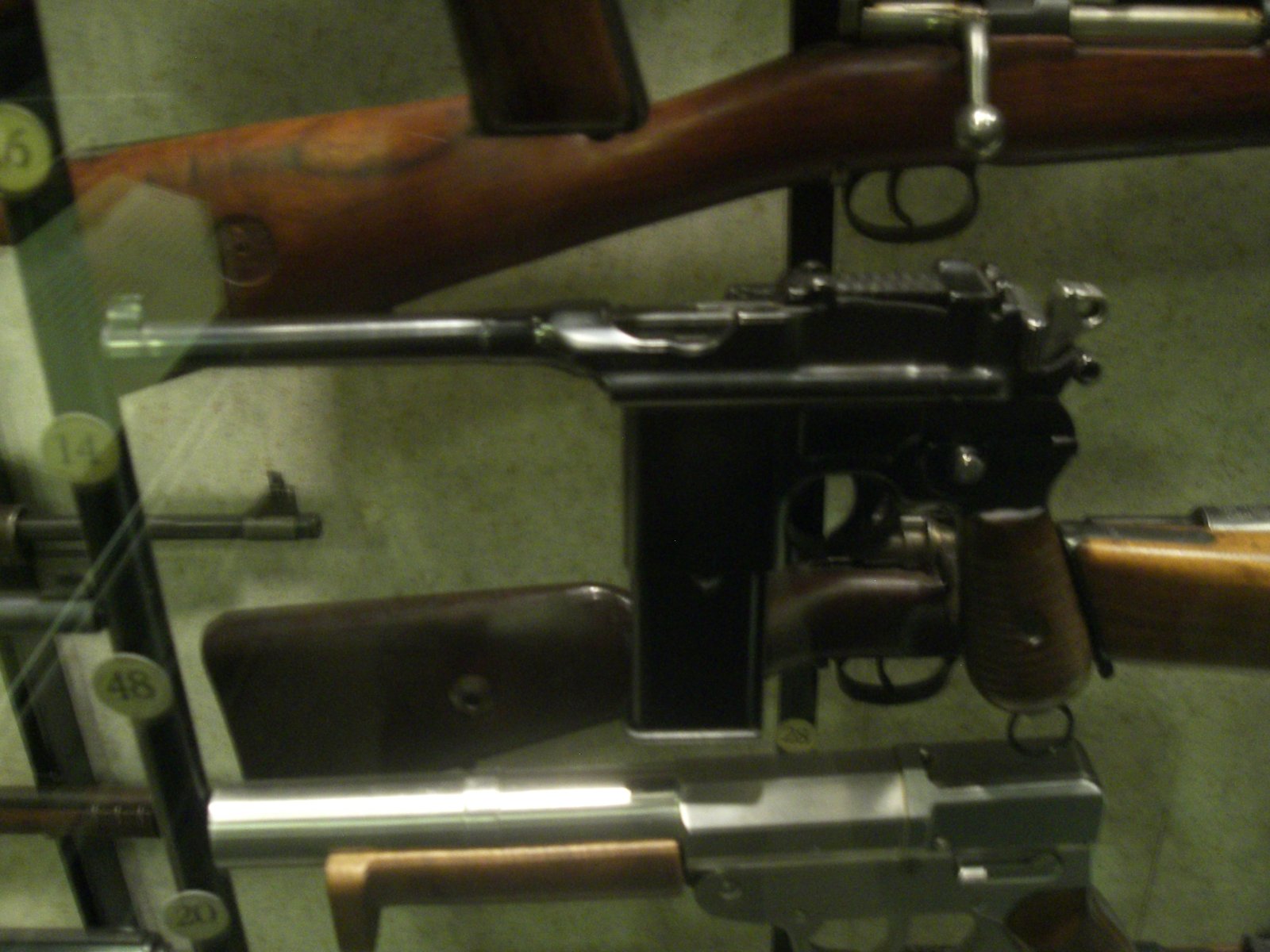
| Astra 900-series | Spain (Unceta) | Mechanically distinct copy; often one-piece bolt/barrel differences; Spanish proofs |
| Chinese commercial copies | various Chinese arsenals | Crude machining/metallurgy; many in 7.63 |
| Chinese Shanxi Type 17 | Taiyuan Arsenal, Shanxi (warlord Yan Xishan), ~1929 | Chambered in .45 ACP — oversize receiver/magazine + oversize stock/holster; Chinese inscriptions; the famous “big bore broomhandle.” See ../references/extracted_text/Chinese_Type_17_Gorelick_text.txt |
The Astra and Chinese copies matter for both collectors (don’t pay Mauser money for a copy) and prop donors (a copy can be a legitimate, cheaper donor if the silhouette is right).
4.4 Identification checklist
Read these in order against the serial (Vol 5):
- Hammer — cone / large ring / small ring (§4.1).
- Receiver sides — milled panels (deep / shallow) vs flat side.
- Barrel length — 5.5″ standard, 3.9″ Bolo, <4″ 1920-rework, 4.75″/4″/5.25″ era variants (Vol 3,
../blueprints/README.md). - Chamber marking — “SYSTEM MAUSER” → “WAFFENFABRIK MAUSER OBERNDORF” → Mauser banner (Vol 5).
- Safety — long early lever (down to apply) → late first type → “Ns” → Universal (Vol 6 covers the mechanism).
- Caliber tells — 7.63 default; 9×25 Export (magazine indentation, reinforced chamber); 9×19 Red 9 (carved red “9”, Eagle on magazine front); .45 (Shanxi Type 17, oversize).
- Maker — Mauser banner / Oberndorf address vs Astra/Chinese marks.
4.5 Choosing a C96 as a prop donor (bridge to the DL-44 and future Mauser blasters)
For a prop build that wants a real C96 base, the donor question is mostly about silhouette and legal friction, not collector value:
- Silhouette: the DL-44 (and most Mauser-derived blasters) read off the standard 5.5″ large/small-ring profile. A Bolo’s short barrel changes the proportions — confirm the intended look before committing (this is the debated point in the DL-44 deep dive,
../../DL-44/). - Don’t sacrifice a collectible. Use a rough, mismatched, or already-modified gun, a copy (Astra/Chinese), or a non-firing/deactivated specimen rather than cutting a matching-numbers original.
- Legal: a real-firearm donor carries the full antique/C&R posture (Vol 5, Vol 11); a copy or deactivated piece may not — which is often why prop builders prefer them.
- Hand it back to the prop deep dive: the modification steps (scope mount, flash hider, grips, refinishing) live in the DL-44 series, not here. This volume just answers “which C96, and is it the right base.”
4.6 References (Vol 4)
- Henrotin, The Mauser C96 Explained (©2002) — facts only; Breathed & Schroeder, System Mauser; Jan C. Still, Pistols of Germany (
../references/). - Gorelick, “The Chinese Shanxi Type 17” (
../references/extracted_text/). - US Patents 1,980,874 and 2,058,746 (public domain,
../blueprints/). - Synthesis:
../volume_sources/research_notes.md§5–6. Dating detail: Vol 5. Full bibliography: Vol 12.