Mauser C96 Broomhandle · Volume 3
Caliber & Cartridge
From the 7.65 Borchardt to the 7.63×25 bottleneck, the 9 mm Export, and the 9×19 Red 9 — and our 9×19 build
Contents
The C96’s cartridge history is short, linear, and directly relevant to a modern build: it explains why the gun is shaped the way it is, and it sets the constraints for chambering one in 9×19 mm Parabellum today.
3.1 The starting point: 7.65 mm Borchardt
The first Mauser prototype was chambered in 7.65 mm Borchardt — a DWM cartridge (DWM owned Mauser) developed for Hugo Borchardt’s C-93, the first effective semi-automatic pistol (1893). At the time it was essentially the only suitable self-loading-pistol cartridge in existence, so it was the natural choice for the prototype.
3.2 The 7.63×25 mm Mauser bottleneck
For production, Mauser adapted the Borchardt case into the 7.63×25 mm Mauser: the bottleneck case diameter was reduced and the powder charge increased, producing a high-velocity, flat-shooting round. Paired with the C96’s long (≈140 mm / 5.5″) barrel, it gave the pistol range and penetration well beyond its contemporaries. The 7.63×25 was the highest-velocity commercially produced pistol cartridge until the .357 Magnum arrived in 1935. Bore diameter is .3008″; peak chamber pressure is on the order of 30,000 psi.
This cartridge is the reason for the long barrel, the tangent rear sight graduated optimistically to several hundred meters, and ultimately the whole long-bore-axis silhouette. (The 7.63×25 later became the parent of the Soviet 7.62×25 Tokarev — dimensionally close, loaded hotter; do not assume interchangeability for a build.)
3.3 The 9 mm Mauser Export (9×25)
Around 1907–08 Mauser introduced the 9 mm Mauser Export (9×25 mm) commercially, aimed at colonial markets — Africa, South America, and the Orient — where larger calibers were preferred. Export-chambered C96s are generally found in the 40,000–80,000 serial range, sometimes with a small “a” beneath the serial number.
Two mechanical points matter for identification and for understanding chamber design:
- Export guns are characterized by a magazine indentation milled into the upper surface of the well to feed the larger round.
- Later Export guns extended the chamber’s external flat sides forward — done to strengthen a chamber whose forward wall had been thinned to accommodate the longer, straight-walled case. This is the clearest period evidence that chamber wall thickness is the limiting factor when adapting the C96 to a fatter or longer cartridge — directly relevant to a 9 mm build.
The Export was phased out in 1914.
3.4 The 9×19 mm Parabellum “Red 9” (WWI)
In early 1916, with WWI in full swing and a handgun shortage, the German military ordered roughly 150,000 C96s in their own serial range — but chambered in 9×19 mm Parabellum to match the standard-issue Luger P08 and avoid a second pistol-cartridge supply chain. To stop soldiers loading 7.63 Mauser into a 9 mm gun (the rounds are dimensionally similar enough to chamber in each other’s pistols, with dangerous results), a large “9” was carved into the grip panels and painted red — the famous “Red 9.” The carving was done by the issuing units, not at the factory (quality and grip fit vary widely). Most Red 9s carry the Imperial German Eagle stamped on the front wall of the magazine well. The order was nearly complete when the war ended in 1918.
The Red 9 is the historical proof of concept for this build: 9×19 runs in the standard C96 frame and magazine.
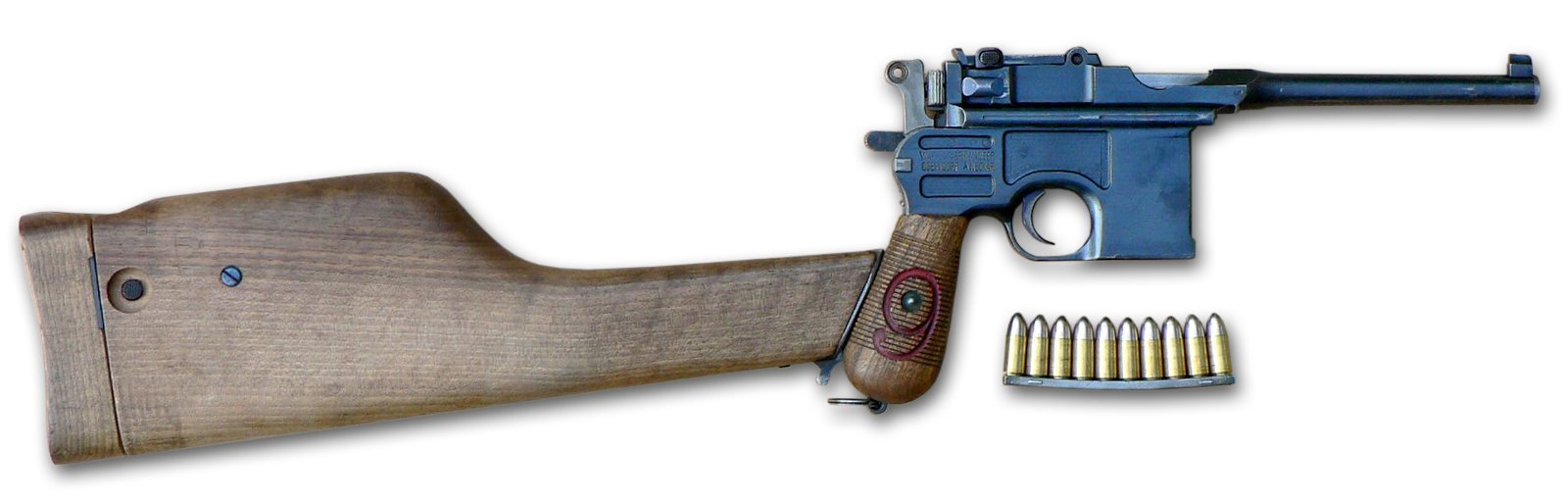
3.5 Our build: 9×19 mm Parabellum
We chamber this build in 9×19 mm Parabellum, chosen for current ammunition availability. What that decision changes, relative to the original 7.63×25:
- Case length and shape. 9×19 is shorter than the 7.63×25 (and shorter than the 9×25 Export), and it is a tapered, near-straight case rather than a long bottleneck. Chamber and feed geometry must be cut for 9×19 specifically — do not scale a 7.63 chamber drawing. Headspace is on the case mouth (rimless, mouth-headspacing), not on a shoulder.
- Feed geometry. The magazine follower, lips, and feed ramp must suit the shorter, fatter round. The Red 9 used the standard well with appropriate feed geometry — use a 9 mm Red-9-pattern follower/lip geometry as the reference, not a 7.63 one.
- Chamber wall. Per §3.3, the Export experience shows chamber-wall thickness is the constraint when going to 9 mm. 9×19 is shorter than the 9×25 Export, which helps, but the from-scratch barrel/chamber (Vol 9) should preserve adequate forward chamber-wall thickness and not blindly thin it to a 7.63 profile.
- Pressure. Standard 9×19 runs around 35,000 psi (SAAMI) — in the same neighborhood as the 7.63×25’s ~30,000 psi, so the locked-breech action is well within its design envelope at standard pressures. Avoid +P/+P+ in a vintage-pattern or freshly fabricated action without explicit proof testing.
3.6 Rifling
Original C96 rifling was four grooves, right-hand twist, changed to six grooves around serial number ~40,000. For a 9×19 build, a 9 mm (.355″) barrel, six-groove, right-hand is the period-consistent and correct choice. The barrel/rifling is the likely farm-out for the from-scratch path (bought-in blank chambered and fit, or a rebore) — see Vol 6 and ../blueprints/README.md.
3.7 Cartridge quick table
| Cartridge | Era | Case | Notes |
|---|---|---|---|
| 7.65 mm Borchardt | prototype (1894–95) | bottleneck | DWM; Borchardt C-93 round |
| 7.63×25 mm Mauser | 1896– | bottleneck | The classic C96 round; .3008″ bore; ~30k psi; highest-velocity pistol round until .357 Mag (1935) |
| 9×25 mm Mauser Export | ~1907–14 | long straight | Colonial markets; magazine indentation; thinned/then-reinforced chamber |
| 9×19 mm Parabellum | ”Red 9” 1916; our build | tapered short | Matches Luger P08; standard frame/mag; mouth-headspacing |
| 6 mm experimental | pre-production | straight cylindrical | Tested, abandoned |
3.8 References (Vol 3)
- Henrotin, The Mauser C96 Explained (©2002) — facts only; Breathed & Schroeder, System Mauser.
- Wikipedia / Sportsman’s Vintage Press (bore, pressure, barrel-length-by-era) — see
../blueprints/README.md. - Synthesis in
../volume_sources/research_notes.md. Full bibliography in Vol 12.