Mauser C96 Broomhandle · Volume 11
Legal & Regulatory Posture
The C96's specific pivot points — antique vs C&R, the shoulder-stock SBR trap, the Schnellfeuer machine-gun line, and home manufacture
Contents
The C96 carries the heaviest set of legal pivot points of any build in this hub so far. This volume is the build-specific tail of ../../_shared/legal_ethics.md — read both. This is not legal advice; it is US-centric; and state law frequently overrides federal-only assumptions. When a path’s posture is unclear for your state, confirm before acting.
11.1 Antique vs C&R — the foundational split
- Pre-1899 manufacture = a federal “antique” (18 USC §921(a)(16)): not a “firearm” under the GCA, regardless of caliber, as long as it hasn’t been reworked into a non-antique configuration. Antiques ship and transfer under different (looser) federal rules.
- Post-1899 = a modern firearm. Most C96s are Curio & Relic eligible (27 CFR 478.11 — over 50 years old / on the ATF C&R list), which changes who may buy/ship/sell (C&R FFL) but does not exempt the gun from the NFA pivots below.
- The cutoff is by manufacture date, inferred from serial + features (Vol 5) — and because the C96’s serial blocks are not one clean sequence (Vol 5 §5.1), the exact pre-1899 boundary is variant-specific and contested at the margins. Document the determination; don’t assert “antique” from a round-number serial. ATF publishes the relevant guidance — cite it, don’t guess.
- State override: a gun that is a federal antique may still be regulated as a firearm by your state. Confirm.
11.2 The shoulder-stock holster → SBR pivot
The C96’s classic accessory is a wooden holster that doubles as a shoulder stock. Attaching a functional stock to the pistol creates a short-barreled rifle/firearm under the NFA (27 CFR 479; rifle barrel <16″ or OAL <26″) — tax-stamp territory.
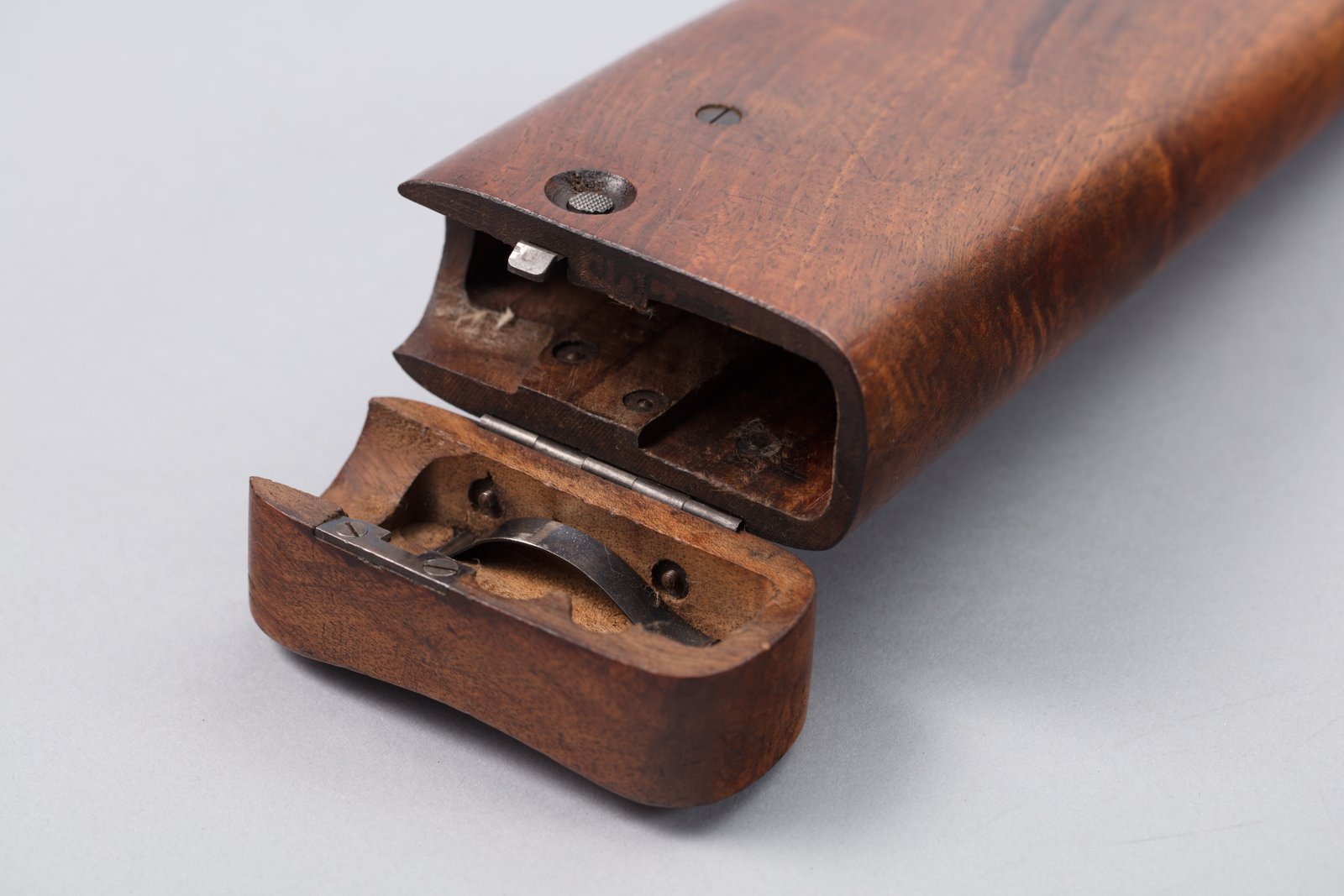
- The 2014 ATF carve-out: ATF ruled that original C96 (and Luger) shoulder-stock holsters paired with their C&R pistols are exempt as C&R items in that original configuration — a narrow, specific exemption. A reproduction stock, or an original stock on a non-C&R gun, does not automatically enjoy it. Cite the specific ruling; treat the exemption narrowly.
- Constructive possession (
../../_shared/legal_ethics.mdstanding rule 4): possessing the pistol and a fitting stock can itself be the SBR even unassembled, outside the exemption. If you build/own a stock, understand exactly which configuration you’re in.
11.3 Schnellfeuer / M712 = machine gun
Select-fire C96s (Nickl/Westinger Schnellfeuer, “M712” — Vol 4 §4.2.7) are machine guns under the NFA (fire >1 round per trigger pull). Civilian new manufacture is effectively closed under the Hughes Amendment (1986). Consequences for this hub:
- Never build, convert toward, or document a conversion to select-fire. This series shows the Schnellfeuer’s history and mechanism (Vol 4) for identification and legal-status purposes only.
- An existing transferable Schnellfeuer is a registered NFA item; a semi-auto C96 must stay semi-auto (and must include the disconnector, Vol 6 §6.2 — a gun that doubles or runs away is a malfunctioning machine gun, a serious problem).
- A genuine Schnellfeuer that has been legally de-activated to semi-auto (e.g. second sear welded/disabled, fire-select lug removed) is the only “Schnellfeuer that’s a non-MG,” and that status must be documented.
11.4 Home manufacture (Path C) and parts kits (Path B)
- Federal: a non-prohibited person may make a non-NFA firearm for personal use, not for sale, without a manufacturing license. Post-2022 ATF Final Rule 2021R-05F expanded “readily” and the frame/receiver definition and tightened marking expectations; the regulatory picture is evolving — verify current rules.
- Serialization: federal personal-use manufacture has not required a serial historically, but ATF rules and many states now require serialization/registration — and some states prohibit home manufacture outright (CA, NJ, NY, etc., have specific regimes). Confirm your state before building (Path B or C).
- No counterfeit marks (Vol 10 §10.6): if you serialize, use your own distinct mark — never a fake Mauser number/banner/proof. Counterfeiting is a separate offense.
- 80%/receiver: the C96 receiver is the firearm (18 USC §921). Re-welding a demilled receiver or machining a receiver to functionality is manufacturing a firearm — all of the above applies (
../../_shared/legal_ethics.md).
11.5 Demill, shipping, import marks
- Demill criteria (federal) are specific (cut through the chamber/receiver per ATF, etc.) and not negotiable; a “parts kit” relies on the receiver having been properly demilled (Vol 8). State criteria may differ.
- Shipping: a modern (post-1899) C96 generally ships to an FFL across state lines; antiques are federally exempt but may not be at state level. C&R items have their own shipping rules for C&R FFL holders.
- Import marks: many C96s in the US carry importer markings; their presence/format is a provenance and legality signal (a post-‘68 import without proper marking is a flag).
11.6 Primary sources (cite these, not memory)
- 18 USC §921 — definitions (“firearm,” “antique firearm,” “machinegun”).
- 18 USC §922 — transfer/prohibited-person rules.
- 27 CFR Part 478 — GCA implementation (frame/receiver, C&R at 478.11).
- 27 CFR Part 479 — NFA implementation (SBR/SBS/MG/AOW/suppressor, tax stamps).
- 15 USC §5001 — imitation-firearm marking (relevant to non-firing/display or prop-stand-in builds).
- ATF Final Rule 2021R-05F (2022) — frame/receiver + “readily.”
- ATF ruling on original C96/Luger stock-holsters (2014) — the narrow C&R stock exemption.
- Your state statutes — cited by number, not third-party summaries.
11.7 Bottom line by path
| Path | Headline posture |
|---|---|
| A — Authentic specimen | Real firearm. Antique (looser) vs C&R; no stock unless you understand the SBR pivot; keep it semi-auto. |
| B — Parts kit | Receiver provenance is everything; re-welding/manufacturing a receiver = making a firearm; state may forbid. |
| C — From scratch | Personal-use manufacture (federal, evolving); state may require serialization or prohibit it; no NFA configs; own serial only, no counterfeit marks. |
| Non-firing / prop stand-in | Not a firearm federally; 15 USC §5001 + state imitation-firearm rules apply. |
When unsure, ask / confirm before acting. (../../_shared/legal_ethics.md standing rule.)
11.8 References (Vol 11)
../../_shared/legal_ethics.md; the primary sources in §11.6.- Cross-refs: Vol 4 (Schnellfeuer), Vol 5 (dating→antique/C&R), Vol 8 (kits/receiver), Vol 9 (home manufacture), Vol 10 (markings). Full bibliography: Vol 12.