Mauser C96 Broomhandle · Volume 1
Overview & Decision Tree
What the C96 is, the three build paths, and how to read this series
Contents
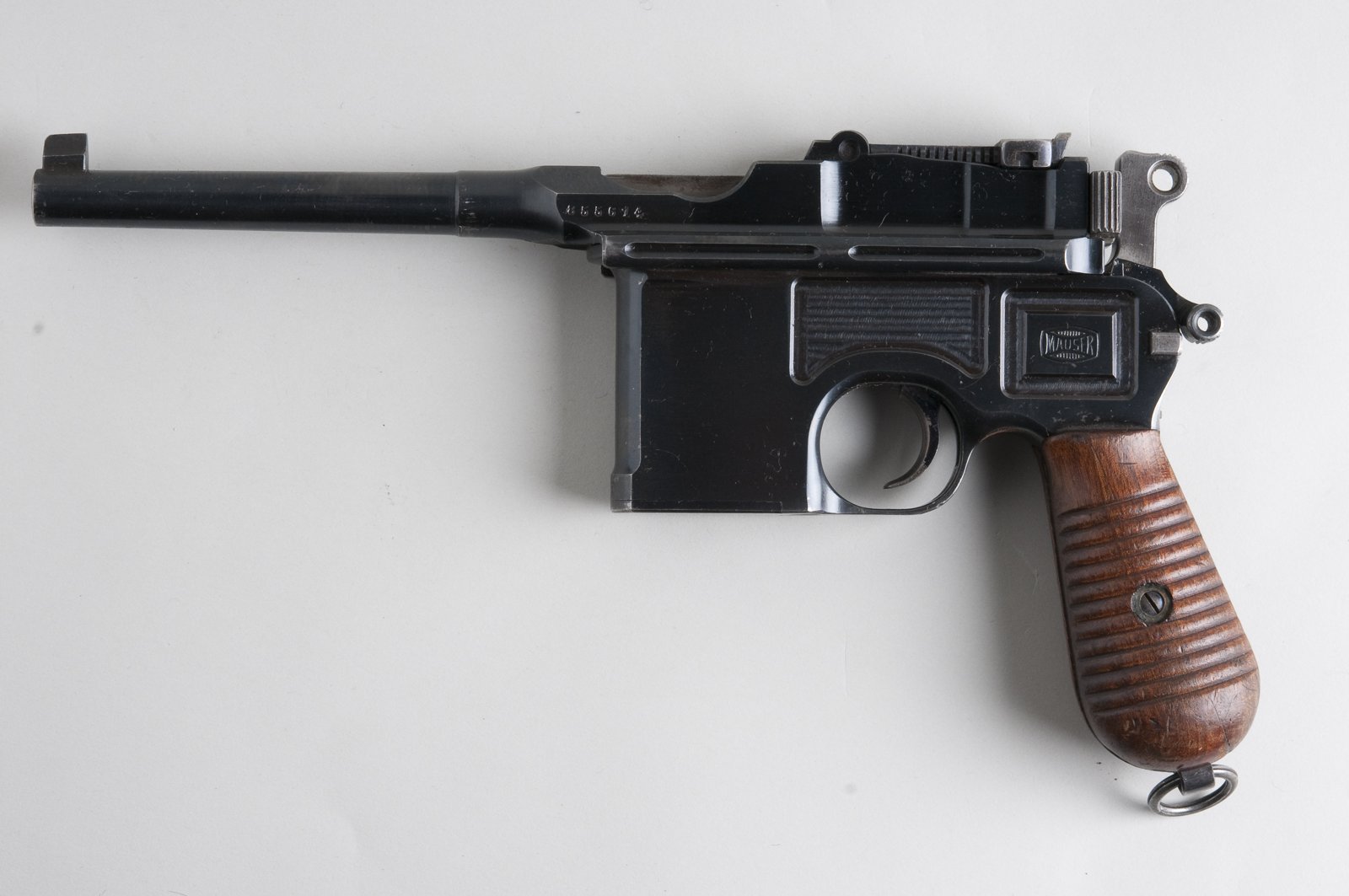
The Mauser C96 “Broomhandle” (Mauser Construktion 96) was the first commercially successful self-loading pistol — roughly a million made between 1896 and the late 1930s, across factory variants, military contracts, and a forest of foreign copies. It is also the Firearms hub’s first non-prop build: documented here as a real firearm in its own right, not as a Star Wars donor.
This series has a dual role. It is a build manual for actually owning, restoring, or fabricating a C96 — and it is the canonical C96 platform reference that the prop builds in this hub draw on. The DL-44 deep dive (../../DL-44/) cites this series for the donor-firearm questions (variant identification, serial-range dating, mechanics, legal status) rather than re-deriving them, and future Mauser-derived blasters will do the same.
It is written for an experienced maker / gunsmith with a real lab — multi-CNC, multi-3D-printer, a 100 W laser, and a full gunsmithing bench. The from-scratch volume in particular assumes that capability, because the C96 is one of the few historic pistols where machining one from raw stock is genuinely on the table.
1.1 What the C96 actually is
The C96’s defining features are visible at a glance and are the reason it reads as itself on sight:
- an integral box magazine forward of the trigger guard, charger-loaded on most variants (the Chinese nickname “box cannon” comes from this rectangular well);
- a slab-sided receiver and the round broomhandle grip that gives it its name;
- a machined-from-solid lockwork with no pins and a single screw — the action is held together by the geometry of its interlocking parts (Vol 2);
- a long, bore-axis-high silhouette and a prop-up, short-recoil locked-breech action (Vol 6).
It was built around the high-velocity 7.63×25 mm Mauser cartridge, with 9 mm Mauser Export and the wartime 9×19 mm Parabellum “Red 9” as the principal alternatives (Vol 3).
1.2 The dual role of this series
| Audience | What they take from this series |
|---|---|
| You, building a real C96 | All three build paths (Vols 7–9), mechanics + dimensions (Vol 6), finishes (Vol 10), and the legal posture (Vol 11). |
| A prop build (DL-44, future Mauser blasters) | The variant survey + dating (Vols 4–5) and the design/mechanics background (Vols 2, 6) — the “which C96, and what is it” reference. |
1.3 The three build paths
Per ../../_shared/deep_dive_protocol.md § 4, every firearms deep dive treats build-from-parts and build-from-scratch as mandatory. For a real C96 there is no “replica/airsoft” path as there is for a prop — this is the actual firearm — so the three paths are:
| Path | Vol | Source | Skill | Lab use | Legal posture | Time |
|---|---|---|---|---|---|---|
| A. Authentic specimen | 7 | A real C96 (pre-1899 antique or post-1899 C&R) | High | Low–medium (clean, fit, refinish) | Real-firearm: antique / C&R rules | 10–60 hr |
| B. From parts kit | 8 | Surplus/demilled parts kit + repro/replacement parts | High | Medium | Receiver-provenance + manufacturing law | 20–50 hr |
| C. From scratch | 9 | Raw billet + bar stock | Very high | Full — CNC + lathe + 3D print + laser + finishing | Manufacturing-for-self law | 100–300+ hr |
1.4 Decision tree — which path
- Goal: simply have a real C96. → Path A. Buying a clean C&R or antique specimen beats building one. The C96 is widely available on the collector market; from-scratch fabrication is a project, not a shortcut.
- Goal: a shooter built around a specific variant or surplus economics. → Path B, subject to receiver-provenance and applicable manufacturing law.
- Goal: the build is the point. → Path C. This is the path matched to the lab — and it is honestly one of the hardest from-scratch handgun builds there is, because of the screwless lockwork (Vol 2, Vol 9). Budget the fitting time and confirm the barrel/rifling path early (Vol 6).
1.5 Chambering: 9×19 mm Parabellum
This build targets 9×19 mm Parabellum — chosen for current ammunition availability. Historically this is the WWI “Red 9” path: in 1916 Mauser delivered ~150,000 C96s in 9×19 to match the Luger P08, proving the platform runs the cartridge in the standard frame and magazine. Because 9×19 is shorter than both the original 7.63×25 bottleneck and the 9×25 Export, the chamber and feed geometry must be dimensioned for 9×19 specifically — see Vol 3 and Vol 6. The cartridge story and its build implications are Vol 3.
1.6 Lab capability — and what it shifts
For most people the screwless C96 lockwork puts a from-scratch build out of reach. For this lab it is on the table, and it is the most interesting path — so Vol 9 gets first-class machinist treatment. The honest caveats (carried through the series): the barrel and rifling are the likely farm-out (confirm in-house rifling capability before promising it), and the lockwork tolerances want confirmation that the mill can hold them in 4140. Specifics live in ../DEVELOPMENT.md and the lab catalog (TBD).
1.7 Volume-by-volume index
| Vol | Title | What’s inside |
|---|---|---|
| 1 | Overview & Decision Tree | This volume |
| 2 | Design Rationale & Engineering History | Why the C96 is built the way it is; the patent; manufacturing |
| 3 | Caliber & Cartridge | 7.65 Borchardt → 7.63×25 → 9 mm Export → 9×19 Red 9; our 9×19 build |
| 4 | Variant Survey & Identification | Cone hammer → flat side → large/small ring → Bolo → M30 → Schnellfeuer → copies |
| 5 | Provenance, Serial Ranges & Dating | Dating handles; antique vs C&R |
| 6 | Mechanics, Dimensions & Drawings | The no-pin takedown; the drawing/CAD source package |
| 7 | Build Path A — Authentic Specimen | Acquire + restore/refurbish |
| 8 | Build Path B — From Parts Kit | Kit assembly + repro parts |
| 9 | Build Path C — From Scratch | Full machinist depth, 9×19 |
| 10 | Finishes & Markings | Rust blue, straw, parkerize; marking caution |
| 11 | Legal & Regulatory Posture | Antique/C&R, shoulder-stock SBR, Schnellfeuer = MG |
| 12 | Operational Posture & Cheatsheet | Storage, transport, range; laminate-ready synthesis |
1.8 Reading order
- Building from scratch: Vol 2 → Vol 6 → Vol 3 → Vol 9 → Vol 10 → Vol 11.
- Buying/restoring a specimen: Vol 4 → Vol 5 → Vol 11 → Vol 7.
- Here for the prop-donor question (DL-44 etc.): Vol 4 → Vol 5, then Vol 2/6 as needed.
1.9 What this series is not
It is not a Schnellfeuer/M712 conversion guide. Select-fire C96 variants are machine guns under the NFA; this series documents their history and legal status (Vol 4, Vol 11) but never a conversion. It is also not legal advice — firearms law is jurisdiction-dependent (Vol 11, ../../_shared/legal_ethics.md).
1.10 Sourcing & copyright note
Factual content here is synthesized from period and collector sources — Paul Mauser’s patents (public domain), Breathed & Schroeder’s System Mauser, Jan C. Still’s Pistols of Germany, and others. Where a source is itself copyrighted (e.g. Henrotin’s The Mauser C96 Explained), only facts are used — facts are not copyrightable — and its text and images are not reproduced. Drawings reproduced in this series are public-domain patent figures; community CAD and commercial drawings are cited, not copied (Vol 6, ../blueprints/README.md).
1.11 References (Vol 1)
- US Patent 584,479 (P. Mauser, 1897) — public domain. See
../blueprints/. ../../_shared/deep_dive_protocol.md(§ 4 mandatory volumes);../../_shared/legal_ethics.md.../blueprints/README.md— dimensioned-drawing and CAD source catalog.- Full bibliography consolidated in Vol 12.