DL-44 "Heavy" Blaster · Volume 3
Donor Firearm Provenance — Mauser C96 Broomhandle
Contents
This volume covers the Mauser C96 “Broomhandle” pistol at the depth a DL-44 builder needs — variants, identification, era markings, chamberings, sourcing, and the C&R / antique legal status that determines how the donor can be acquired and transferred. It is not a complete C96 gunsmithing manual — for action work, headspace regulation, ejector timing, and other deep gunsmithing topics, see the collector references in § 3.10. This volume gets a DL-44 builder from “what is this thing” to “I know which one to buy”.
The C96 is a foundational pistol — the first commercially-successful semi-automatic pistol design, in service in some form from 1896 to the present (Spanish-made copies continued into the 1940s; Chinese copies into the 1950s). It is also a legal grey-zone donor, with antique / C&R status varying by exact production year, and with at least one famous NFA pivot point (the original shoulder-stock holster). Both technical and legal grounding matter for a successful build.
3.1 The C96 family at a glance
The Mauser C96 was designed by the Feederle brothers (Fidel, Friedrich, and Josef Feederle) at the Mauser factory in Oberndorf am Neckar, Germany. Production began in 1896; the design was patented in 1895. Over 41 years of Mauser production (plus subsequent copy production), an estimated one million pistols were made, in dozens of variants.
The key distinguishing features that define a C96 — and that the DL-44 inherits visually:
- Slab-sided receiver — the receiver block is wider at the sides than at the top, giving the gun a distinctive flat-sided silhouette.
- Bolt that rides above the grip, in a tunnel through the receiver block. The bolt cycles linearly back and forth; it is not a tilting or rotating action.
- Integral magazine box ahead of the trigger guard, with internal capacity of 6 or 10 rounds depending on variant. Most variants are stripper-clip-loaded through the top of the action; the M712 has a detachable box magazine.
- “Broomhandle” grip shape — the grip is roughly rectangular in cross-section, with rounded corners, and stands proud of the trigger guard. The community name “broomhandle” refers to this grip; the official Mauser name was simply “Construktion 96” (Construction 96, hence “C96”).
- Tangent rear sight on most variants, calibrated optimistically to 1000 m (the actual effective range is ~50 m).
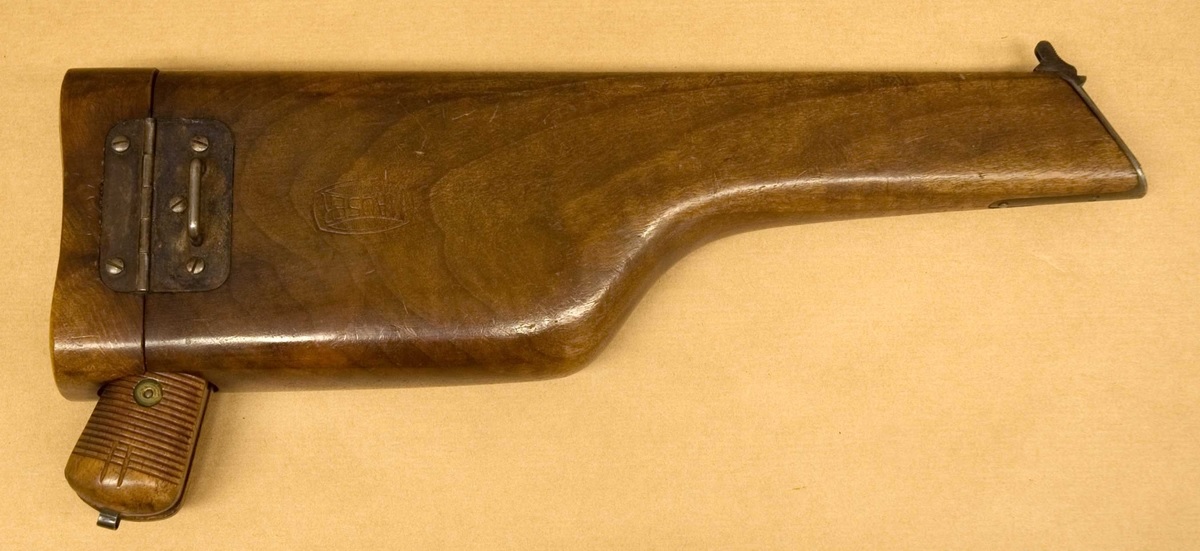
- Wooden shoulder-stock holster as an issued accessory on many variants — the wooden holster could be clipped to the rear of the grip frame, turning the pistol into a carbine-stocked weapon. (This is the NFA pivot point; see § 3.7.)
3.2 Variant taxonomy — what’s what
The C96 went through multiple major variants, distinguishable on sight by hammer shape, frame milling, magazine capacity, barrel length, and chambering.
3.2.1 Cone Hammer (1896-1899)
- Production: ~12,000 (very early production)
- Hammer: Tall, conical / “cone-shaped” hammer head — distinctive of early production
- Frame: Distinctive early milling patterns (“step” cuts and finishing)
- Capacity: 10-round integral magazine standard
- Chambering: 7.63×25mm Mauser only
- Antique status: Pre-1899 production is federal antique under 18 USC § 921(a)(16)
- DL-44 relevance: Visually plausible donor but rarely seen in builds; cost prohibitive
3.2.2 Small Ring Hammer (1899-1902)
- Production: Transitional, smaller numbers
- Hammer: Hammer head reduced from cone to “small ring” shape — a flatter profile with a hole through the head
- Frame: Refined from Cone Hammer; cleaner milling
- Capacity: 10-round standard
- Chambering: 7.63×25mm Mauser
- Antique status: 1899-production C96s straddle the federal antique cutoff — pre-Dec-31-1898 = antique; post = modern firearm. Specific serial-range cutoffs are published by ATF.
- DL-44 relevance: Plausible donor but again rare
3.2.3 Large Ring Hammer (1902-1937) — the canonical DL-44 donor
- Production: The bulk of C96 production — most surviving C96s are this variant
- Hammer: Larger “ring” through the hammer head — the most-iconic C96 hammer shape
- Frame: Various sub-revisions over 35 years of production
- Capacity: 10-round standard (6-round on some commercial models)
- Chambering: 7.63×25mm Mauser (most), 9mm Mauser Export (rare), 9×19mm Parabellum (1916 “Red 9” contract — see § 3.2.5)
- Antique status: Post-1899 production is C&R-eligible under 27 CFR 478.11 but remains a firearm under federal law
- DL-44 relevance: The community-consensus hero donor. The DL-44 hero is most-commonly identified as a Large Ring Hammer C96 with the standard 5.5″ barrel, in 7.63×25mm.
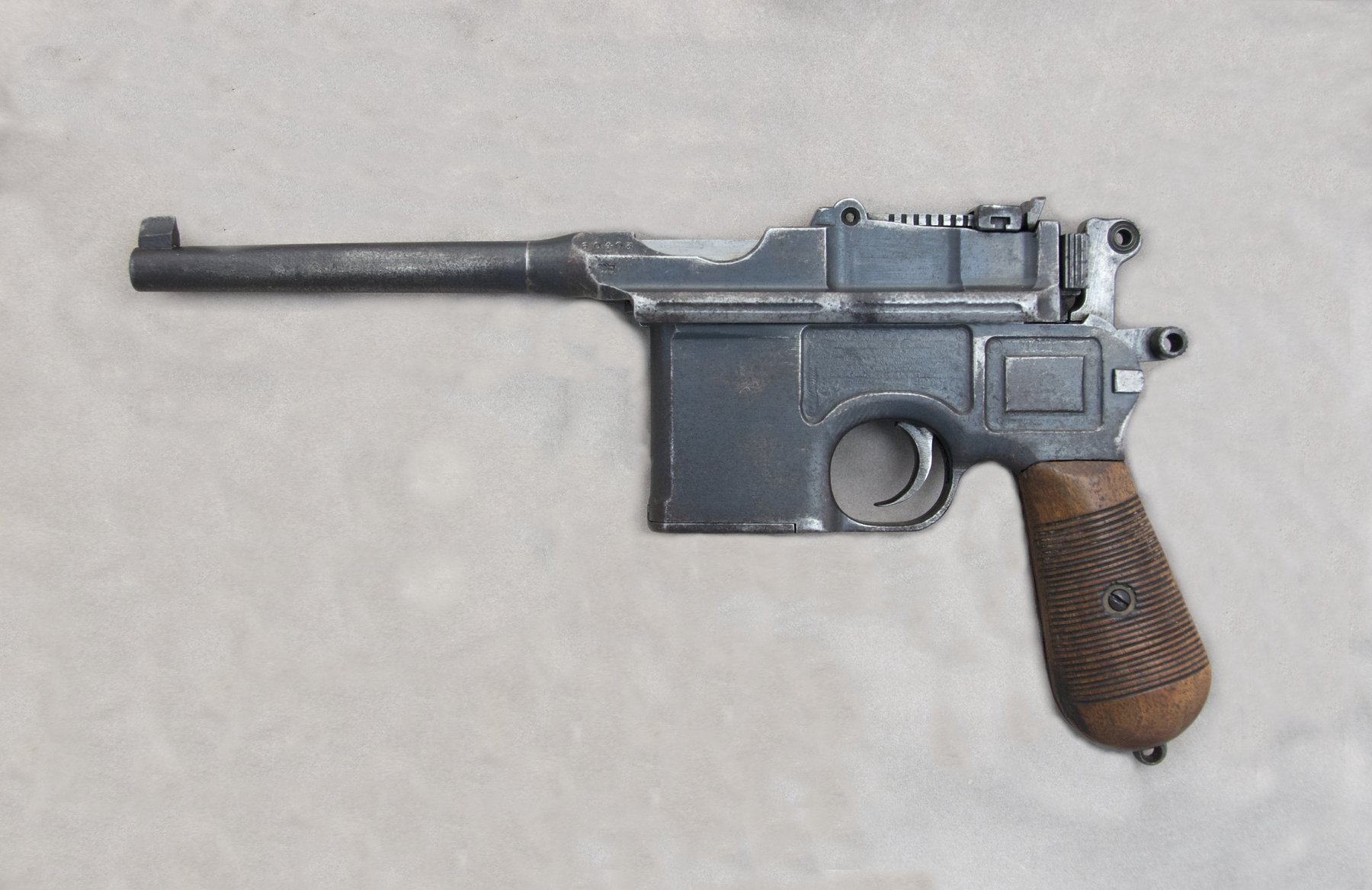
3.2.4 Bolo (1920s short-barrel commercial)
- Production: Post-WWI commercial production — the Treaty of Versailles restricted barrel length and frame size on military-pattern pistols, so Mauser produced the “Bolo” (short for “Bolshevik” — many were exported to Russia) with a shorter barrel and smaller grip frame to comply with the export-permitted commercial-pistol restrictions.
- Barrel: 3.9″ / 99 mm — substantially shorter than the standard 5.5″
- Grip: Smaller, more compact
- Capacity: 10-round integral
- Chambering: Primarily 7.63×25mm Mauser
- Antique status: All Bolos are post-1899 → C&R-eligible
- DL-44 relevance: The minority-position donor for the ANH hero, and the strongest-position donor for at least one ESB-era piece. The Bolo’s short barrel + an extending flash hider can produce a silhouette consistent with some screen analysis. A real Bolo + a longer flash hider is a viable build target.
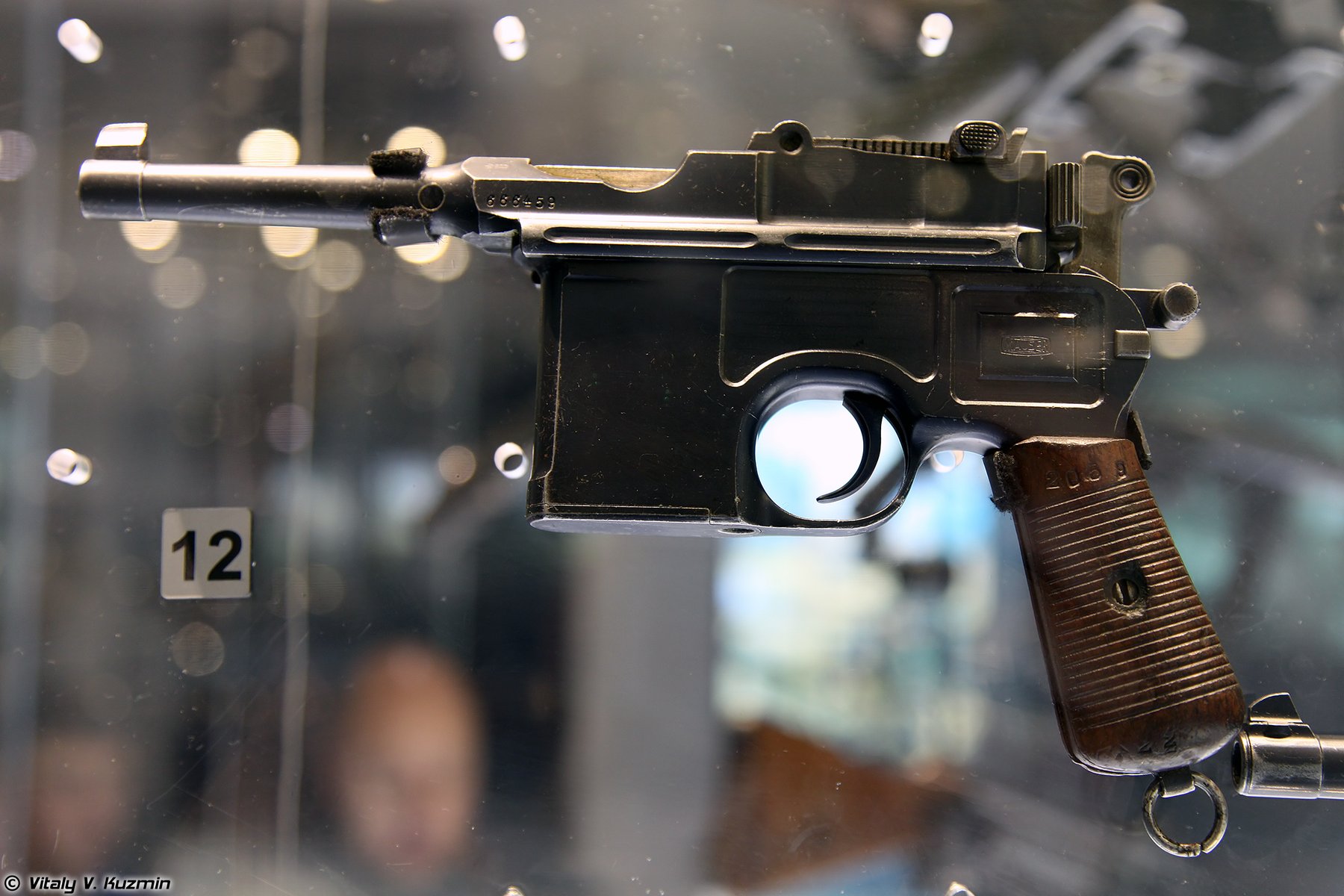
3.2.5 M1916 “Red 9” (9×19mm Parabellum contract)
- Production: ~150,000 in 1916 — German military contract to make up Luger P08 production shortfalls in WWI
- Chambering: 9×19mm Parabellum (not the original 7.63×25mm Mauser) — to use the same ammunition as German Army Lugers
- Identifying mark: Large red-painted “9” on each grip panel — the most distinguishing visual feature, intended to prevent loading 7.63mm ammo into a 9mm pistol
- Frame: Otherwise visually a Large Ring Hammer
- Antique status: All Red 9s are 1916 production → C&R-eligible
- DL-44 relevance: Plausible donor — the 9mm chambering is irrelevant for a display build, but the “9” grip-panel mark would have to be removed or covered. The hero piece is not a Red 9 (the hero grips are plain, not stamped); a builder using a Red 9 as a donor would replace the grip panels anyway.
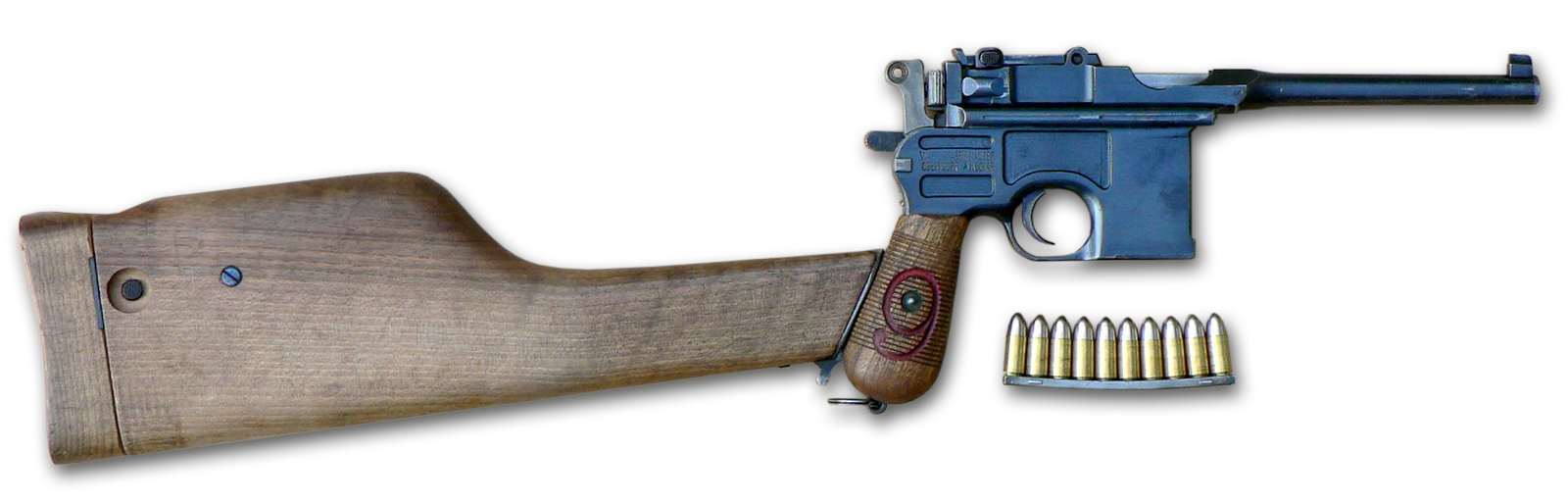
3.2.6 M712 “Schnellfeuer” Selective-fire (1932-1937)
- Production: ~98,000, mostly for commercial export
- Distinguishing feature: Selective-fire — a fire-selector lever above the trigger allowing full-auto fire
- Magazine: Detachable box magazine (10 or 20-round), unlike the integral mag on other C96 variants
- Chambering: 7.63×25mm Mauser
- Antique status: Post-1899 → C&R-eligible but selective-fire makes it an NFA Title II machine gun. Owning a Schnellfeuer in the US requires an NFA tax stamp.
- DL-44 relevance: Avoid as donor. The detachable-magazine feature would have to be reverted to integral, and the NFA legal posture makes the piece harder and more expensive to source. Use a Large Ring Hammer instead.
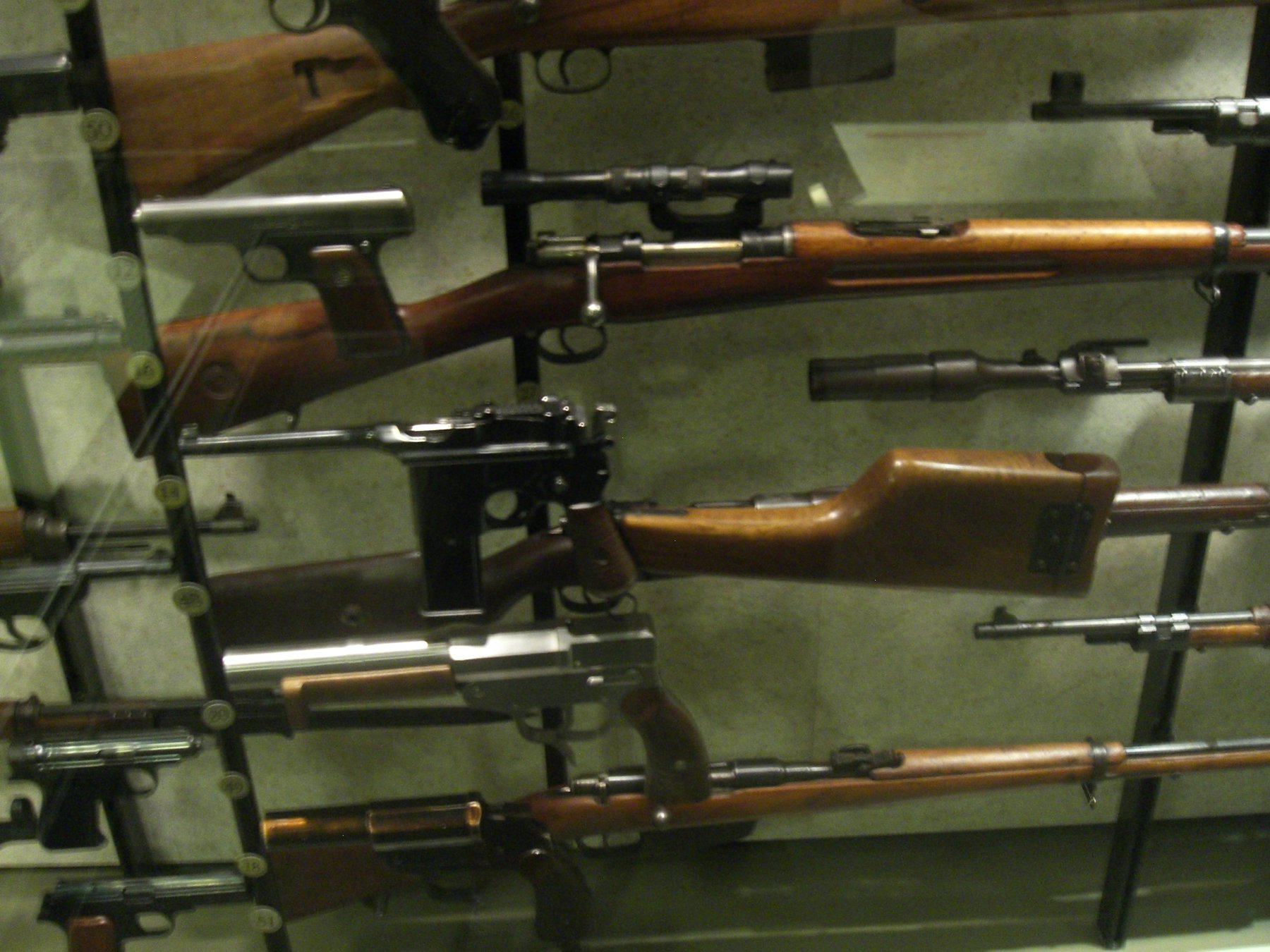
3.2.7 Spanish copies (Astra Model 900, Royal MM31, etc.) (1920s-1940s)
- Production: Various Spanish makers (Astra-Unceta y Cia, Beistegui Hermanos, etc.) produced C96-pattern pistols, some closer copies, some with significant departures
- Chambering: 7.63×25mm Mauser standard, occasional 9mm variants
- Quality: Variable — Astra-made pistols are often very high quality; some smaller-maker copies are rough
- Antique status: Mostly post-1899 → C&R-eligible
- DL-44 relevance: Plausible budget donor. Spanish-copy C96s are cheaper than original Mausers ($300-1000 vs $800-3000 for Mausers), and the silhouette is preserved. Markings on the receiver would differ from the original Mauser banner — for a high-screen-accuracy build, this matters; for a display piece, less so.
3.2.8 Chinese copies (1920s-1940s)
- Production: Multiple Chinese arsenals (Hanyang, Shanghai, others) produced C96-pattern pistols, often in various chamberings including 7.63 Mauser and .45 ACP
- Quality: Highly variable — Hanyang Type 17 pistols are workmanlike; many warlord-era copies are crude
- Markings: Often have Chinese-character markings on the receiver — would need to be covered or removed for a screen-accurate build
- Antique status: Mostly post-1899 → C&R-eligible (varies by exact production date)
- DL-44 relevance: Budget donor option, but proceed with care. Chinese-copy quality varies enormously; the silhouette may be subtly off (different proportions on some copies); the markings would need work. Spanish copies are usually a better budget donor.
3.3 Identifying a C96 by sight
Quick visual identification for a builder evaluating a potential donor:
- Hammer shape — Cone (early), Small Ring (1899-1902), Large Ring (1902-1937). If it’s Large Ring with a 5.5″ barrel and a 10-round mag well, it’s the DL-44-canonical variant.
- Barrel length — 3.9″ = Bolo. 5.5″ = standard. Longer = uncommon, possibly carbine variant.
- Grip-panel material — wood checkered (most), red-painted “9” stamped (Red 9 variant), plain wood (the DL-44 hero look).
- Magazine well — integral 10-round (or 6-round commercial) on most C96s; detachable on M712 Schnellfeuer.
- Selector lever above the trigger — present on Schnellfeuer only.
- Receiver markings — “Waffenfabrik Mauser Oberndorf a/N.” or similar on original Mausers; Spanish or Chinese makers have different banners.
For a real-purchase decision, verify with the seller the variant identification before transacting. C&R-licensed dealers (Type 03 FFL) deal with C96 identification routinely; auction houses (Rock Island, James D. Julia, Heritage) provide pre-auction inspection reports.
3.4 Chamberings — what cartridge is in there
Three chamberings dominate the C96:
- 7.63×25mm Mauser — the original chambering, designed for the C96. A high-velocity bottlenecked cartridge similar to (and the parent of) the Soviet 7.62×25mm Tokarev. Ammunition was relatively common pre-WWII, becoming scarcer post-war; modern production (Prvi Partizan, Hornady, etc.) is occasionally available. Chamber pressure is high; old surplus 7.62×25 Tokarev ammo is not interchangeable in a C96 — pressure differences will damage the action.
- 9×19mm Parabellum — the Red 9 variant. Standard NATO pistol cartridge; widely available. Modern 9mm in a 1916 Red 9 is generally safe with standard-pressure loads (avoid +P or +P+).
- 9mm Mauser Export — rare variant, larger-frame C96. Cartridge is hard to find today; not relevant for a typical DL-44 donor decision.
For a display-only build (where the donor won’t be fired), the chambering is essentially irrelevant — any of the three works as a DL-44 donor. For a functional build (where the donor remains operational and might be range-shot), 7.63×25mm requires sourcing the cartridge or having custom ammo loaded, 9×19 (Red 9) makes ammunition trivial, and 9mm Mauser Export is impractical.
3.5 Antique vs C&R vs modern — the legal status pivots
Federal law sorts C96s into three categories with substantially different rules:
3.5.1 Federal antique (pre-1899 production)
Under 18 USC § 921(a)(16), a “firearm” excludes antique firearms — and antique firearms are defined to include any firearm manufactured before 1899. Pre-1899 C96s are therefore not firearms under federal law:
- Sale and transfer: Not subject to GCA. Can be sold person-to-person across state lines without FFL involvement (federally; state law may impose additional rules).
- Shipment: Can ship via USPS or common carriers without FFL involvement (federally).
- Background check: Not required for federal antique purchases.
- Records: Not required to be kept under federal law.
State rules may still apply. California, New York, New Jersey, Massachusetts, and Washington DC treat antique firearms similarly to modern firearms in many contexts. Verify state-of-residence rules before assuming “federal antique = unregulated.”
Specific cutoff: ATF treats firearms manufactured “in or before” 1898 as antique. C96 production began 1896, so all Cone Hammer C96s (pre-1899 production) plus a small slice of early Small Ring Hammer C96s (1899 production, depending on exact date) are antique.
For a DL-44 builder: A pre-1899 antique C96 is the most-legally-flexible donor. Acquisition cost runs $1500-3000+ for clean specimens.
3.5.2 C&R-eligible (Curio & Relic)
Under 27 CFR 478.11, a firearm is C&R-eligible if it’s at least 50 years old, was certified by the ATF Curio & Relic List, or otherwise meets the C&R criteria. All C96s are C&R-eligible (Mauser production stopped in 1937 — well over 50 years ago).
C&R status affects who can transact:
- Type 03 FFL (Curio & Relic) license holders can ship and receive C&R firearms directly to/from each other and to/from other licensees (Type 01, etc.) without the C&R firearm passing through a local FFL.
- Non-licensees still must abide by GCA rules — interstate purchase generally requires shipment to a local FFL for transfer.
- C&R firearms remain firearms under all other rules — background checks at FFL transfer, state rules, NFA rules where applicable, etc.
For a DL-44 builder: A C&R-eligible post-1899 C96 is the most-common donor — cheaper than antiques, more available, but with full firearm legal posture. Acquisition cost runs $800-2500.
A Type 03 C&R FFL costs $30 for three years (ATF Form 7CR) and substantially expands a builder’s donor-acquisition options. Many DL-44 builders hold a C&R license for this reason — and for the broader benefit of being able to ship C&R firearms (other Mausers, Lugers, period-correct M1 Garands, etc.) to and from one’s home.
3.5.3 Modern firearm
A C96 imported into the US recently (within the last 50 years, post-Mauser-production, etc. — applies to the rare modern Mauser-Werke “Construktion 1996” reproduction and some Norinco-made Chinese copies) is not C&R — it’s a modern firearm subject to full GCA, NFA-where-applicable, and import rules.
For a DL-44 builder: Modern-import C96s are rare. The Norinco Chinese-made Type 80 and similar modern copies have specific import histories and may carry import marks affecting collector value. Treat as standard modern firearms for transfer.
3.6 Sourcing — where to find a C96
| Source | Typical price (large-ring 5.5″) | C&R/antique handling | Notes |
|---|---|---|---|
| Rock Island Auction | $1500-5000+ | All categories handled; ships per buyer’s license | Premier C&R auction house; rigorous provenance |
| James D. Julia (now Morphy’s) | $1500-5000+ | All categories; ships per license | Strong militaria reputation |
| Heritage Auctions | $1500-5000+ | All categories; ships per license | Lower volume for C96 than Rock Island |
| GunBroker | $800-3000 (varies wildly) | Buyer’s responsibility to verify category; FFL transfer usually required | Convenience but lower-fidelity provenance; verify variant identification |
| Specialty C&R dealers (e.g. Numrich Gun Parts, Empire Arms, Simpson Ltd) | $800-2500 | C&R or modern firearm category | Often have detailed identification; good for variant-specific shopping |
| Local gun shows | $700-2500 | Buyer’s responsibility; FFL transfer if state requires | Variable; expect to inspect carefully |
| Person-to-person (collector network) | $500-2500 | Buyer’s responsibility | Lower friction but verify legality of transfer per state |
Realistic budget for a serviceable Large Ring Hammer C96 donor at scaffolding-time market: $1200-2000 for a typical specimen. Antique pre-1899 Cone Hammer adds 50-100% to the cost. A Bolo runs slightly less than a standard 5.5″ ($600-1500 typical). Avoid sub-$500 specimens unless personally inspected — they’re often rough rebuilds, mismatched-numbers, or non-functional.
3.7 The shoulder-stock holster — NFA pivot point
The C96 famously shipped with a wooden shoulder-stock holster as a standard accessory. The holster is hollow on the gun-side; the C96 sits in it like a regular holster. The opposite side has a flat surface and a metal hook that clips to the rear of the C96’s grip frame. With the holster clipped on, the C96 becomes a stocked carbine — and a stocked C96 with a sub-16″ barrel is a Short-Barreled Rifle (SBR) under NFA.
This is the famous NFA pivot point:
- Owning an unmodified C96 + its original stock-holster (separately or attached) constitutes constructive possession of an SBR — unless the configuration falls under a specific exemption.
- ATF Open Letter 2014 (which is what the community-canonical name “ATF 2014 ruling” refers to) exempts original-manufacture C96 stocks attached to antique pre-1899 C96s from NFA classification, because the antique frame is not a “firearm” under federal law and the stock therefore can’t make it an SBR.
- Post-1899 C&R-eligible C96s with original stock-holsters are NOT exempt — the antique-status exemption doesn’t apply.
- Reproduction stocks (modern-made wooden stocks fitted to a C96) are not the original-manufacture stocks the 2014 letter exempted, even if attached to an antique frame. Modern reproductions making a sub-16″ C96 stockable would create an SBR.
For a DL-44 builder: The shoulder-stock holster is not part of the DL-44 prop — Han Solo’s blaster is a pistol, not a stocked carbine. So the SBR concern only applies if the donor C96 came with its original stock-holster as a separate accessory.
Practical rules:
- If the donor is pre-1899 antique with original-manufacture stock-holster: legal under the 2014 ruling, no NFA tax stamp required. But verify the stock is original-manufacture, not a reproduction.
- If the donor is post-1899 C&R with stock-holster: constructive possession risk even if the stock is never attached. Either (a) sell the stock-holster separately before completing the build, or (b) file an NFA Form 1 SBR tax stamp on the configuration, or (c) ensure the donor configuration after stock-attachment has a 16″+ barrel (an extended barrel or a carbine-version donor frame).
- If only the pistol came with the donor (no stock-holster included): no SBR concern. Most donors come this way.
This is the single most-asked-about legal question in DL-44 builds. Vol 10 § 10.4 has the full posture analysis.
3.8 Disassembly basics — what you’ll do on a Path A build
For a builder modifying a real C96 donor (Path A), the basic disassembly sequence is:
- Remove the magazine follower — release through the magazine well.
- Cock the hammer, release the hammer-axis pin, withdraw the bolt assembly through the rear of the receiver.
- Remove the grip panels — single screw on each side (or one screw through both panels into a heel lug on some variants).
- For the DL-44 build, the next steps depend on path:
- To attach a scope mount: drill and tap two mounting points into the top of the receiver. This compromises the C96 for shooting — high-stress receiver area should be avoided if the donor will remain functional.
- To attach the flash hider: thread or pin the muzzle. The original barrel may or may not be threaded; threading is a lathe operation.
- To replace the grips: trivial — just unscrew, swap, screw back.
C96 disassembly is notoriously finicky — the action retains itself by interlocking parts, not by retaining pins in the modern sense. Refer to a proper C96 disassembly guide (Schmid’s System Mauser has the canonical procedure) before going past the bolt-removal step. The hammer-axis pin is the gatekeeper; once it’s out, the rest comes apart in a specific order.
Vol 4 (Build Path A) has the DL-44-specific procedure.
3.9 Era markings — what’s on the receiver
Original Mauser-Oberndorf C96s have specific receiver markings:
- “WAFFENFABRIK MAUSER OBERNDORF a/N.” (Waffenfabrik Mauser, Oberndorf am Neckar) — the canonical Mauser banner on commercial production, typically on the left side of the receiver, above or below the chamber area.
- Serial number — on the receiver, frame, barrel, and several internal parts. Matching-numbers C96s (where all major parts share the same serial) command premium collector prices.
- Caliber stamp — “Cal. 7,63 mm” or “Cal. 9 mm” on the chamber area.
- Proof marks — German proof house marks (crown over letter, eagle over swastika for late wartime production, etc.) depending on era.
- Period-of-production hints — early production has “Waffenfabrik Mauser Oberndorf”; later production has “Mauser Werke” (the company changed name in the 1920s). 1916 Red 9 production has specific contract markings.
For a screen-accurate DL-44 build, the receiver markings are visible in some close-up screen caps and are preserved on the hero piece — the prop department did not grind off the Mauser markings. Some DL-44 close-ups appear to show “WAFFENFABRIK MAUSER OBERNDORF” or partial markings.
Don’t grind off the markings on a real donor even for a prop build. It tanks the donor’s collector value and a fresh-ground receiver looks worse on screen than original markings.
For a Path C (from-scratch) build that wants screen-accurate marking: the 100 W laser can reproduce period-correct Mauser receiver markings on a billet steel receiver. This is one of the from-scratch path’s standout capabilities — the laser-engraved reproduction marking will be sharper than an original deeply-pitted finished steel C96, and can be deliberately aged to match.
3.10 References (Vol 3)
- Cocchio, Marco. The Mauser C96 Pistol. Collector Grade Publications, 2013. — The standard C96 collector reference. Variant identification, production timeline, marking decoder.
- Schmid, Walter. System Mauser: A Pictorial History of the Mauser Self-Loading Pistol. Collector Grade, 1967. — The canonical C96 mechanical reference. Disassembly, action timing, mechanical detail.
- Belford, James and Jack Dunlap. Mauser Pistole 7,63 mm and the C96 “Broomhandle”. Bordertown Books, 1969. — Classic mid-century reference.
- ATF Open Letter 2014 (re: original C96 stocks on antique C96s) — searchable at atf.gov; referenced in Vol 10.
- 18 USC § 921(a)(16) — federal antique firearm definition.
- 27 CFR 478.11 — Curio & Relic definition.
- Rock Island Auction Company. Catalog entries for C96 variants (multiple years, ongoing).
- Mauer, Albert, ed. Mauser Pistolen: Development and Production, 1877-1946. Mowbray, 2009. — Production-records reference.