DL-44 "Heavy" Blaster · Volume 1
Overview & Decision Tree
Contents
The BlasTech Industries DL-44 “Heavy” Blaster Pistol — the on-screen designation for Han Solo’s sidearm across A New Hope (1977), The Empire Strikes Back (1980), and Return of the Jedi (1983) — is the most-replicated, most-built, most-arguably-photogenic prop firearm in the Star Wars original trilogy. It is also the canonical instance of the original trilogy’s prop-design pattern: a real WWI/WWII-era German firearm, dressed with three or four greeblies, photographed in the right light, and a science-fiction icon falls out the other side.
This twelve-volume reference covers everything Jeff needs to build a DL-44 — at depth — across the three first-class build paths the firearms hub supports (modify a real Mauser C96 donor, assemble from off-the-shelf parts, or machine the whole thing from raw stock in the shop), plus the half-step paths (Denix replica conversion, airsoft donor conversion, kit-builder assembly). It is written assuming an experienced-maker / gunsmith audience with a CNC + 3D-print + 100 W laser + gunsmithing-bench lab — the from-scratch volume in particular is what this lab is for.
1.1 What the DL-44 actually is
In-universe the DL-44 is BlasTech Industries’ “heavy blaster pistol” — a sidearm class above the standard SE-14 / DH-17 line, packing more punch per shot at the cost of magazine capacity and refresh rate. Imperial regulations made the DL-44 difficult to legally own in many sectors during the Galactic Civil War, which is the in-canon explanation for why Han Solo, a smuggler, carries one.
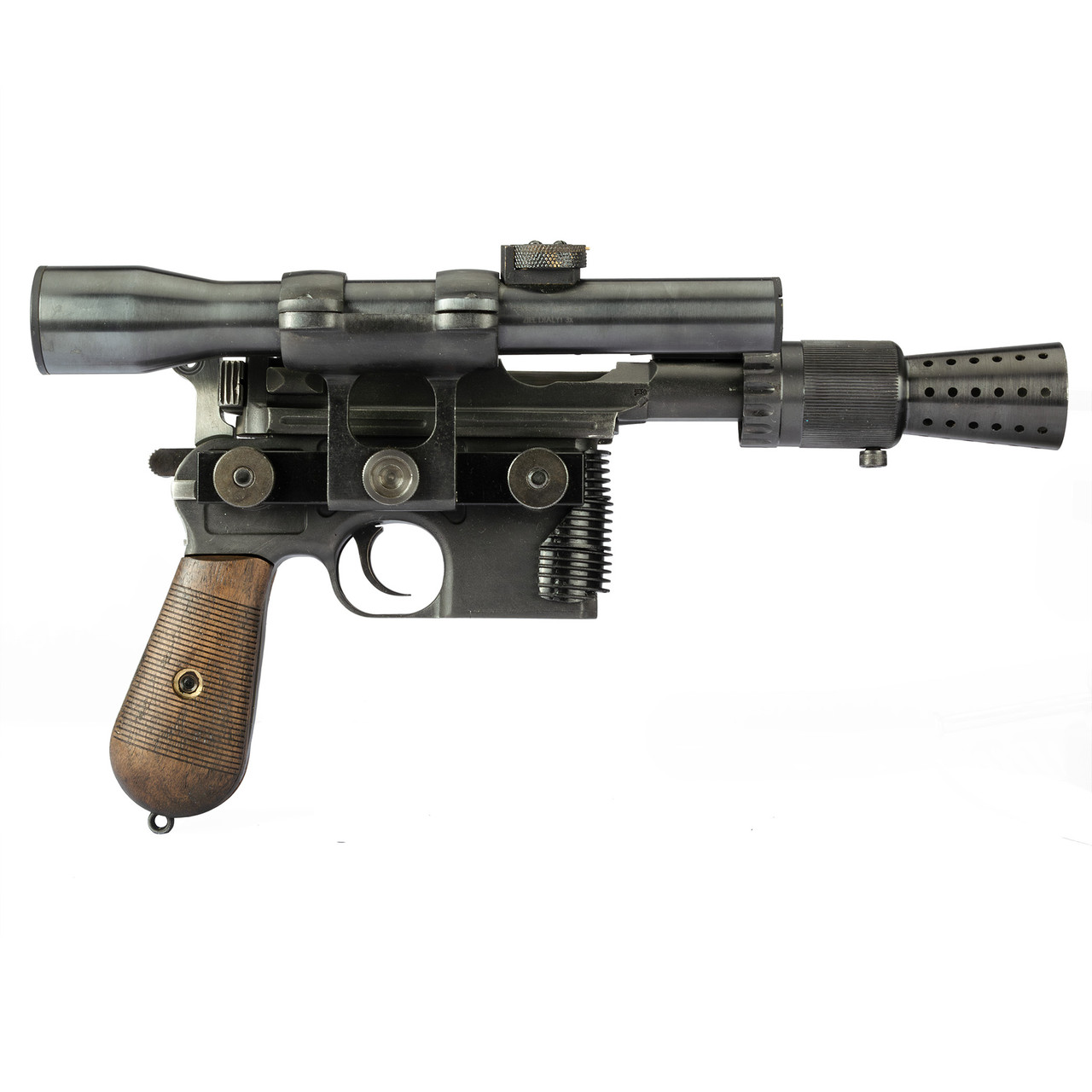
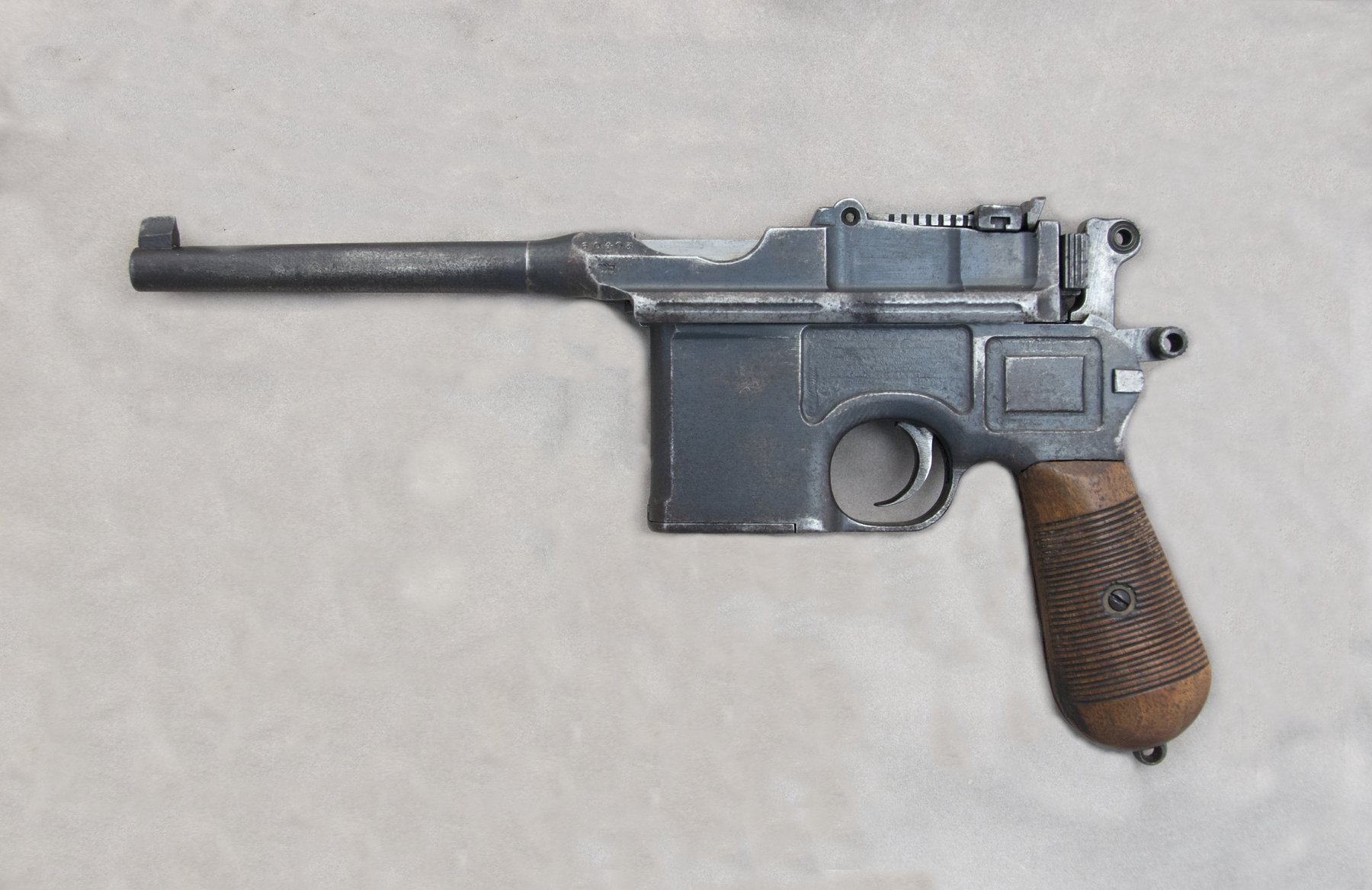
Out-of-universe the DL-44 is a hand prop built by the Elstree Studios prop department for the original Star Wars (1977). The construction pattern is unambiguous: a Mauser C96 “Broomhandle” pistol is the donor frame, with three primary modifications and several minor ones:
- A Hensoldt-Wetzlar “Ziel-Dialyt” 3× telescopic sight mounted to the top of the receiver via a custom-machined scope mount.
- A WWII-era German machine-gun flash hider (commonly identified as MG-15 or MG-81 — debated; see Vol 7) attached to the muzzle end of the barrel.
- Custom wood grip panels replacing the C96’s factory wood-checkered grips.
Minor modifications: small switches, levers, or rivets added to the receiver area, and the rear ramp sight may be selectively modified across versions.
The DL-44’s silhouette — the C96’s slab-side receiver, integral forward magazine box, broomhandle grip, plus the scope and flash hider — is unmistakable on screen and unmistakable on the bench when a build is done correctly. The proportions are forgiving in ways that flatter the build (the C96 is already a striking-looking pistol; the modifications enhance rather than fight the silhouette) and unforgiving in others (the scope-to-barrel relationship has to be right or the whole thing reads wrong).
1.2 The three first-class build paths
Per ../../../_shared/deep_dive_protocol.md § 4, every firearms deep-dive in this hub treats build-from-parts and build-from-scratch as mandatory volumes. The DL-44 additionally warrants a donor-modification volume because the prop-accurate path is literally to start with a real C96 — that’s how it was originally made.
| Path | Vol | Donor / source | Skill | Lab use | Legal | Time |
|---|---|---|---|---|---|---|
| A. Donor modification | 4 | Real Mauser C96 (post-1899 C&R or pre-1899 antique) | High | Medium — surface work + mount drilling + greeblie attachment | Heavy — modifying a real firearm; state law applies | 40-80 hr |
| B. From off-the-shelf parts | 5 | Denix replica / airsoft C96 / kit-builder package | Low to medium | Low to medium | Light — usually not a firearm federally; state imitation-firearm rules apply | 5-50 hr depending on sub-path |
| C. From scratch | 6 | Raw billet + bar stock + filament + sheet | Very high | Full — CNC + 3D print + lathe + laser + finishing | Light — usually not a firearm federally; state imitation rules apply | 60-200+ hr |
The “from off-the-shelf parts” volume internally sub-divides into:
- B1. Kit-builder package — pre-machined replica-maker kit, assemble + finish (5-20 hr)
- B2. Denix replica conversion — start with a Denix non-firing zinc C96, refinish + greeblie (20-40 hr)
- B3. Airsoft donor conversion — start with a Marushin / WingunReply / KWA airsoft C96, refinish + greeblie + possibly retain firing function (30-50 hr)
The from-scratch volume (Vol 6) is the one this hub is built around. With multiple CNC machines, multiple 3D printers, a 100 W laser, and a full gunsmithing toolset, the entire DL-44 can be made from raw stock to high screen accuracy — frame, scope mount, flash hider, grips, scope-tube body — without buying a single donor part except (optionally) a real Ziel-Dialyt scope.
1.3 Decision tree — which path is right for this build session
Goal of this build?
│
├── Maximum screen accuracy + heirloom-grade build, willing to handle real-firearm legal
│   │
│   └── Path A (Donor modification, real C96) → Vol 4
│
├── Maximum screen accuracy + clean legal posture
│   │
│   └── Path C (From scratch) → Vol 6
│
├── Display piece for a wall or shelf, minimal build time
│   │
│   ├── Pre-finished, near-instant → Path B1 (Kit-builder) → Vol 5 § 5.1
│   │
│   └── Hands-on refinish for character → Path B2 (Denix conversion) → Vol 5 § 5.2
│
├── Cosplay / convention use, needs to feel like a real weight in the hand
│   │
│   ├── Real-weight steel feel → Path A or Path C
│   │
│   └── Lighter, more durable for travel → Path C with aluminum or polymer-and-paint
│
├── Active range / blank-firing use (legally permitted in your state)
│   │
│   ├── Functional C96 retained → Path A (very carefully)
│   │
│   └── Replica-functional → Path B3 (airsoft) with blank conversion if permitted
│
└── "I want the build to be the project, not just the result"
    │
    └── Path C (From scratch) — this is what the lab is for → Vol 6
1.4 The reference variants — ANH vs ESB vs ROTJ, hero vs stunt
The DL-44 prop existed in multiple physical pieces across multiple films. Vol 2 documents the differences exhaustively; here is the executive summary:
- ANH (1977) hero: The canonical reference. A standard 5.5″-barrel large-ring-hammer Mauser C96 with Ziel-Dialyt scope, MG-style flash hider, custom wood grips. Multiple stunt pieces existed for run-and-gun scenes; the hero piece is what shows up in close-up shots.
- ESB (1980): Visibly the same prop family with subtle differences — scope mount geometry slightly evolved, finish wear from three years of handling and intervening conventions, possible part swaps on damaged pieces.
- ROTJ (1983): Further evolved, with at least one prop in ROTJ visibly different from the ANH hero in scope-rail design.
The community-canonical reference is the ANH hero — that’s the prop most replicated and the one most prop dimension sheets target. Vol 2 has the per-film comparison; if Jeff doesn’t specify, default to the ANH hero.
Stunt pieces — used for run-and-gun and the more violent action — were cast / simplified versions, often without the functional C96 internals or the real scope. Stunt pieces are easier to replicate but read less well in close-up.
1.5 Donor identification: what’s a Mauser C96, briefly
The Mauser C96 “Broomhandle” is a semi-automatic pistol designed by the Feederle brothers and produced by Mauser from 1896 to 1937, with continued copy production by Spanish and Chinese manufacturers into the 1940s. Distinguishing features:
- Slab-sided receiver with a bolt that rides above the grip, giving the silhouette its name (the “broomhandle” is the grip shape, often compared to a broom handle).
- Integral magazine box in front of the trigger guard, stripper-clip-fed in most variants (the M712 detachable-magazine variant is the exception).
- Caliber options — 7.63×25mm Mauser (most common, the original chambering), 9mm Mauser Export (rare, larger-frame), 9×19mm Parabellum (1916 contract “Red 9” variant), and various less-common Spanish / Chinese copies in 7.63 or 9mm.
- Major variants — Cone Hammer (earliest), Small Ring Hammer, Large Ring Hammer (most common, most production), Bolo (short-barrel post-WWI commercial variant), M1916 “Red 9” (9mm Para contract for German military), M712 Schnellfeuer (selective-fire, late 1930s).
The DL-44 hero is most commonly identified as a standard 5.5″-barrel Large Ring Hammer C96, though some analyses argue for a Bolo (short-barrel) configuration. Vol 3 has the full variant-by-variant catalog with the prop-community consensus on which donor matches which film.
Legal status at scaffolding time (2026-05-13):
- Pre-1899 production C96s are federal antiques under 18 USC § 921(a)(16). They can be bought / sold / shipped without FFL involvement federally. State law may impose additional rules.
- Post-1899 C96s are C&R-eligible (Curio & Relic, 27 CFR 478.11), which means a C&R-licensed dealer (Type 03 FFL) can transfer them directly. They remain “firearms” federally.
- Original wooden shoulder-stock holsters — the C96 famously shipped with a wooden holster that doubled as a buttstock — fall under NFA as SBR-relevant accessories. Attaching the stock to a sub-16″-barrel C96 makes the configuration a Short-Barreled Rifle under NFA. In 2014 ATF ruled that original-issue C96 stocks attached to antique C96s are exempt from NFA (Open Letter 2014-OL), but this is narrow and does not apply to replicas. Vol 10 has the full legal landscape.
1.6 Lab capability — and what it shifts
Jeff brings to this build:
- Multiple CNC machines — mills and/or routers, exact spec TBD.
- Multiple 3D printers.
- 100 W large-format LASER cutter / engraver.
- A full gunsmithing toolset.
- Experienced firearms / gunsmithing background.
For most builders, the easiest answer is Path B (assembly from a kit or Denix). For Jeff, Path C (from scratch) is genuinely buildable and produces a higher-quality result than any kit. The from-scratch volume (Vol 6) therefore gets first-class treatment in this series — full machinist depth, fixture / jig design, operation sequence, tolerance targets, finishing process.
This series does not present Path C as the “right” answer reflexively — Jeff may pick Path B for a quick display piece, Path A for an heirloom build on a real C96 donor, or Path C when the build is the project itself. Each volume documents its path with the depth needed to execute it.
The specific lab capability — CNC model + travels + spindle, printer count + tech + max build volume, laser bed size, gunsmithing tool catalog — is not yet captured. Before starting a from-scratch build, capture this into ../../../_shared/lab_capability.md so the from-scratch volume can reference specific capabilities (mill spindle handles 4140? laser bed accommodates a full grip panel cut in one pass? etc.).
1.7 Volume-by-volume index
| Vol | Title | Mandatory | Length target | Primary audience |
|---|---|---|---|---|
| 1 | Overview & Decision Tree (this volume) | yes | 25 KB | Anyone arriving cold; “should I read this?” answer |
| 2 | Screen Accuracy Reference | yes (prop) | 20 KB | Anyone who wants the build to be recognizable as a DL-44 |
| 3 | Donor Firearm Provenance — Mauser C96 | yes | 20 KB | Path A or any build that wants the donor right |
| 4 | Build Path A — Donor Modification | conditional | 18 KB | Path A specifically; real-firearm modification |
| 5 | Build Path B — From Off-the-Shelf Parts | MANDATORY | 25 KB | Path B (kit / Denix / airsoft); fastest practical build |
| 6 | Build Path C — From Scratch | MANDATORY | 35 KB | Path C; the lab’s primary build path |
| 7 | Sub-Assemblies & Greeblies | yes | 22 KB | Anyone fabricating any part of the prop — scope mount, flash hider, grips, etc. |
| 8 | Materials & Finishing | yes | 20 KB | Anyone making metal or wood parts; finish choice + recipe |
| 9 | Use Cases & Display | yes | 15 KB | After-the-build life — cosplay, photography, range, display |
| 10 | Legal & Regulatory Posture | MANDATORY | 22 KB | Required reading before any path involving a real C96 or shipping replicas |
| 11 | Operational Posture | yes | 15 KB | Storage, transport, photographing in public, insurance |
| 12 | Cheatsheet | yes | 12 KB | Laminate-ready synthesis |
Total target: ~250 KB markdown → ~350 KB final HTML (matches the BP6 / Marauder Firmware / M5StickS3 / Cardputer ADV depth pattern from the Hack Tools hub).
1.8 Cross-volume reading order recommendations
- First-time DL-44 builder, no path chosen yet: Vol 1 (you’re here) → Vol 2 (screen accuracy) → Vol 3 (donor C96 background) → § 1.3 decision tree → relevant build-path volume (4, 5, or 6) → Vol 7 (sub-assemblies) → Vol 8 (materials & finishing) → Vol 10 (legal) → Vol 11 (operational) → Vol 12 (cheatsheet)
- Path A (donor mod) build session: Vol 4 + Vol 3 + Vol 8 + Vol 10 — keep Vol 10 open the whole time. The gunsmithing operations are routine; the legal landscape is where you’ll get tripped up.
- Path B (from parts) build session: Vol 5 + Vol 7 + Vol 8. Vol 10 § 5 (imitation-firearm state law) is the only legal section that matters.
- Path C (from scratch) build session: Vol 6 + Vol 7 + Vol 8 + the per-sub-assembly sections in Vol 7. Open the cheatsheet (Vol 12) for the dim quick-reference.
- Already built, want to display / carry / photograph: Vol 9 + Vol 11.
- Quick reference at the bench: Vol 12.
1.9 What this series is not
- Not a Mauser C96 manual. Vol 3 covers C96 background at the level needed to build the prop. For full C96 gunsmithing reference (action timing, headspace, ejector regulation, etc.), see Walter Schmid’s System Mauser and James Belford’s Mauser Pistole 7,63 mm.
- Not a Star Wars prop encyclopedia. This series is the DL-44 specifically — sister blasters (E-11, T-21, A180, etc.) get their own subdirectories under
../../../and their own deep dives. - Not legal advice. Vol 10 catalogs the federal landscape and flags state-level concerns; it does not replace consulting a state-licensed attorney for a specific build’s jurisdictional posture.
- Not vendor-impartial. Where a specific vendor’s kit, replica, or parts source is the clearest reference, this series names it. Vendor URLs are verified against live pages at the time of authoring; some vendors will disappear (the replica-prop community churns).
1.10 Community-consensus disclaimer
Several “facts” about the DL-44 hero prop are community consensus rather than primary-source fact:
- The Hensoldt-Wetzlar Ziel-Dialyt scope identification is community consensus, well-supported by side-by-side photo comparison but not confirmed by primary-source production documentation.
- The flash hider donor identification (MG-15 vs MG-81) is actively debated. Both donors have plausible visual matches. Vol 7 presents the evidence on both sides without resolving the debate.
- The exact Mauser C96 variant of the hero piece (Bolo vs standard 5.5″) is debated by a smaller margin — most analyses converge on standard 5.5″ but a credible minority argument exists for a converted Bolo.
- Per-film prop swaps (which exact pieces appeared in which scenes across ANH / ESB / ROTJ) are partially reconstructed from screen analysis and partially from the cited memories of the prop department; some claims are well-supported and some are inferred.
Where a claim is community-consensus rather than primary-source, this series flags it as such with the phrase “community-consensus identification” or equivalent. Don’t update the build based on consensus claims without checking the underlying evidence — and if Jeff is building for screen accuracy, the surviving original prop pieces (when they appear at auction or in museum displays) are the highest-fidelity reference available.
1.11 Photo policy
Photos in this series come from three sources:
- Jeff’s own photos of his donor, parts, build process, and finished pieces — drop them in
02-inputs/reference_photos/jeff/and reference by path in the figure markup. No credit line needed for Jeff’s photos. - Wikimedia Commons for donor-firearm reference shots (Mauser C96 variants, MG-15 / MG-81 muzzle hardware, period German scope examples). Fetched via the Photo Helper at
C:\Users\Jeff\Documents\Claude\Projects\Photo Helper\per the global rule in~/.claude/CLAUDE.md. ThecreditLinefrom Photo Helper must appear verbatim in the figure caption — CC-BY / CC-BY-SA require it. - Prop-specific photos (hero-piece auction shots, museum display photos, replica-maker portfolio shots) are not auto-fetched. Most are copyrighted. Either Jeff sources them manually with attribution, or this series describes the reference without embedding it.
At scaffolding time (2026-05-13) no photos have been embedded yet — figure placeholders appear throughout but are unrendered. The first photo round happens in a follow-on session.
1.12 References (Vol 1)
- Bishop, Chris. Star Wars: The Blueprints. Epic Ink, 2013. — Reference for production design archives where DL-44 dimension sheets occasionally surface.
- Cocchio, Marco. The Mauser C96 Pistol. Collector Grade Publications, 2013. — Donor-firearm collector reference.
- Replica Prop Forum (RPF) —
therpf.com— community-curated DL-44 build threads, dimension sheets, parts-source lists. The single most-load-bearing community reference for prop builders. - Star Wars (1977), Lucasfilm. Source film, ANH hero appearances.
- Star Wars: The Empire Strikes Back (1980), Lucasfilm. Source film, ESB variant appearances.
- Star Wars: Return of the Jedi (1983), Lucasfilm. Source film, ROTJ variant appearances.
- ATF Open Letter 2014 (re: original C96 stocks on antique C96s). — NFA-stock exemption ruling.
- 27 CFR Part 478 — Gun Control Act regulations (frame/receiver definitions, transfer rules).
- 27 CFR Part 479 — NFA regulations (SBR/SBS/suppressor/MG/AOW/DD definitions).
- 18 USC § 921 — definitions (firearm, antique firearm, destructive device).
Full bibliography across all volumes is consolidated in Vol 12 (Cheatsheet) § 12.10.